
A buddy of mine gave me a heads up this week that our last local drive-in closed for good a few weeks ago. When I was a kid, there were nine drive-ins spread out in the sticks, and on the fringes of the rapidly-expanding suburbs. Not surprisingly, I kept waiting to feel bad about what he told me, but it didn’t come. The fact that I had to be told the theater was closed, instead of knowing that myself, pretty much sums up where the drive-in experience rests with me: it died a long, long time ago.
By Paul Mavis
Of course, when my kids were little I took them to that last remaining ozoner; I wanted to see if you could go back home again. But their safe, boring, homogenized viewing of some mind-numbing, gazillion-dollar Marvel piece of sh*t wasn’t anything like the rowdy, hilarious, and downright exciting times I routinely had at the drive-ins when I was little…and a little bit older. When cheap, fast, energetic B exploiters like Macon County Line quit showing up at the ozoners, it was all over for me.
Click to order Macon County Line on Blu-ray:

(Paid link. As an Amazon Associate, the website owner earns from qualifying purchases.)
Macon County Line‘s story is simple—as are all good allegorical nightmares. It’s 1954, and brothers Chris (Alan Vint) and Wayne Dixon (Jesse Vint), originally from Chicago, are on a two-week bender of prostitutes and low-crime hijinks throughout the South before their upcoming stint in the Air Force. Wayne re-upped to go in with his brother when Chris, in trouble with the law, was given the option of military service or prison (do the courts still do that?). Rolling through Louisiana, the brothers pick up hitchhiker Jenny Scott (Cheryl Waters), a pretty blonde with a backstory she’s not all that willing to divulge.

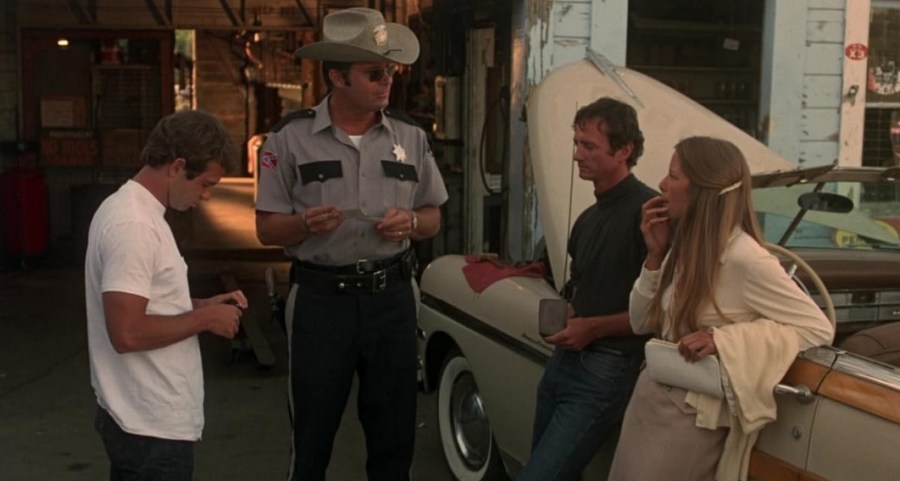
Meanwhile, in a small backwater town, local sheriff Reed Morgan (Max Baer, Jr.) is preparing to bring back his son Luke (Leif Garrett) from military school; hunting season starts the next day and Reed decides to buy Luke a new 12 gauge shotgun. As Chris, Jenny, and Wayne roll through the back roads of Louisiana, their fuel pump starts acting up, and they stall out in Reed’s town. Unable to buy a new pump, they scratch together enough money to get it patched up by garage owner Hamp (Geoffrey Lewis).

Waiting at the garage, they’re casually threatened by Reed, who reminds them that they could be thrown in jail for vagrancy…if they decided to stay in town. Getting the message, the brothers and Jenny head out as soon as the car is fixed. But a simple twist of fate—the fuel pump gives out—puts the three into a deadly situation with Reed, with a shattering conclusion for all.
MAJOR SPOILERS ALERT!
If you’ve never seen Macon County Line, or even if you have and you don’t remember the ending, I urge you not to read any further, and just watch the movie. There’s an effective twist ending I’m going to discuss…so be forewarned.
Macon County Line will forever be associated in my mind with those summer days in the early 1970s when I was a kid, when seemingly every week or so one drive-in cult movie after another crossed over into the mainstream popular success. For the most part, even more “adult” early 70s drive-in fare was still pretty tame by today’s standards, but just the suggestion that a movie was overly violent or erotic (an impression hammered home with incessant, hyperbolic TV and screaming radio ads) created a strong whispering campaign—particularly among young boys and teens—that had to be obeyed.
RELATED | More 1970s film reviews
Movies like Billy Jack, Jackson County Jail, The Texas Chainsaw Massacre, and Walking Tall were must-see flicks (if you could convince your older brothers to take you on the sly) because they sounded like they were going to be “the real deal.” It’s almost impossible to convey to today’s younger media watchers—who can catch stronger stuff on YouTube, let alone the most vile hard-core porn on the internet—how wonderfully taboo the average 1970s drive-in feature was, with its promise of a flash of nudity or a messy gun shot splatter.
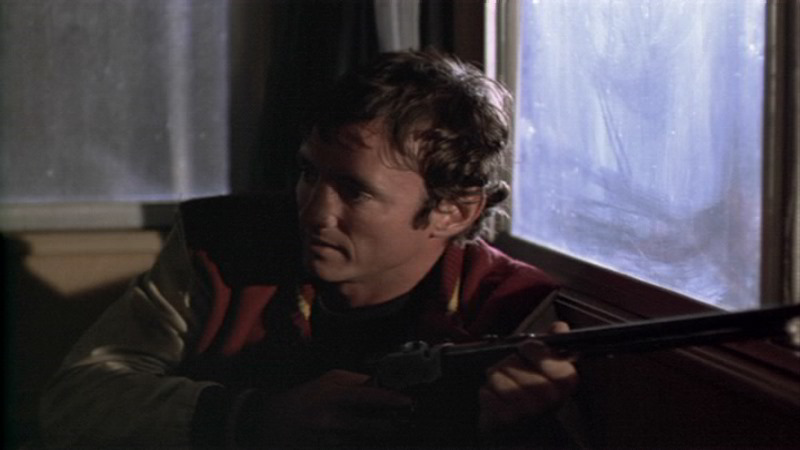
And of course, if those radio and TV ads hollered that the gore-and-sex-soaked sleeper down at your local backwoods drive-in was based on a true story, then admission was mandatory (Walking Tall, The Texas Chainsaw Massacre, The Legend of Boggy Creek and The Town That Dreaded Sundown owned that particular marketing gimmick). Prior to all the true-crime TV shows and documentaries that fill the streaming and cable airways now, the notion that you might see a lurid story based on true, actual events would soon have you lying right to all your friends’ faces, telling them how you heard the real story was even worse than what happens on the screen (which was a double lie because you hadn’t even gone to the movie yet).
Macon County Line is billed as a true story, right on that first title card—no doubt to lend an air of authenticity to the proceedings (as well as piggy-backing, perhaps, that other drive-in classic, Walking Tall, that had proved to be such a huge hit with ticketbuyers the year before). Fans of Macon County Line now know the story is fictional, of course, but with its careful attention to character development and a surprisingly surefooted, almost allegorical approach to the material, it doesn’t matter that the story is made up. If anything, that only helps with Macon County Line‘s weird schizo documentary/dream-like atmosphere.
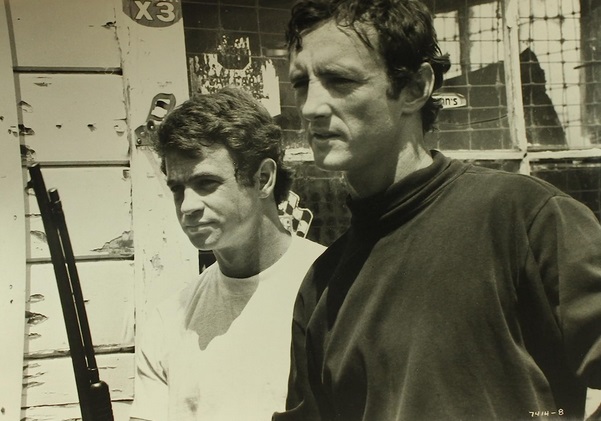
Made on a ridiculously small budget (even by 1974 exploitation standards), Macon County Line turned out to be the single most profitable film of 1974 (in film cost to film gross ratio), making upwards of $30 million at the box-office on less than a $200,000 investment. Shepherded by actor Max Baer, Jr. (who had found himself typecast as supernaturally stupid Jethro Bodine from that brilliant 1960s sitcom, The Beverly Hillbillies), Macon County Line is a cut above most of the exploitation flicks that crawled into local drive-ins at the time, as much for the “documentary” feel that so many critics at the time noted (even if at the same time they dismissed the picture), as well as its almost dream-like, relentless descent into nightmare that director Richard Compton so ably achieves.
Certainly, the notion that this was a “true” story may have further influenced the critics who noted the Macon County Line‘s gritty, low-budget feel, the non-star leads (the Vint brothers, familiar faces to attentive moviegoers, hit just the right notes here), and the realistic rural location work and sets. Cartoonish at first (the movie’s opening sequence, where both brothers share a whore off-camera, is low-brow, barnyard Southern humor at its raunchiest), Macon County Line switches tone almost immediately and becomes increasingly somber and contemplative as the brothers get closer to meeting their inevitable fate.

The screenplay by Baer and Compton is careful to make sure we understand the brothers aren’t exactly innocents before their fateful meeting with Reed. They steal the whore’s purse as they escape from her pursuing husband, and skip out on a check at a local eatery (Compton stages a gag that’s far superior to the same one in American Graffiti where the boys rip off the entire front end of a cop car). These are troublemaking rowdies, out for a good time. Only after meeting Jenny do they “settle down” (the sequence where we think they’re going to rob Hamp with a rifle is expertly staged), a change in characterization that correctly sets up the ultimate outrage of their fate at the hands of Reed: they may be punks, but they don’t deserve what happened to them.
Max Baer as Reed further levels off audience expectations of a simplistic, rowdy good time at the drive-in with his complex portrayal of Deputy Morgan (just as he was remarkably adept essaying the cosmically dumb Jethro, Baer is equally impressive here with his 180 degree turn into drama). Some critics at the time simply dismissed the character as a buffoonish bigot, but Reed’s far from that. Wearing a Confederate flag patch on his sleeve (which all the police wear, and which wouldn’t have been inaccurate for 1954 Louisiana law enforcement officers’ uniforms at the time), Baer’s Reed shows no outward signs of being an overtly racist or bullying police officer (as so many other reviews have described the character). His discussion of race with his son, Luke, who has befriended some black youths who play ball near the military school, is always noted by critics who point to Reed’s wish (not demand) that Luke not play with them in the future, as a sign of his bigotry. And it is.

But it’s important to note that Reed’s reasons are measured and thoughtful—within the prejudiced framework of 1954 Louisiana, of course—and not openly cruel (“cruel” would be more like, “Poor kids are just as bright and just as talented as white kids,”—your current selected President said that, among countless other openly racist remarks over the decades). Reed’s concern, which he says his wife shares, is for his son, saying that it seems “easier” for white and blacks to stay separated (if that makes you feel smug and superior to the character and by extension, those bigoted times, I suggest you visit any major U.S. college campus today, where segregation among black and white students is alive and well, and not only tolerated but actively endorsed by those schools’ administrations. The only difference now from 1954 Louisiana…it’s whites who aren’t welcome in certain areas). Reed doesn’t tell his son that blacks aren’t as good as whites, nor does he yell any insults or threats at the young boys who call out to Luke when Reed picks him up from school.
Indeed, Reed’s far more threatening to the young white kids at the garage. His subtle yet clear warning to Chris, Wayne and Jenny is get out of town while the getting is good. He is bullying them, but again, it’s not overt or broad—and therefore far more effective and sinister—and it would seem to be a normal function of a small-town sheriff at that time: watch out for strangers, determine if they’re a potential threat, and let them know they’re just passing through. Or else.

In a nicely staged sequence, director Compton shows how Reed is totally misguided as to which strangers in his town he should be concerned. As hard-core criminals Lon (Timothy Scott) and Elisha (James Gammon) get gas at the filling station at the same time Deputy Reed is getting ready to harass Chris and Wayne, director Compton shows Reed, behind dark (i.e.: “unseeing”) sunglasses, peering out at the brothers…while completely missing Lon and Elisha freaking out because they think Reed is staring at them. Indeed, one could make a case that in their screenplay, Baer and Compton wish to show Reed as well-meaning…but decidedly misguided in almost all his actions.
Director Compton (a favorite here at Movies & Drinks, with fun flicks like The California Kid and Deadman’s Curve), working from a strong, bright, sunshiny palette at the beginning of the film, makes Macon County Line progressively darker, both visually and thematically, until the final scenes take place exclusively in varying degrees of shadow or pitch blackness, mirroring the terror of the brothers’ final stand against Reed. Compton, going against the usual drive-in exploitation standards of showing a lot of skin and action right up front (remarkably, most of the acute violence in Macon County Line occurs off-camera, until the final blast), is equally interested in showing all of the characters’ actual falls from grace, including even those characters we might suspect are minor.
Certainly Luke’s strange slow-motion dream as he sleeps in the car (he dreams of hunting with his father, who looks disapprovingly at him when he fails to bag a bird) seems weirdly out of place, until we start to understand what Compton is doing with it. Coming onto the body of his brutally butchered mother (whom Elisha had sexually assaulted and then—perhaps with Lon helping—murdered), Luke, goaded on by his unthinking father who keeps calling for Luke to follow him like it’s a hunting party, stumbles around the river area in a dream-like daze.
Thinking that the brothers and Jen are responsible for her death (their car had conked out in front of Reed’s house, but they had camped out in a nearby barn), Reed pursues them and wounds Jenny. But it’s Luke, in a terrific, unexpected twist ending, who finishes off Wayne and Jenny, and almost kills Chris (Compton quite skillfully tricks us into thinking Reed is the one doing the stalking). Reed, ineffectual in his misguided perceptions all the way down the line, lays dead in the reeds, with his son finally measuring up to his father’s ideals: he bags his first kills.

It’s a wowzer of an ending, not just because it’s a finely crafted suspense sequence (somewhat reminiscent of the houseboat scenes in the first, infinitely superior Cape Fear), but because it’s so well integrated into the thematic elements of the story. Macon County Line is a drive-in actioner with brains, with the emphasis on “drive-in.” Watching this latest Shout! Factory Blu-ray transfer, I couldn’t help but think this isn’t the way to watch this movie. I don’t want it this clear and sharp and colorful, no matter how big the monitor is, nor how comfy the chair or couch is.

Macon County Line needs to be seen in its natural environment: the drive-in. You have to be sitting with somebody in your car (just like Chris and Wayne), with the windows down and the strange, soft sounds of the woods nearby carried along by a warm summer breeze, and as the night sky gets deeper and the darkness envelops the car, that’s when the events on the screen seem so much more threatening, so much more real. Movies like Macon County Line belong on a deserted drive-in screen, out in the middle of nowhere—and nowhere else.

Read more of Paul’s film reviews here. Read Paul’s TV reviews at our sister website, Drunk TV.
 Movies & Drinks
PAUL MAVIS should have been a writer/director! His understanding of the material equalled writer/director Richard Compton and FAR exceeded Max Baer’s, who proved to be nothing more than a criminal oaf that stole the script from a production company when it was known as REDNECK AMERICA! He was sued but because of his father’s political and athletic fame he got away with it.
Good work, Paul! Very insightful, and then some!
LikeLike
How very kind, thank you!
LikeLike
How very kind, thank you!
LikeLike