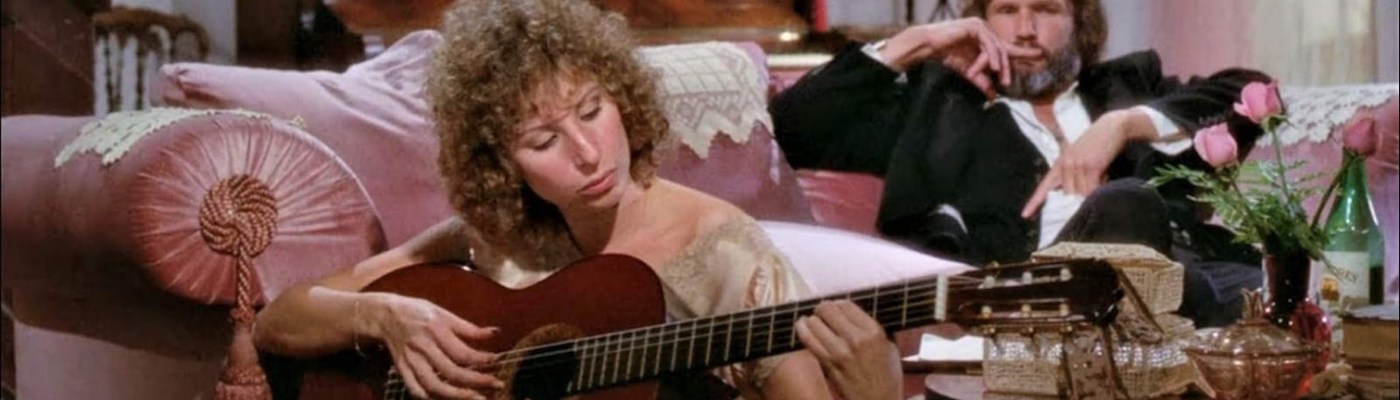
So, I haven’t thought about Barbra Streisand in something like decades (I honestly thought they had found her dead at the Orange Julius in her Malibu mansion’s subterranean mini-mall). But when I saw she was browbeating asking the Academy to sing about Robert Redford at the Oscars (who didn’t die at a mall but rather was found crushed to death under all the gold bars he had from selling his hands-off “conservation” land in Utah), I knew she had to be up to something.
By Paul Mavis
Sure enough, after a little searching I found, a few weeks prior to her suspiciously magnanimous offer to the Academy, Babs got a lot of flak for posting a rambling, barely-coherent tweet about Olympic U.S. figure skater Alysa Liu (the least painful distillation is that Barbra’s qualified to congratulate Liu because she once ate an eggroll in Brooklyn). In short: when she is remembered, irrelevant Babs never fails to disappoint.
…except in one of her biggest hits: Warner Bros.’ 1976 remake of the Hollywood evergreen, A Star is Born, co-starring Babs, Kris Kristofferson, Paul Mazursky, and Gary Busey, written by John Gregory Dunne and Joan Didion, and directed by co-scripter, Frank Pierson. A massive box office hit when it premiered at the end of 1976, it was the second most-popular movie released that year (Babs beat King Kong, but couldn’t touch Rocky).
Click to order A Star is Born on Blu-ray:
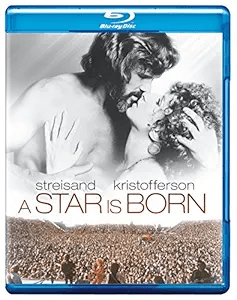
(Paid link. As an Amazon Associate, the website owner earns from qualifying purchases.)
Unlike so many liberal critics (and viewers), I can successfully separate a performer from who that person actually is in life (it’s commonly agreed that gen-u-wine traitor/terrific actress Jane Fonda is the viewer baseline for this kind of self-imposed Vulcan mind trick of denial). I’ve enjoyed Babs in several movies (although I can’t sit through 30 seconds of her singing), particularly her sexy, breathless fast-patter turn in Peter Bogdanovich‘s What’s Up, Doc? in 1972, which straight up should have won her the Best Actress Oscar.
Unfortunately, there is only one thing of value—one—in her A Star is Born remake, and that’s Kris Kristofferson‘s amazingly adept, heartfelt performance as the doomed rock star, self-destructing despite the love of up-and-coming singer Streisand. There’s not a wrong note in his performance, one that should have at least received an Oscar nomination that year (if you had to take out one of the five performances that were nominated, he was certainly better than mystery nominee Giancarlo Giannini in Seven Beauties).
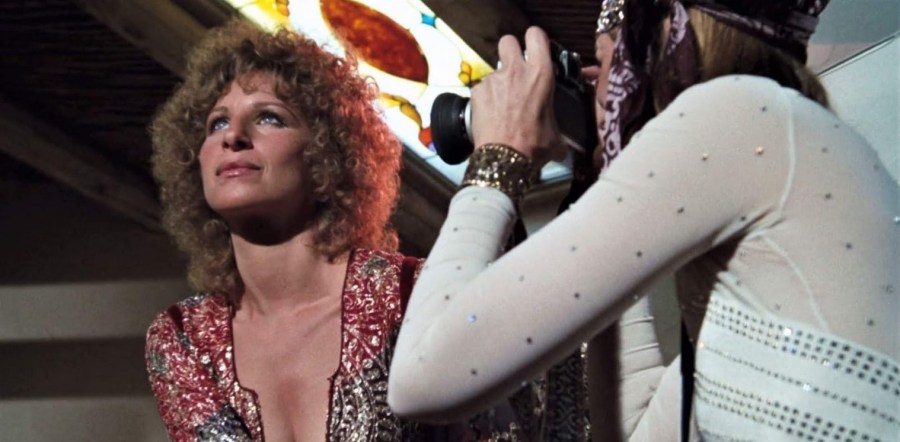
That said…the remainder of A Star is Born is an unmitigated disaster that has the megalomaniac fingerprints of Barbra Streisand and her hairdresser/producer boyfriend, Jon Peters, all over it.
John Norman Howard (Kristofferson) is a hard-drinking, hard-partying, hard-charging rock ‘n’ roll star who is rapidly burning all of his bridges with his record buyers and with his work associates. Contemptuous of the fans who only want to hear his old hits, he shows up drunk to concerts, and verbally assaults the audience when they lose patience with his drugged-out antics.
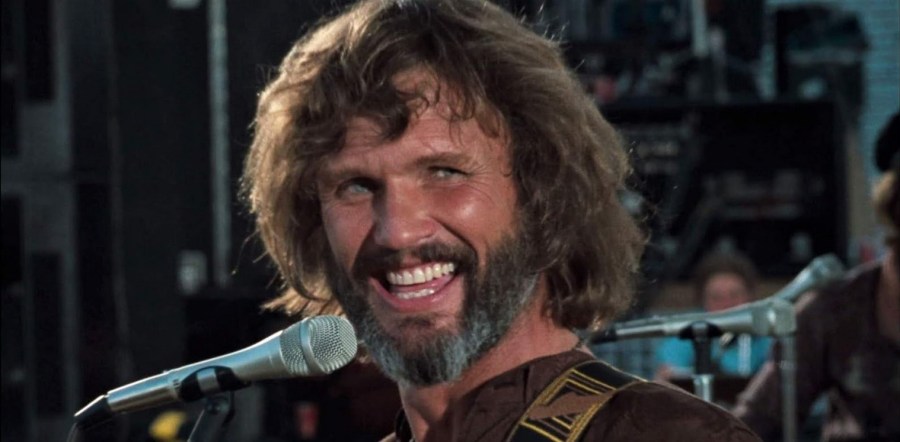
Escaping from a near-disastrous concert, John finds himself at a dive bar, where he tries to listen to Esther Hoffman (Streisand), who’s singing lead in a female trio. But of course, his obnoxious behavior first disrupts Esther’s set, and then leads to an altercation with a pushy fan.
Esther, inexplicably taking pity on him, leads him away from the chaos, and lets him to take her home. Not allowing him in, Esther invites him back for breakfast, where the fast-smitten John shows up, and promptly takes her by helicopter to the site of his huge outdoor rock concert.
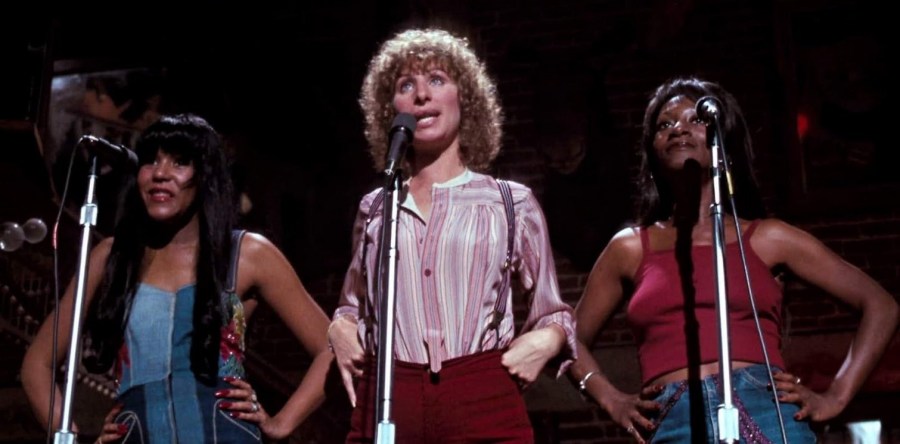
Once on the stage, John again loses focus (because of Esther), and resorts to his usual drunken antics; this time, he borrows a fan’s motorcycle and crashed it off the stage. In the subsequent confusion, Esther is left behind. Days later, after trying to get a hold of Esther, John happens to run into her again at a recording studio (after he’s caused another fracas with a slimy D.J.).
This time, Esther returns with John, and after improvising a song together, they make love, and have a bath together (as you do). Fast forward to John being a hard-task master, getting Esther ready to record her own songs. After that success, John pushes her out on the stage of a benefit he’s performing at, where Esther wows the crowd and becomes an overnight success. Now able to stand on her own professionally, Esther convinces John to marry her.
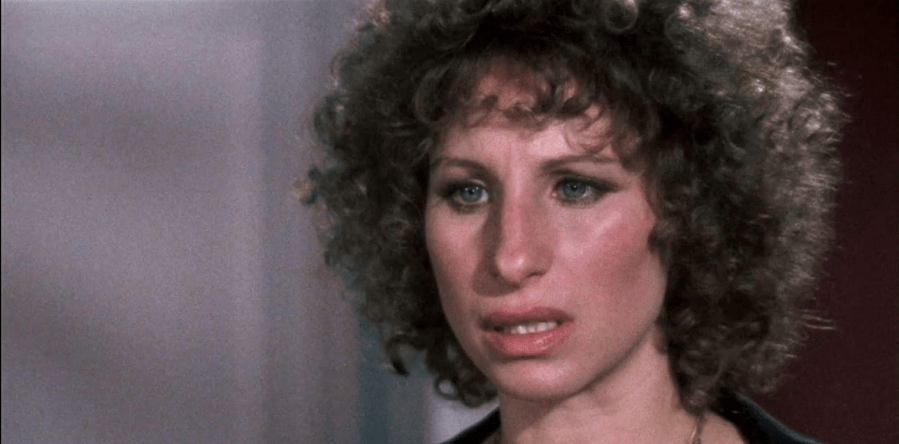
With the lovers happily ensconced in their new Arizona hideaway on John’s ranch, their idyllic life is interrupted by the tiresome realities of their fame; to wit: Esther’s new tour. Dissuaded by his manager to go along with Esther on a co-bill, John realizes that his rapidly sinking career, along with his inabilities to conquer his inner demons, is jeopardizing Esther’s happiness.
Back in Los Angeles, John tries to write songs, but can’t. His band has moved on without him, charting a successful single without his participation. The walls are closing in on John. When John humiliates himself and Esther at the Grammy Awards (in which she wins one), it’s just one more step down the road to his self-destruction.
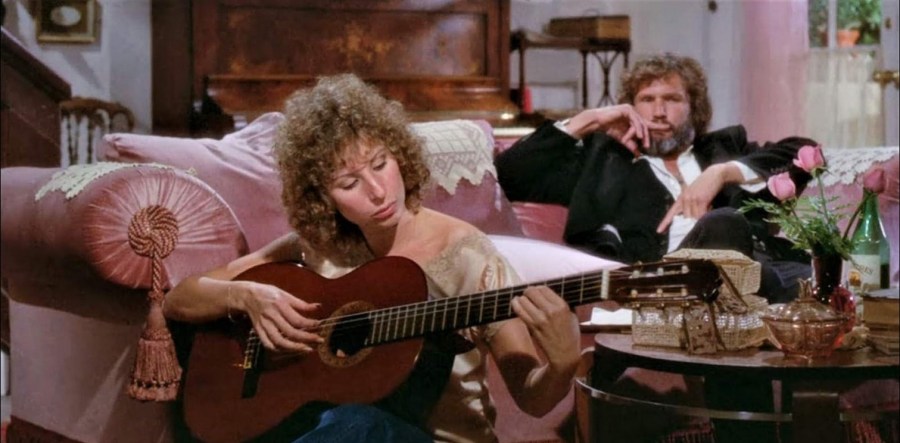
After catching him with another woman (the last thing he can think of to screw up his life), Esther essentially gives up on him, only to beg him to fight for her again, only to state she hates him, only to state she loves him (you have to see this scene to believe it).
Spoiler Alert…but seriously who doesn’t know the plot of this story
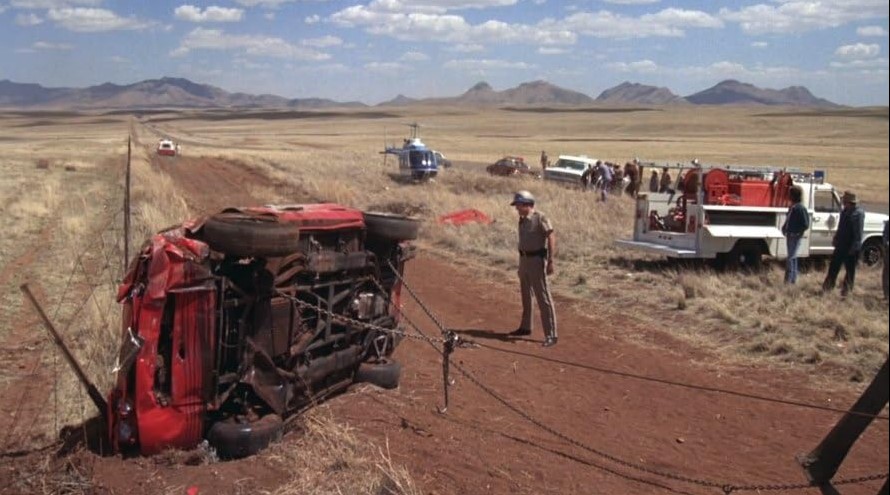
Upon returning to Arizona one more time, John, drinking as usual, gets into his red Ferrari, and heads tearing off onto the desert roads. Esther later learns of his fatal car accident, and mourns over his body at the crash site. Fast forward to Esther performing in concert, now billed as Esther Hoffman Howard.
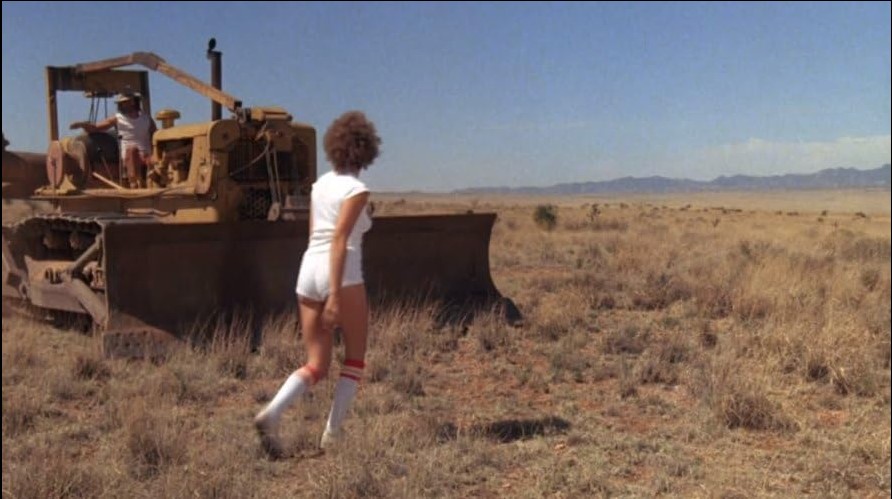
Evidently, A Star is Born was a troubled production from day one. Originally conceived as a tough, hard look at the music industry, the screenwriters John Gregory Dunne and Joan Didion originally envisioned rock stars James Taylor and Carly Simon as the leads. Evidently, the couple saw too many real similarities to their lives in the story, and backed out (someone also must have sensibly stated that there would be mass audience casualties due to crushing boredom, if Taylor and Simon had ever starred).
Others were considered for the roles, including Diana Ross, and Cher and Gregg Allman. Even Elvis was bandied about, co-starring with Liza Minnelli (the Colonel put the kibosh on that but quick, son). Eventually, it was Barbra Streisand’s hairdresser/boyfriend, Jon Peters, who saw a copy of the script, and eventually convinced Streisand to do the picture – with him as the producer.
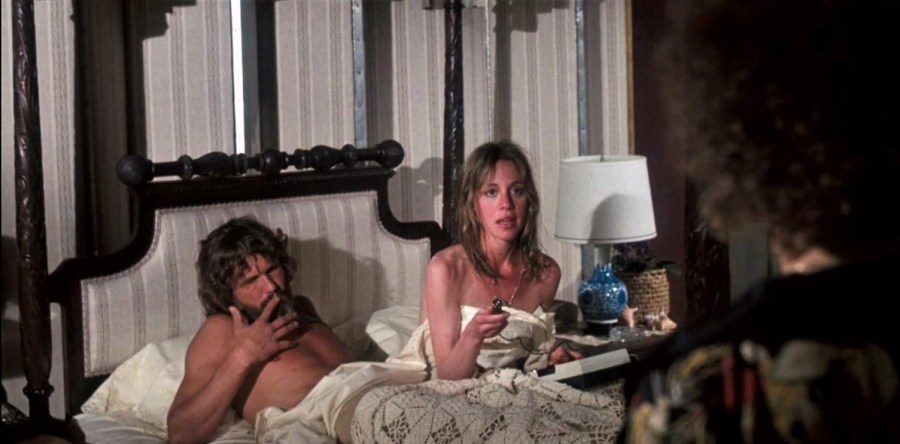
General hilarity ensued among the Hollywood power players when it was heard that not only was Peters the producer, but that he was seriously considering co-starring with Babs, as well as directing the feature…and all with her consent.
Wisely, cooler heads prevailed, and after seriously considering Mick Jagger, Marlon Brando, and one more attempt to snare Elvis (he would have been perfect at this debauched period of his career), Kris Kristofferson was hired to play the doomed rock star.
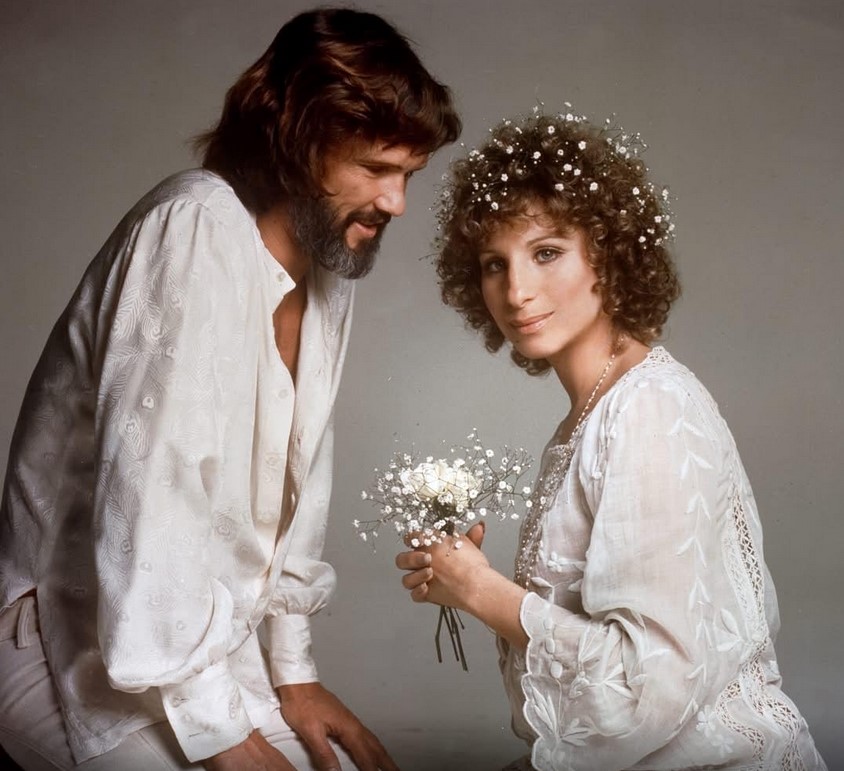
TV helmer and scripter Frank Pierson, who only had one big screen directing credit to his name (1970’s flop, The Looking Glass War), but who was hot with a script for Al Pacino‘s Dog Day Afternoon, was offered the chance to direct his script of A Star is Born…as long as he let Streisand co-direct (an absolute disaster in the making that everyone should have seen coming). Evidently, Streisand and Peters wanted Pierson fired from day one, while Kristofferson, high on drugs and booze, would sit out scenes, waiting for the yelling to stop between the co-directors.
And on top of that, producer Peters was alienating everyone else, declaring that the movie was his idea all along, and that the world was waiting to see a filmed representation of his love affair with Barbra. Ultra-perfectionist Streisand (who had final cut) obsessedly fiddled with the edit (while eliminating a lot of Kristofferson in the process), further causing consternation for the studio big-wigs who smelled a coming disaster.
RELATED | More 1970s movie reviews
Despite all of this conflict, A Star is Born was delivered on time for its December 19th release, and soon went on to gross an astronomical $92 million, 1976 dollars—a phenomenal gross for that time. Certainly, the tie-in record promotion of the songs on the soundtrack (Streisand-composed Evergreen would sell millions, and win the Academy Award for her and lyricist Paul Williams) helped at the box office, as did the foul language (still a relative novelty back then on the big screen) and the steamy (for then) sex scenes. But the critics weren’t having any of it, destroying the picture in the press, and handing Streisand the worst reviews of her career.
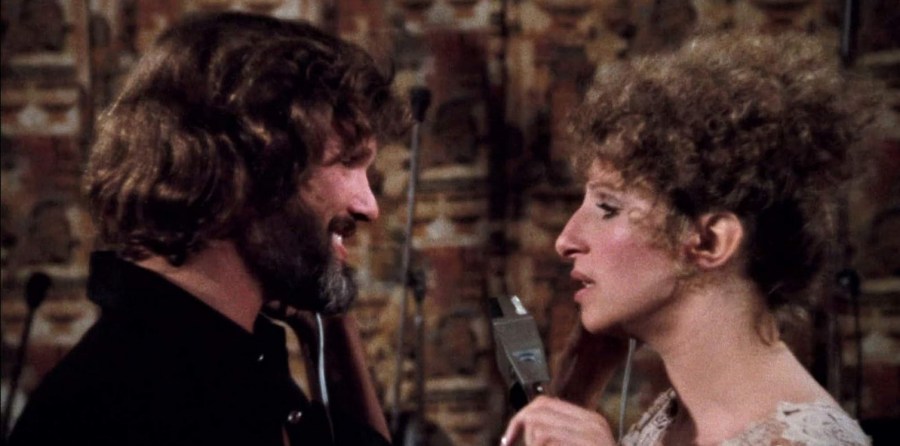
It’s hard to know where to begin in listing the problems with A Star is Born. Certainly, first and foremost, the largest share of the blame must rest solely on Streisand; this was her baby all the way, and her central performance (or more accurately, the lack thereof), emotionally cripples the movie.
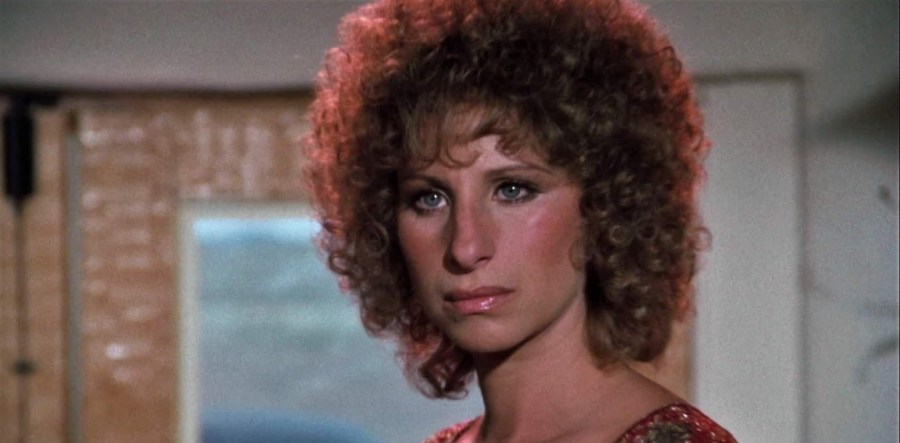
The problem is: we never really believe Streisand’s Esther. We never believe that she has that all-encompassing fire in her belly to become a star. Events just happen to her, unmotivated, and she goes along for the ride with little or no explanation for her actions.
Streisand employs a schizophrenic approach to the character that allows her to meet John Howard for the first time, where she has the gumption to tell him to shut up (because his drunken fracas is ruining her set), inexplicably followed by her meekly taking him out of the club when trouble starts, to her inviting him back for breakfast at her place. Nothing makes sense in her pursuit for a career, or in her allowing John’s pursuit of her.
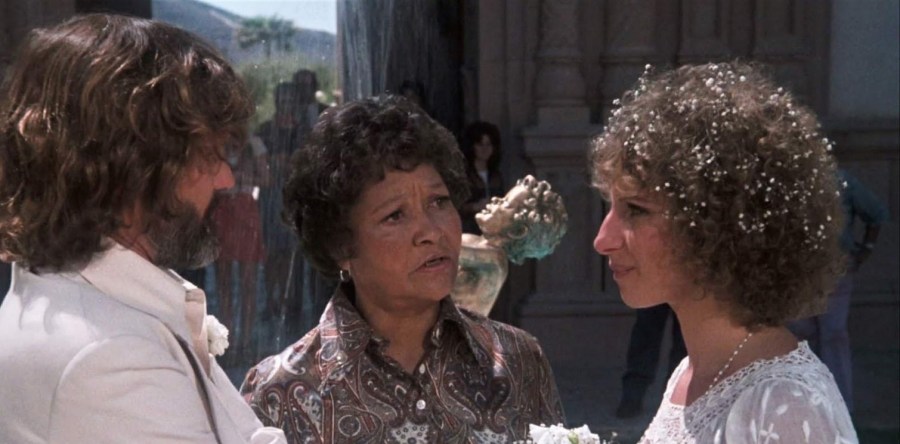
Streisand can be such a magnetic performer; I remember seeing her in What’s Up, Doc? and being totally captivated with her smart, hilarious, sexy performance. But here, she radiates tension and nervousness; she seems at a loss to try and give the audience anything that resembles the “Streisand magic.” It’s a phoney, mechanical Streisand imitation, with all the gears showing, and the whirring audible.
It doesn’t help matters that the movie itself is overlong by a half hour, at least, and that it contains some of the all-time great howlers of the 1970s. Selections of scintillating dialogue include: “You have a beautiful mouth,” “Even though I talk too much?” or “This here is Pumpkin,” to which Streisand “jokes,” “Is your last name Pie?” as well as, “Are you an alcoholic?” where Kristofferson replies, “Probably,” to which Streisand rejoins, “You could have used some vocational guidance.” Huh?
The movie is filled with such improbable, laughable dialogue (the “I love you! I hate you!” scene should be famous as a camp classic), as well as highly questionable scenes, such as John Howard shooting at a helicopter on his property (with no apparent consequences), or Streisand putting makeup on Kristofferson in the tub (Streisand said this was something she and hairdresser paramour Jon Peters used to do. Oooookay.).
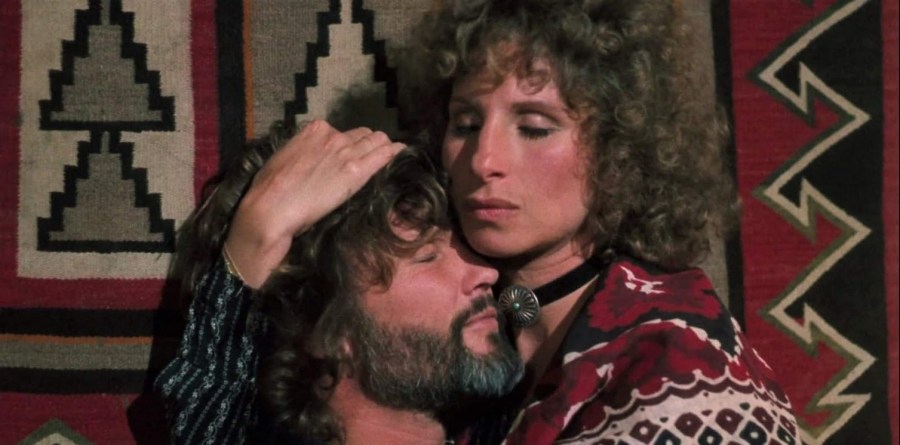
Perhaps most egregious is the contempt that Streisand shows not only for the material, but for her fans. Streisand isn’t content with just letting the classic story unfold; she stated publicly that the material had to be updated for the 1970s sensibilities, making Esther stronger in her disapproval of John Howard’s self-destruction (as a huge fan of George Cukor’s 1954 masterpiece version of the story with Judy Garland, Streisand’s take is incorrect, but whatever).
That may have worked, if we were given a clearer picture of the exact nature of that destruction. But the movie really craps out when it doggedly refuses to define the exact nature of John’s death. Was it suicide or an accident? The original story’s whole point was the “noble” (and totally wrong-headed) notion of the male star’s self-sacrifice to end what he thought was his contamination of the pure, unsullied nature of Esther’s talent.
But Streisand’s ego can’t allow the male character to take the lead in 1976, so she undercuts the power and emotion of his final death scene (a truly stunning moment in the 1954 version), by not only not showing it happen on screen, but by then invading the scene, and taking it over as her own. Now we have the spectacle of Streisand emoting over the corpse of John Howard. Now the scene is about her pity and grieving—not his foolish, touching decision.
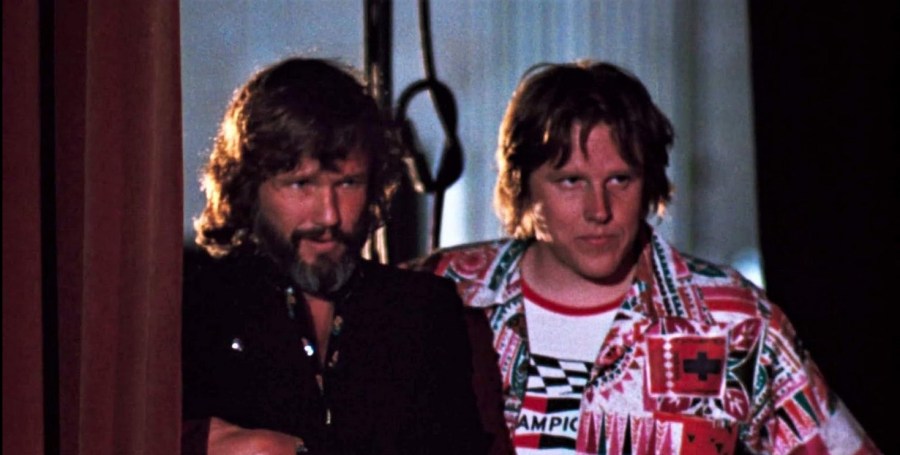
As well, if I were a die-hard Streisand fan, I’d be pretty upset with how fans are depicted in A Star is Born. Fans, according to Streisand’s view, are either uneducated rowdies, or grasping, tearing fame junkies who can never get enough of a star’s pain (an opinion voiced by Streisand at the Grammy Award ceremony sequence in the movie).
A Star is Born sets the tone for this assault on Streisand’s fans by having a voice-over announcer (setting up a rock concert scene with Kristofferson), telling the audience (both in and out of the movie) that, “We don’t want to keep repeating these things, but there are two or three a#$holes out there who don’t want to listen.”
If you doubt that this anti-fan message is in the movie, then I would direct you to the truly noxious commentary track that was provided by Streisand for the anniversary DVD edition that was released some time ago, where she throws out these helpful thoughts on the people that made her a multi-millionaire: “Singularly, they [the audience—you, dear reader] may not be that bright, but collectively, they’re brilliant, and they pick up the truth;” and, “Some [again, you dopes out there, according to Babs] achieve their dreams, and the others are angry.”
Aiding this vitriolic attack on her fans is A Star is Born‘s crazy, hilarious, cliched notion that if only artists were allowed to create, without the presence of “big business,” we’d all be a lot happier. When the limos arrive at John Howard’s and Ester’s desert retreat, it’s shot like some kind of spy movie, with the dreaded assassins coming to zap out the leads.
There are constant references in the movie to how difficult it is to be a huge star, with tons of money, tons of free time, tons of adoring fans, tons of places to go during the day that cost lots of money—in other words: incredible freedom from the workaday drudgery 99.9% of us experience—weighing them down. It’s that kind of loopy thinking that epitomizes A Star is Born, illustrating that this movie was more of a personal statement by Streisand, about her love life, her “woes” as a famous artist, ad nauseam, rather than a movie made to entertain her fans.
Technical credits aren’t up to snuff, either. The direction by Pierson and Streisand is unfocused and chaotic; scenes start and end with no internal rhyme or reason; it’s an ugly-looking movie, too, with loose, jumbled framing, and bad editing (the montage scene of Esther on the road is simply awful).
The filmmakers even botch the rock ‘n’ roll milieu they strive to capture; Streisand always thought that Kristofferson was too “country” for the role, but he does well enough. But the songs he’s forced to sing don’t ring true with the rock scene from 1976. As for Barbra; well, as Cher said when she found out that Streisand had beat her out for the role: “Barbra doesn’t know sh#$ about rock ‘n’ roll!”
And she doesn’t; it’s laughable to think that rock audiences that came to see John Howard, would immediately take to Esther when he shoves her out on stage. After hearing the mainstream, pap-filled Soft Pop songs of hers, she’s be lucky to get off the stage to the accompaniment of loud boos and whizzing-by beer bottles.
And her final “rock-out,” the ungodly long close-up of Streisand at the end of the movie, when she supposedly captures the spirit of John Howard and moves into the realm of rock ‘n’ roll goddess, is laughably, hysterically, inept. Watch Barbra “boogie,” and know the true meaning of the word “poser.” If the main character is unmotivated and unbelievable, and if the world that’s trying to be recreated rings false, you have a total artistic failure.
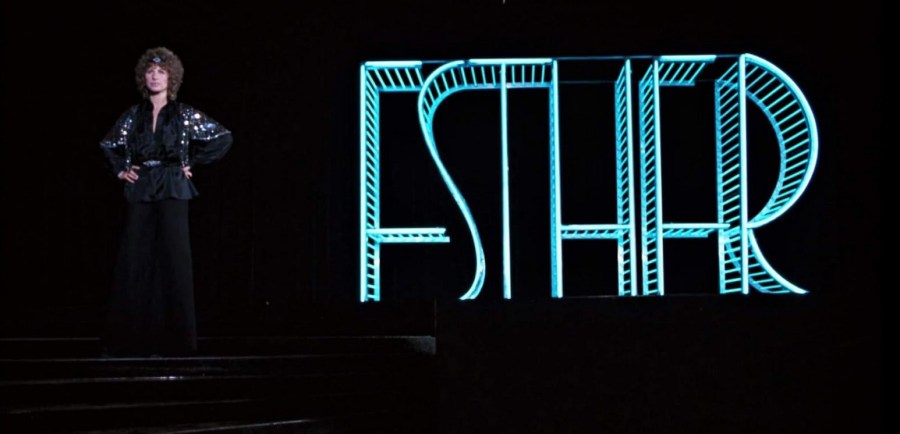
And just for fun, even though I rarely discuss extras from the disc releases I review, I thought I’d comment on this one…for obvious reasons. For Streisand fanatics, a full-length commentary track by Babs herself is offered up on this edition. Quite frankly, by the end of this nauseating, mind-numbing trip through Streisand’s thought processes (say that again in your head and try not to laugh), I was ready to toss the disc through the window.
It’s bad enough that Streisand repeatedly expresses utter contempt for lesser mortals (as recounted in the review above), but her continuous stream of minutia and trivia concerning herself, rather than the production at large, is ultimately maddening. How many times must I hear about the length of her fingernails, or the year of production of this or that vintage piece of clothing, or the state of her posterior in this particular shot (at the time, critics had a field day, counting the number of rear-end shots of Streisand in the movie, as well as how many times Kristofferson commented on it in the movie)?
There are occasionally revealing moments (Streisand giggling derisively when she recounts that hairdresser boyfriend Peters wanted to be a movie producer), but for the most part, it’s a sorry showing for Streisand.
Just like the movie.

Read more of Paul’s movie reviews here. Read Paul’s TV reviews at our sister website, Drunk TV. Visit Paul’s blog, Mavis Movie Madness!…but mostly TV.
 Movies & Drinks