Reduced, these past few weeks, to basically laying flat on my back (they took out 37 feet of my guts—I’m basically a soda fountain now), there hasn’t been much I can do but watch TV and movies. And certainly patterns of comfort TV-watching manifested themselves fairly quickly, including hours and hours of 70s TV (Emergency!, Adam-12, The Rockford Files), and lots and lots of drive-in fare (anything and everything American International put out during the 1960s and 1970s, from biker flicks to horror movies).
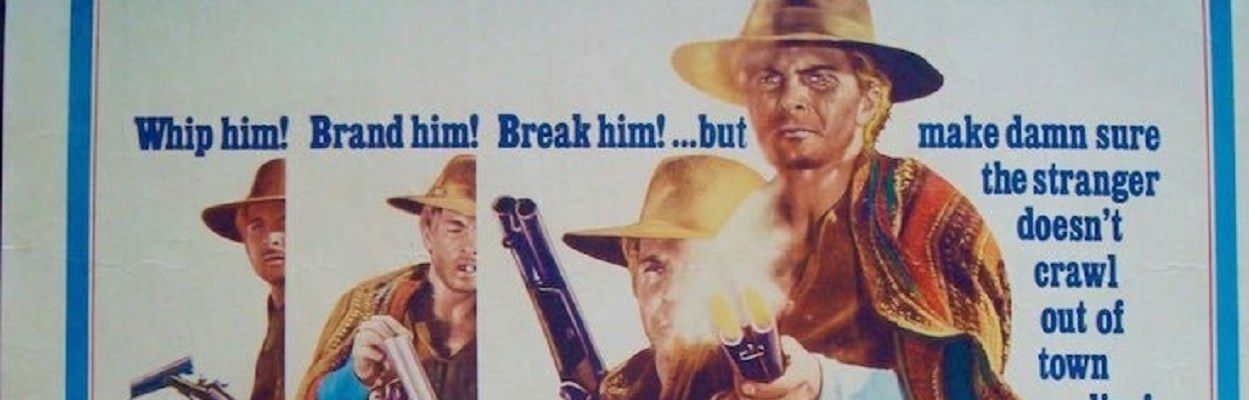
Westerns, of course, have been unspooling at a furious rate, too (a great chance to catch up on some Randolph Scott oaters I missed), so when I saw last week that Clint Eastwood has turned 95, I checked my pulse to see if I was still alive, and started watching anything with him and a horse. And when I was finished, I started in on as many spaghetti westerns as I could…including the underrated “Stranger Trilogy” of westerns all’italiana starring Tony Anthony.
By Paul Mavis
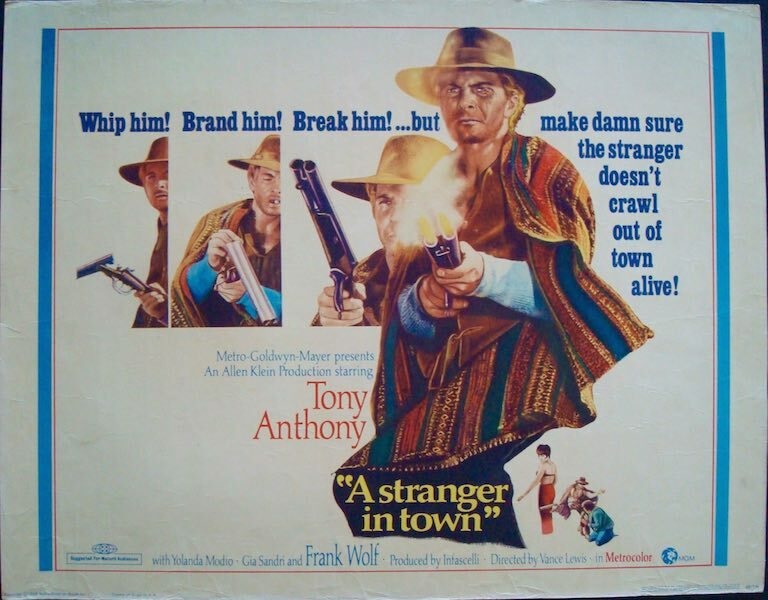
A few years back, Warner Bros.’ Archive Collection of M.O.D. (manufactured-on-demand) hard-to-find library and cult titles released The Stranger Collection, a two-disc, three-movie gathering of star Tony Anthony’s three “Stranger” Italian oaters, all of which were originally released in the States by Metro-Goldwyn-Mayer. Included here are: 1968’s A Stranger in Town, originally released in Italy in 1967 where it was titled Un dollaro tra i denti (); 1968’s sequel, The Stranger Returns, originally released in Italy in 1967 as Un uomo, un cavallo, una pistola (A Man, A Horse, A Gun); and finally The Silent Stranger (Lo straniero di silenzio), which was shot in 1968 but held up for U.S. distribution until 1975 (apparently, it never received an official European release).
Click to order The Stranger Collection on DVD:

(Paid link. As an Amazon Associate, the website owner earns from qualifying purchases.)
The first two Stranger spaghetti Westerns were surprisingly beefy international b.o. hits, and they still have second-tier name recognition among more-than-casual fans of the genre (somewhere around the Sergio Corbucci or Sabata area, maybe?). While they’re not in the league of Leone (what is?), Anthony’s grimy, sneaky little punk killer is an interesting addition to the genre, and these three very different movies are definitely worth a look for fans of macaroni Westerns. Let’s look at the debut outing.
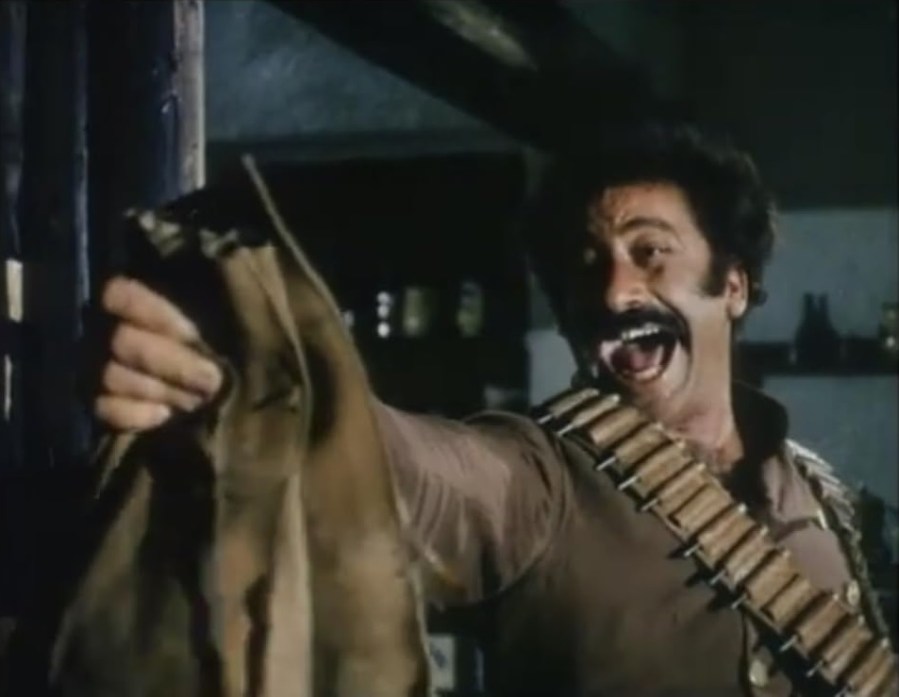
Into a sleepy, seemingly deserted Mexican village, The Stranger (Tony Anthony) rides. At a cantina, a henchman pulls a knife on The Stranger, telling him to ride 10 miles out of town…or else. The Stranger takes a whiskey bottle and instantly kills said bandito. Watching from a main street window, The Stranger sees notorious bandito Aguilar (Frank Wolff) and his gang zap an approaching Mexican army unit, and don their uniforms. The Stranger, putting on his own “borrowed” Union cavalry blue coat, greets Aguilar and passes himself off as a friend of the American officer who’s in charge of delivering a shipment of gold to Mexico’s government.

The Stranger offers his help in ripping-off said shipment, assistance which Aguilar accepts, and that comes in the form of The Stranger pulling a gun on Captain Ted Harrison (Enrico Capoleoni) and telling him he’s outnumbered. When it comes time to settle up, though, Aguilar proves correct his bad reputation by beating up The Stranger and flipping him one little gold piece for his troubles.

Wounded, The Stranger escapes their hideout and takes a girl from the village that Aguilar has held prisoner. Will The Stranger exact his revenge and kill every last member of Aguilar’s gang?
RELATED | More 1960s movie reviews

It’s been awhile since I re-visited a Tony Anthony Stranger movie. When you mention “Tony Anthony” to me, I think first of either his better-known spaghetti Western, Blindman, from 1971, or Comin’ At Ya!, his surprise 1981 macaroni oater hit—the first title I ever saw projected in 3-D (a big, big deal back in 1981, when movie fans thought the format was, for all intents and purposes, long gone for good).

So I was stoked to see Warner Archive bring out the first three Stranger titles in anamorphic widescreen (this is the kind of relatively obscure stuff they do so well). Compared to the reams and reams of material on Leone and his Dollars trilogy, there’s not a whole lot out there on Anthony and his Euro-Westerns. From what I could gather, stage-trained (Actors Studio) Anthony was a go-getter from the get-go, making a couple of low-budget features here in the U.S. in the early 60s (including a children’s short that won some minor acclaim at the Venice International Children’s Film Festival), before he went to Italy to co-write and star in two more features.
A co-producing partner, Saul Swimmer, who was based in the U.K., had become friends with Abkco Records’ Allen Klein, the manager of The Rolling Stones and a Metro-Goldwyn-Mayer stockholder. Making movies in Italy, Anthony saw the profit potential of doing a spaghetti Western, a subgenre which in the mid-60s was completely dominating the Italian boxoffice (before making major inroads in the international markets with the delayed release of Leone’s and Eastwood’s Dollars movies). Two sources I found indicate Anthony contacted Swimmer, who contacted Klein, with the outcome being money put up by both Klein and Anthony for a cheap spaghetti Western to be released by M-G-M (the budget apparently was no more than $50,000 U.S.).
The movie was shot quickly in 1966 and released in Italy to good numbers in January, 1967, before it made similar successful runs throughout Europe. M-G-M’s prez Robert O’Brien thought A Stranger in Town might be a good way to soak up some of that spaghetti Western money that United Artists was minting with Leone and Eastwood, so Anthony’s opus was released in the States in the spring of 1968. Critical reception was dire (for a giggle, I recommend Roger “The Most Overrated Movie Critic of All Time” Ebert’s truly wretched goof of a Hemingway-esque review, which not only shows he didn’t get Hemingway at all…but which also gives us yet another example of his scurrilous penchant for slamming movies he didn’t actually watch all the way through…). Then as now, though, critical barbs meant little to the ticket buyers, who made A Stranger in Town a nice-sized hit for M-G-M that spring.

I wasn’t sure what to think about A Stranger in Town when it first started to unroll. Initially, it certainly seemed derivative of Leone’s work, with Anthony sporting a black hat, serape, and a quasi-Eastwood squint, riding into a deserted Mexican village as he pits two forces against each other (Wolff’s gang and the U.S. cavalry) in an effort to scam some gold…inbetween all the sadism and sweaty faces. Sound familiar, right?

Of course that kind of, ahem, “borrowing,” was S.O.P. in most countries’ exploitation/genre moviemaking—not just Italy and the spaghetti Westerns (Leone certainly “borrowed” from Yojimbo for that first Eastwood opus…enough to get a lawsuit successfully slapped on him). If something struck gold at the box office, a flood of imitations would follow, no matter what the language or national borders. So, if A Stranger in Town sorta looked and sounded like A Fistful of Dollars…so what? What post-1965 spaghetti Western didn’t echo Leone in some small fashion?

So…is A Stranger in Town as good as its inspiration? No, but again…who cares? I wasn’t expecting iconic moviemaking to strike twice here (Anthony’s take on “The Stranger” is intriguing…but is it “iconic?” I’ll leave that for the hard-core spaghetti Western experts). No, the only thing A Stranger in Town had to do was entertain me with a reasonable collection of spaghetti Western conventions, and this it did—and quite nicely, too.

What I found most strangely appealing about A Stranger in Town is the one element that seems to piss off most of the movie’s annoyed critics, including the few mainstream reviewers who wrote about it back in ’68: its protracted, deliberate pace. During the first 15 minutes or so, I sympathized with them—I just couldn’t see the endless, constant close-ups and pregnant pauses as anything more than director Luigi Vanzi (credited as “Vance Lewis,” as if that would fool Hollywood) taking one of Leone’s innovations and unimaginatively stretching it to the breaking point.
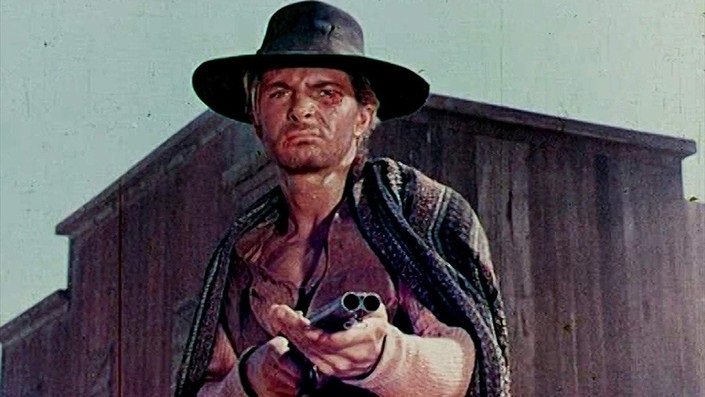
And maybe that’s all his visual/editing schematic was intended to be…but somehow, in some way, eventually, it worked for me. As the movie drives on with this measured, steady beat, it starts to feel like a weirdly twilight comic book (the old school kind), with just one scene/”panel” after another of The Stranger prowling or shadowing after someone else, enlivened by short bursts of action (for once they show you what happens when you’re hit in the head with a whiskey bottle: you die) and howlingly exaggerated sound effects of someone getting shot or beaten or tortured (Vanzi and cinematographer Marcello Masciocchi come up with several visually impressive moments, like the shoot-out in the pitch-black cellar, illuminated by muzzle flashes).

Dialogue is almost non-existent; most of the movie operates in silence, save for composer Benedetto Ghiglia’s somewhat repetitive score (I suppose little dialogue equaled further savings on dubbing sessions). The storyline from Giuseppe Mangione and Warren Garfield (the trailer guy) is exceedingly violent if not particularly bloody (which again may have been a budget factor; when that Mexican army unit gets slaughtered by a machine gun, there’s no exploding squibs or blood smears), with Anthony an exaggerated version of the typically abused spaghetti Western anti-hero (the most perverse element of these various offenses being that the masochistic, half-grinning Stranger doesn’t seem to be minding them all that much).
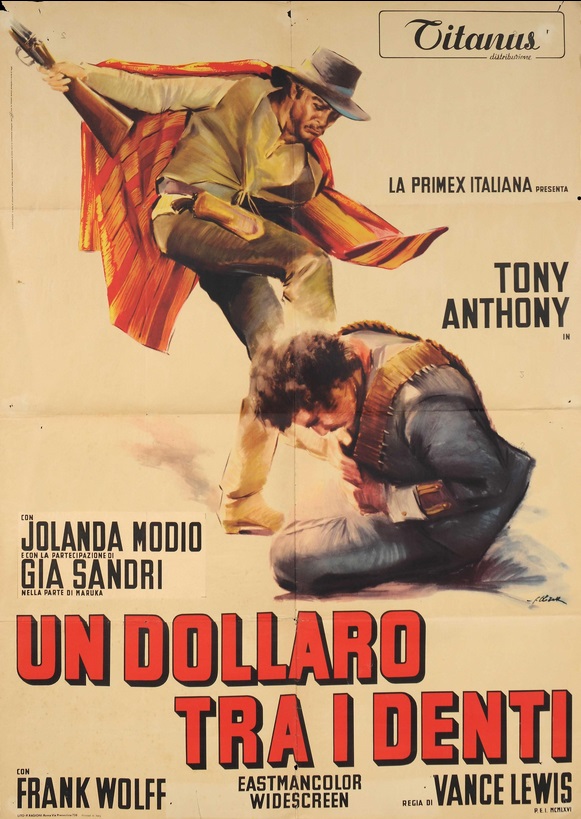
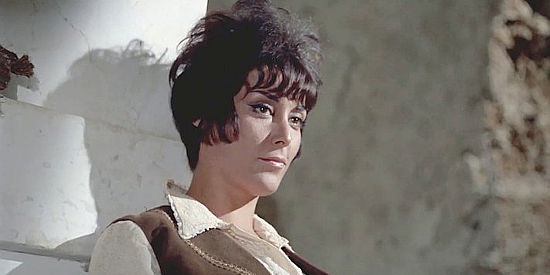
According to what I’ve read, Anthony and director Vanzi designed “The Stranger” to be a scheming, street-wise punk who “did good by accident.” Anthony may not be cruelly handsome like Eastwood or Nero or Hill, but he does have a certain tentative, watchful way about him that fits in perfectly with Vanzi’s measured pacing. Whether he’s half-smiling at the sight of a woman and her baby (something The Man With No Name would never do) or half-smiling after killing a woman (the scene where Pilar whips him and then begins to paw him, right before he viciously smashes her head into the floor, is deliciously overripe), you have to work to figure out where Anthony’s head is…before you realize it probably doesn’t matter in the end.

All you want to see is another 20 minutes or so of that protracted, expertly edited finale, where “The Stranger,” with cat-like agility and silence, stalks his prey, amusingly popping up out of floorboards or walking along rooflines, blowing away his tormentors with nary a flicker of his idiotic grimace/smile. When the movie closes with Anthony adroitly flipping out one final quip, you know you’ve seen something a bit above the literally hundreds of cheap Dollars knock-offs that flooded Italian cinemas in 1967 (and I’ve seen a few). And that’s saying something.

Read more of Paul’s movie reviews here. Read Paul’s TV reviews at our sister website, Drunk TV. Visit Paul’s blog, Mavis Movie Madness!…but mostly TV.
 Movies & Drinks
Here’s hoping you have a full and fast recovery! I’ve had the Stranger Collection on my shelf for years and you’ve inspired me to finally check these movies out.
LikeLike
Due to a steady intake of spirits, I am fast on the mend! Thank you, and I think you’ll enjoy them!
LikeLike