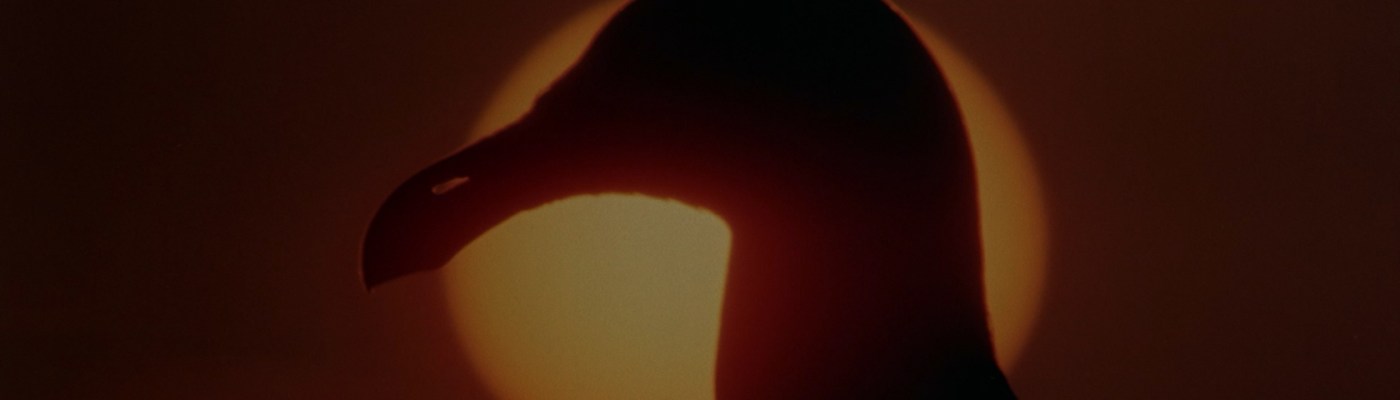
Far out, birdbrain.
By Paul Mavis
Does anybody under 50 even know about Jonathan Livingston Seagull anymore, the 1970 pseudo-Christian/Eastern philosophy hodgepodge parable by Richard Bach that, through word of mouth, became a mammoth best seller? To people who grew up during the early Seventies, a tattered blue paperback copy of Jonathan Livingston Seagull was as iconic a symbol of the times as macrame fern holders, waterbeds, big orange incense candles, earth shoes, and a VW Microbus parked out front. If that rather ghostly white image of Jonathan adorning the book cover wasn’t sitting on the back of someone’s toilet, it was resting on a cinderblock-and-board bookshelf, nestled safely between cherished copies of Love Story and the Collected Poems of Rod McKuen (with two Pet Rocks for bookends). Everybody read that stupid goddamn book.
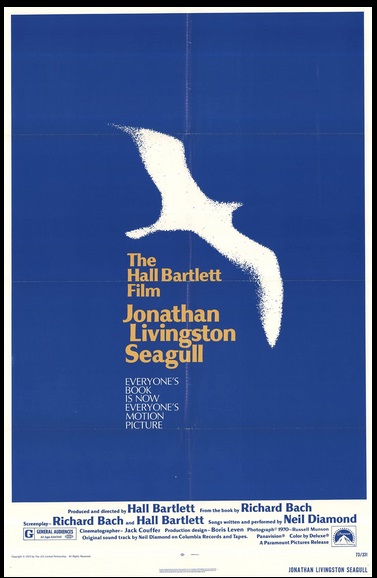
So…in 1973, a lot of people in Hollywood scratched their beaks in amazement when Paramount blew about $1.5 million on a live-action feature film version of the bestseller. After all, how the hell were you going get across Bach’s banal, quasi-religious parable by using real birds? It makes sense, though, for them to at least try. Considering how many millions bought the book, and the devoted cult that sprang up, keeping it on the sales charts for years, if even a portion of those numbers bought movie tickets to Jonathan Livingston Seagull, it would have been a hit, particularly with that relatively tiny budget (I’m betting that number was phony, anyway—that kind of location shooting with animals is traditionally time- consuming and expensive, and the subsequent promotional campaign was extensive).
Click to order Jonathan Livingston Seagull on DVD:

(Paid link. As an Amazon Associate, the website owner earns from qualifying purchases.)
Unfortunately, the critics dropped their doo-doo all over this turkey (sure…why not?), and audiences were completely apathetic, resulting in a total bust for Paramount when Jonathan Livingston Seagull failed to gross more than its below-line cost (with Hollywood’s rather fanciful accounting techniques, a movie has to gross at least 3 times its cost to start returning a profit to the studio).

I didn’t know anything about that in 1973, when I was plopped down at the Southwyck 7 mall theaters with a bunch of other screaming kids to watch this aviary The Razor’s Edge (Jonathan Livingston Seagull carried the dreaded “G” rating, so smart parents dropped off the small fry and ran). Walking out of the theater, I remember…um…actually liking it. Now, I know for a fact that my older brothers enjoyed it, because when they went with me they were stoned out of their gourds.
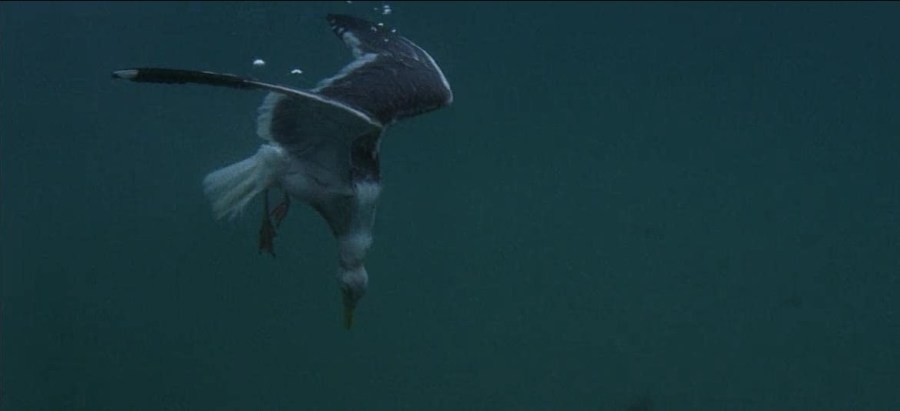
They had heard it was a “head trip,” and packed their snacks accordingly (did the same thing with me next year for Disney’s Alice in Wonderland re-release). As I occasionally glanced back and forth between them as their eyes pinwheeled back into their skulls, I sat and marveled at Jonathan Livingston Seagull‘s truly spectacular scenery…while I tried to figure out what the hell Jonathan was talking about (“Wait…you can go somewhere you’ve never been before, by already being there? Uh…pass the Rasinettes.”).
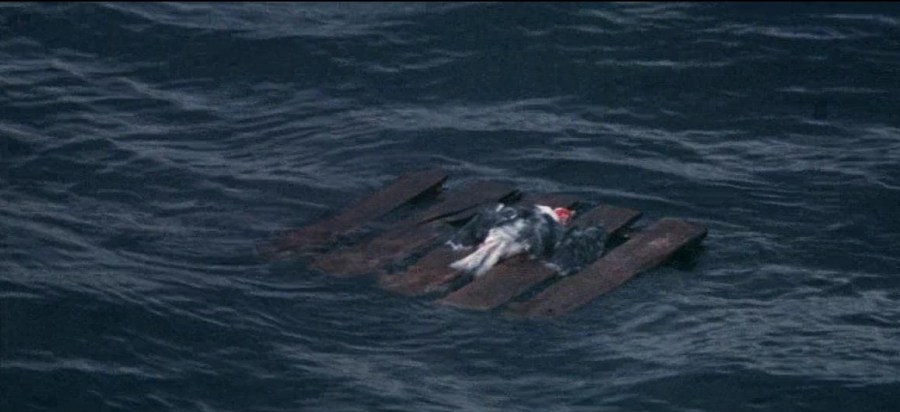
If you don’t know Jonathan Livingston Seagull (or at least the story that’s used in the movie—they changed it from the novel), it concerns a sensitive, questioning seagull named Jonathan Livingston Seagull (voice talent of James Franciscus), who wants more out of his life than just scavenging for fish heads like the rest of his Flock (at least you’re not writing for now-dead DVD Talk, Jonathan…or worse: being a member of the odoriferous OFCS).
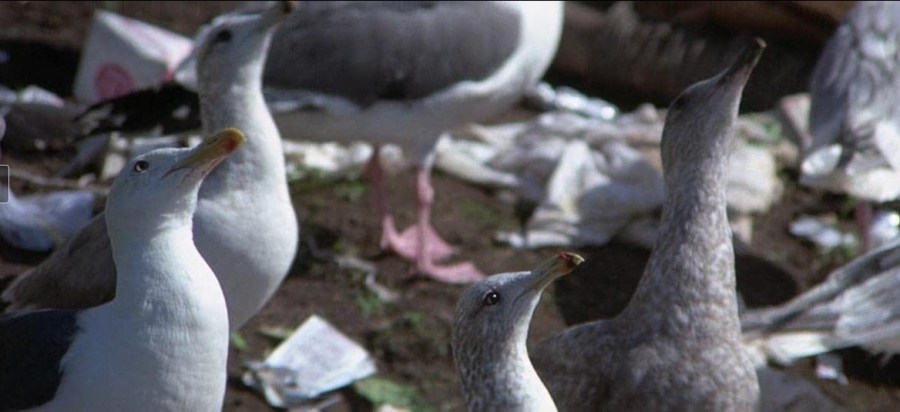
Trying to master high-speed flight, he’s castigated by the Elders of the Flock (voice talent of Hal Holbrook for head elder bird) for not only pursuing the useless skill of speed, but also, more dangerously, for flouting the conventions of the Flock, and for being an, um…individual bird (a heavy, heavy theme in 1970, for man and bird, apparently). Almost killing himself before mastering 200mph-plus flight, he is banished from the Flock, and must find his own way in life.
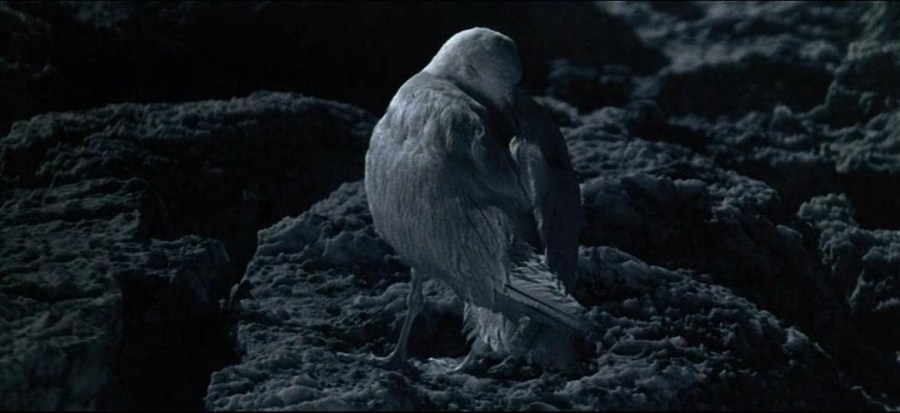
Flying around the world, Jonathan dies (or does he really die?) and is found by new gulls (in a strange world where colors are reversed or washed out) who understand his quest. Maureen (voice talent of Juliet Mills) offers to teach Jonathan, but she realizes that he’s far more advanced than most birds “at this level of existence,” and offers to introduce him to super-bird Chaing (voice of Philip Ahn), who lays down a major freak-out to Jonathan by telling him “perfection” is attainable if you already believe you are. That instantaneous flight to anywhere in the cosmos is possible if you already believe you’re there, and that the body is just a manifestation of the mind. Whoa.
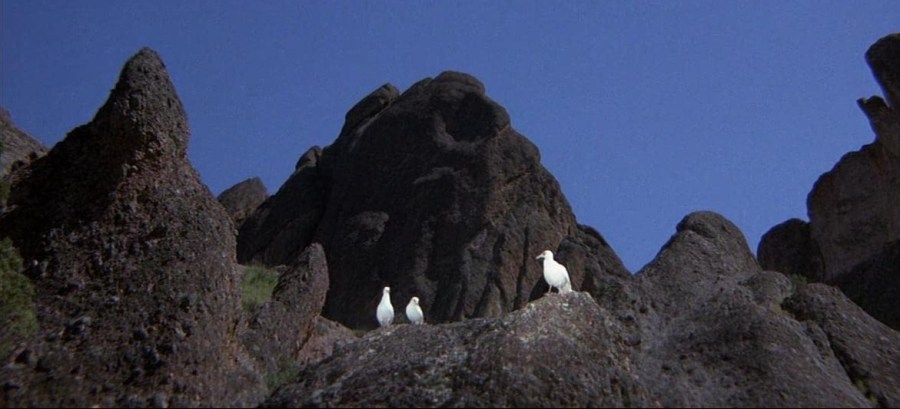
Jonathan, inspired by his teachings and learning what “love” really is, goes back to his flock, where he brings back to life a young disciple, Fletcher (voice talent of David Ladd). With that, the Flock now calls him the “Son of the Great Gull.” Having achieved perfection, he leaves the flock to help others.

Watching Jonathan Livingston Seagull today, I pretty much had the same reaction I had seeing it 50 years ago. It’s a spectacular-looking movie, with images of the California coast battered by massive waves rivaling anything I’ve seen on film. Equally amazing are the scenes of Jonathan, flying around the various locales (cinematographer Jack Couffer rightly was nominated for an Academy Award here). There’s one shot in particular, at the beginning of the movie, where the helicopter camera swoops around a jagged outcropping of rocks, with Jonathan perfectly alighting on it at just the right moment as the copter goes by—what an amazing shot to capture. Numerous evocative sequences like that are caught in Jonathan Livingston Seagull, including a particular favorite where Jonathan tentatively makes his way across a sea of red sand in the desert.
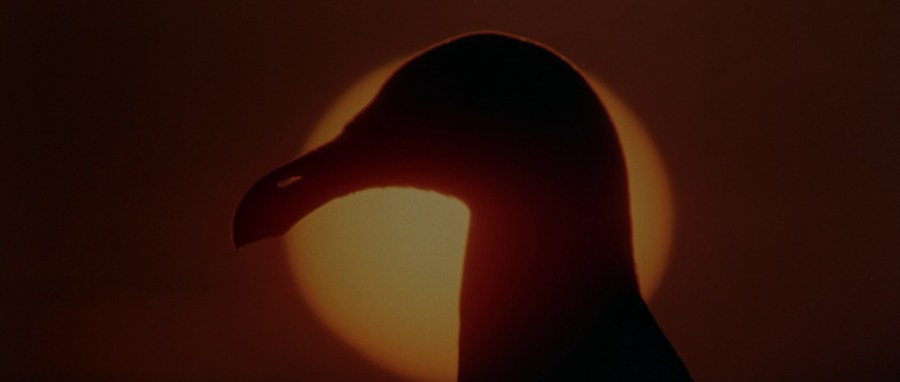
The flying scenes are quite impressive, as well, with a stunt plane used to capture some of the high-speed flying, as seen from Jonathan’s perspective. Now I understand that fake, remote-controlled gliders were used for some of the bird shots—if they were, I couldn’t really tell (so how did they get that realistic shot of a gull smashing into the side of cliff? Better not ask…). And some of the color reversals in the “Heaven” sequences are quite arresting; if nothing else, you can just groove on Jonathan Livingston Seagull, much like my stoned brothers did, no doubt.
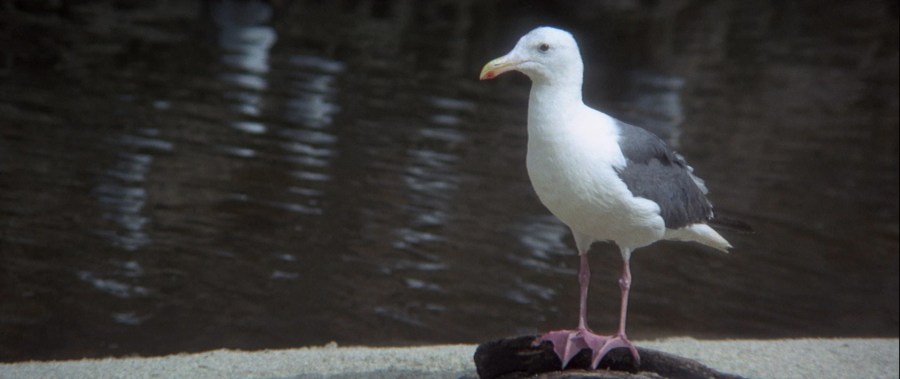
But serious drawbacks arise any time music swells up on Jonathan Livingston Seagull‘s soundtrack, or when some actor opens his beak…which is distressingly all the time. Neil Diamond won a Grammy for the soundtrack of Jonathan Livingston Seagull, but it has to be one of the most bombastic, puerile pieces of music I’ve ever heard. Ladled on each and every scene in the movie to the point of suffocation, Diamond’s turgid music screams, “Listen to me! I’m important! I’m significant!” at every stop, never giving the viewer a moment’s peace to actually contemplate the beauty of the scenery or the intended meaning of a sequence (or the ridiculousness of the dialogue).
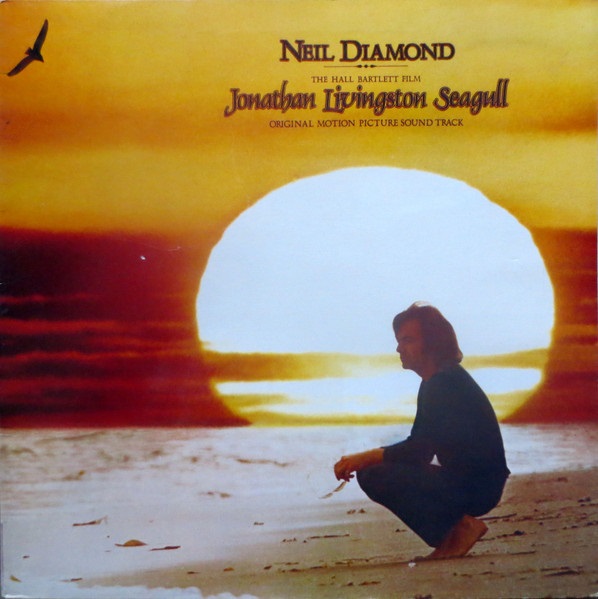
Diamond’s songs are, if possible, even worse. With a penchant for repeating the same two or three-word phrase over and over again, these stunningly inept dirges are as grating as they are frequently indecipherable (I recommend the close-captioning to get what Diamond is screeching about). When you discover that Diamond actually brought suit against the moviemakers and Paramount to put more of his music and songs back into the release print (after someone blessedly cut them out), you have to wonder what he was thinking (I guess he knew something I didn’t: the soundtrack went double Platinum, peaking at number 2 on the Billboard 200 chart).
As for the voice work, I suppose there was no other way but voice-over narration to translate Bach’s asinine hippie-crap amalgamation of Christianity, reincarnation, Eastern philosophy, The Power of Positive Thinking, and Leave it to Beaver (remember when the Beav likens a hole in the street to the Grand Canyon?). But christ: does it have to sound like Franciscus was channeling William Shatner (can you imagine the possibilities had they scored him for the role?)? Franciscus, an actor I’ve always enjoyed (Longstreet rules), plays Jonathan like every single word was spoken for the very first time by a human (or bird). He gushes, he trembles, he…hesitates every single line, until we fear that Jonathan has taken one too many high dives to his feathered noggin.
RELATED | More 1970s film reviews
Of course it doesn’t help that the dialogue Franciscus is given is frequently for the birds (sure—why not?). I actually didn’t mind the story so much; after all, this is Jonathan Livingston Seagull for christ sakes; you were expecting maybe Shakespeare or something? It isn’t supposed to be any good. It’s the worst kind of New Age-y drivel that even people back in the Seventies didn’t really buy (point of fact: they only used it to pick up other people in bars, actually).
Does Jonathan die? Does he go to “heaven?” Is he reincarnated? Is he Christ? Is he Toucan Sam? Cripes…who cares? Shamelessly trying to incorporate and amalgamize every major form of philosophical thought into one easily digestible hamburger, Jonathan Livingston Seagull winds up embarrassing them all, becoming the ethical and metaphysical equivalent of, “Hey, baby; what’s your sign?”
And…that’s cool with me. It’s a parable; you’re not supposed to take it seriously. But each and every time you try to give Jonathan Livingston Seagull its due, you realize all this intangible, incorporeal gobbledygook is supposed to be coming out of freaking birds, and the waves of laughter just, like…roll on and on, man. At times stunningly beautiful, at others—in fact, most of the time—insipid and trite, Jonathan Livingston Seagull can be watched on so many different levels (most of them bad), that when it’s all said and done, Jonathan Livingston Seagull is such a truly weird, conflicted experience that it achieves a kind of inept, screwy perfection of contrast that Jonathan himself might admire….
…if he didn’t have a brain the size of a pea.

Read more of Paul’s film reviews here. Read Paul’s TV reviews at our sister website, Drunk TV.
 Movies & Drinks
I have not yet seen the film, but you make it sound like somethign worthy of an evening’s corrupt entertainment. I had no idea it was sexless and stupid, just foolish. I will track a copy down and if still sane, report back. Two things, Richard Bach had a stunning wife, Leslie Parrish, and I knew and still know Canadian film people who seemed to embrace the concept. Jesus Christ.
LikeLike
I had no idea Bach was married to Leslie Parrish but that increases my respect (or envy) for him by about 10,000%.
LikeLiked by 1 person
Indeed, Leslie and adorable are twins.
LikeLiked by 1 person