So I guess there’s a new Saw movie out there in those theatres that I hear young people go to on occasion. Jesus…if I “want to play a game,” Jigsaw, it’ll be the one where I try to make it through another hopeless night without jumping off a building. It’s remarkable what people will pay money to see nowadays.
By Paul Mavis
One of the fail-safe “movie therapy crutches” that definitely gets me through the Halloween season is a return to old spookum favorites, primarily the Universal “classic monsters” franchises (I love that arch, silky, upper-class tone of Karloff‘s The Mummy the best) and of course, anything starring Vincent Price. In the early 70s, Price’s various horror and sci-fi outings seemingly played non-stop on the 5 whole TV channels we could tune in with our massive Channel Master antenna, popping up constantly on Friday night Late Shows, weekday afternoon Big Shows, and of course Saturday afternoon horror slots like WKBD Channel 50’s Sir Graves Ghastly (“Happy Hauntings…. neeeeeeeeaaaaaaaaaaahhhhhhhhhhhhaaaahhhhaaaahhhhh!”).
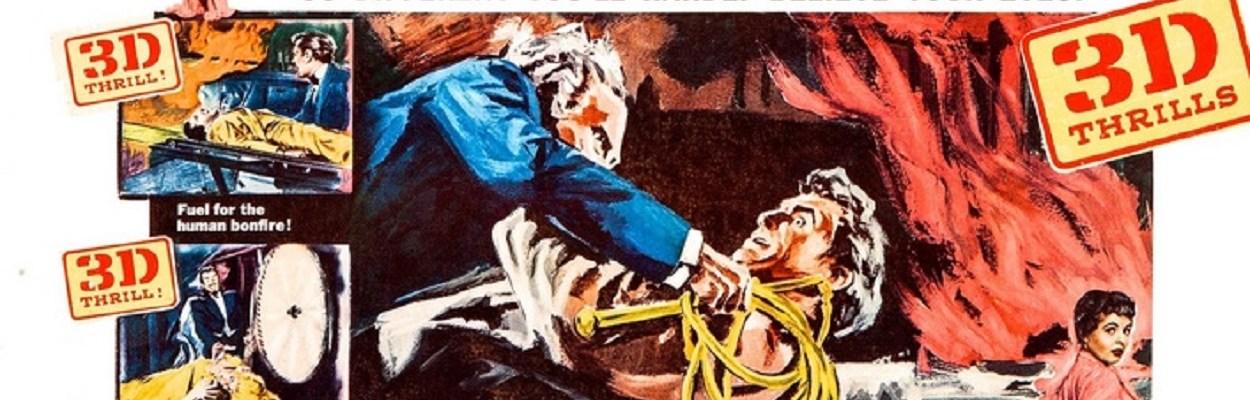
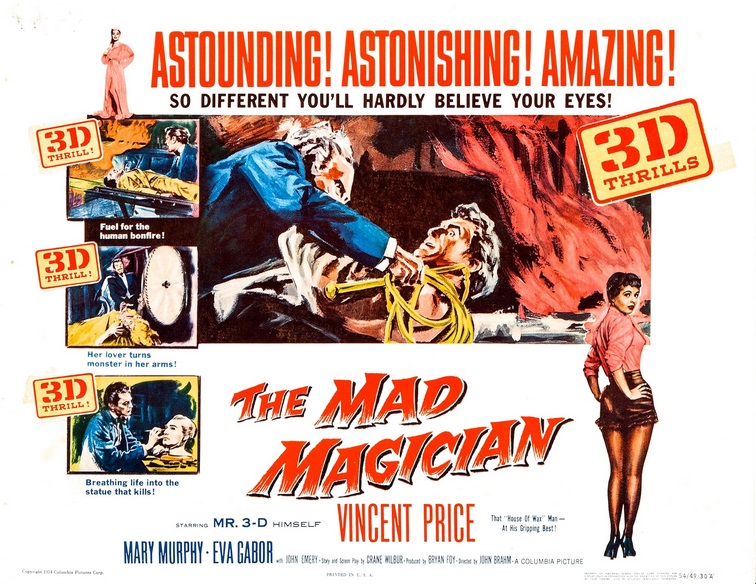
One of those Price flicks that always scored a twist of the dial was the enjoyable (if two-dimensional) three-dimensional horror retread, The Mad Magician. A 1954 entry from Columbia, riding the already-dead 3-D fad, The Mad Magician, starring Vincent Price, Mary Murphy, Eva Gabor, Patrick O’Neal, John Emery, Donald Randolph, Lenita Lane, and Jay Novello, is a fairly obvious lift (including the same star, producer, scriptwriter, and cinematographer) from Warner Bros.’ previous year’s 3D smasheroo, House of Wax. The Mad Magician doesn’t come close to approximating that classic’s gruesome, comic book tone (the blown-out black and white doesn’t help, frankly)…but it is fairly amusing in its own right, largely thanks to another deliciously hambone turn from the master, Vincent Price.
Click to order The Mad Magician on Blu-ray:

(Paid link. As an Amazon Associate, the website owner earns from qualifying purchases.)
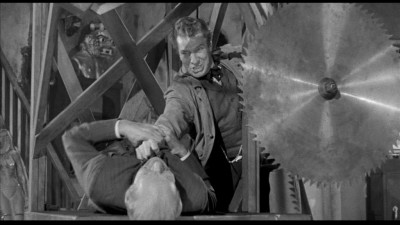
Stage magic effects designer Don Gallico (Vincent Price) is ready to step out from behind his inventor’s workbench and become magician “Gallico the Great.” Armed with state-of-the-art facial masks that allow him to execute impressions of other famous magicians, along with a killer new illusion—”The Lady and the Buzzsaw”—Gallico is ready to take Broadway by storm. Wowing the out-of-town tryout audience with his impersonation of “The Great Rinaldi” (John Emery), Gallico prepares to slice his pretty assistant, Karen Lee (Mary Murphy) in half, when the curtain suddenly comes down.

Gallico’s employer, Ross Ormond (Donald Randolph), letting Gallico get this far with his plans in order to humiliate him, presents an injunction against the act: as his employer, Ormond owns everything Gallico creates—on or off the clock. Back in New York, at their company, Illusions, Inc., Ormond further debases Gallico by taunting him about “trollop” Claire (Eva Gabor), Gallico’s ex-wife whom Ormond seduced and married some years ago. Pushed too far, Gallico goes insane and buzzsaws off Ormond’s head, setting into motion a series of elaborate impersonations and cover-up murders that baffle the
police, including Karen’s fiancé, New York Police Detective Lieutenant Alan Bruce (Patrick O’Neal).

The Mad Magician, released in May of 1954, was one of the later entries in the “golden age” of stereoscopic movies, coming during the second “boom-bust” phase of the era’s relatively short three-year craze. Although examples of stereoscopic test footage and shorts had been around since the first part of the 20th century, the advancement of the red/green anaglyph format and particularly Land’s Polaroid polarizing filters (used in conjunction with two synched prints, for a far superior effect), meant that by 1952, three dimensional movie production and projection, despite lingering technical limitations, was a viable “attention getter” for studios desperate to bring back moviegoers who had abandoned Hollywood for their television sets.

1952’s indie smash, Bwana Devil, started the 3D rush, a flurry of activity that ebbed and flowed particularly after Fox introduced a rival “three dimensional” (as it was originally advertised) process: the two-dimensional widescreen CinemaScope®. By the time The Mad Magician appeared in the spring of 1954, most studios and theatre owners (and moviegoers, too), had already thrown their lot in with the various competing widescreen filming and projection processes.

The limitations of stereoscopic moviemaking at the time—registration issues with synching the prints (and the resulting eyestrain for the viewers), the cost of printing up two prints per engagement, and the problems associated with damage to one print, run-time limitations owing to not being able to switch reels—proved more troublesome than the worth of the admittedly eye-popping visual punch of the 3D effects. So, as with most crazes, it died out…only to be reborn several more times over the decades (it looks like it’s “out” again, as of 2023…thank god).
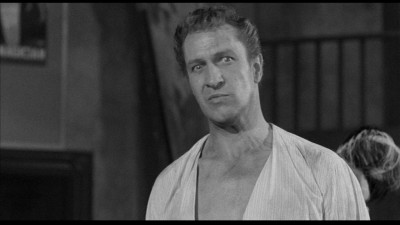
As for The Mad Magician, it’s definitely House of Wax‘s poor relation, in both a literal and figurative manner, since it tries, with many of the same HOW crew, to ape HOW‘s success, only with a noticeably smaller budget…and fewer ideas. HOW remained an audience favorite for decades after its initial 3D theatrical release because it succeeded first as a horror-tinged thriller.
RELATED | More 1950s film reviews
Kids like me in the 70s who watched HOW obsessively every time it showed up on TV may not have known it was shot expressly for 3D effect (although we guessed something was weird about it, owing to all that stuff getting thrown at the camera). However, we knew it was a solid, scary horror outing. Simply put: HOW worked without the 3D effects. However, The Mad Magician, entertaining though it may be, doesn’t work nearly as well as a thriller, and I’m not so sure the 3D effects could “save” it (to be fair, though, I’ve never seen it projected in 3D…).
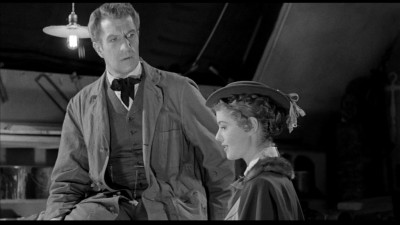
A good example is the sequence involving Price losing his boss’s decapitated head in a satchel mistakenly picked up by Murphy, a suitably gruesome (and inherently funny) plot device. What should have delivered some solid suspense thrills is utterly defeated here when the resolution isn’t even shown (we hear through desultory exposition how the matter was resolved without incident…whoopee). The Mad Magician is like that in most of its suspense elements: the set-ups are intriguing (Price donning masks to impersonate his foes, the arrival of the snoopy landlords Lenita Lane and Jay Novello), but the execution is distressingly familiar (if not downright weak, at times).

And of course, these weaknesses in Crane Wilbur’s script and John Brahm‘s direction are only put into starker relief without the distraction of the 3D effects. Watching a movie like The Mad Magician without its intended 3D context is really no different than watching a pan-and-scanned CinemaScope® title: it’s not the way it was really meant to be seen (…even if many of these 3D titles were often released “flat,” as well). So the 2D 3D effects can only be enjoyed in a knowing historical context; they’re fairly meaningless on their own here when presented “flat.”

You can tell that cinematographer Bert Glennon and director Brahm are careful at times to stagger the foregrounds and backgrounds to give a little 3D visual interest in scenes that don’t involve an overt effect, but when an “eye popper” does come up, it’s fifty-fifty whether it will work (Lyle Talbot’s rubber arm shoving a program in our face is socko) or not (the yo-yo man, aping the amazing paddle ball barker in HOW, is flat and dull…and over in ten seconds). Even the Victorian gaslight settings are disappointingly ho-hum (the choice of b&w isn’t to blame; I suspect the low budget and Columbia’s usual harried house style: set it up fast and shoot it).

That all may sound unnecessarily negative, but it shouldn’t, because despite its obvious limitations and compromises, The Mad Magician is fun in a slight, goofy sort of way…particularly anytime Vincent Price is chewing up the scenery. Eva Gabor plays the hot, spoiled bitch to a “T” (a very pretty neck to strangle, it is noted, should she betray you), but the appealing Murphy is completely wasted in a non-part (another element from HOW and of course The Phantom of the Opera—the strange romantic relationship between the beauty and the obsessive madman—that The Mad Magician fumbles).

Pros Emery, Lane, and Novello seem to think that The Mad Magician should be approached as a spoof, so they’re appropriately (and most welcomely) tongue-in-cheek in their turns, but it’s Price, as always, who holds The Mad Magician together. Wonderfully heady and yeasty even when he’s playing a scene soft and tortured, he’s highly amusing here anytime he goes into overdrive (his, “Go on, laugh! Laugh at me! Laugh!” bit with Randolph is a classic). Price, perhaps more than any other actor I can think of, could simultaneously amuse you and impress you with a deliberately over-the-top performance, while miraculously taking the pejorative sting out of “ham.” No wonder he’s the icon he is today: there’s no other real reason a movie like The Mad Magician would be of interest today, without him.

Read more of Paul’s movie reviews here. Read Paul’s TV reviews at our sister website, Drunk TV.
 Movies & Drinks
Patrick O’Neal was a grand guy and for several years in the late sixties worked on several projects with me. Or me with him. This was his first film as a leading man.
An aside: It was an honor to know him.
LikeLiked by 1 person
I remember you writing about him, Barry. Do you know if his restaurant, O’Neal’s, is still around? Ever go there? Heard it was a cool place for theater people.
LikeLike
It was a real hang out ,but I believe it is gone. Almost like a clubhouse for the show busisess set.
LikeLike
I just verified my comment, O’Neals gone in 2010.
LikeLike