Oh okay so now, supposedly, we’re in big trouble, not only politically but economically? But four years of a shadow government no one elected…and not a peep from the corrupt media that was helping to hide it? Got it.
By Paul Mavis
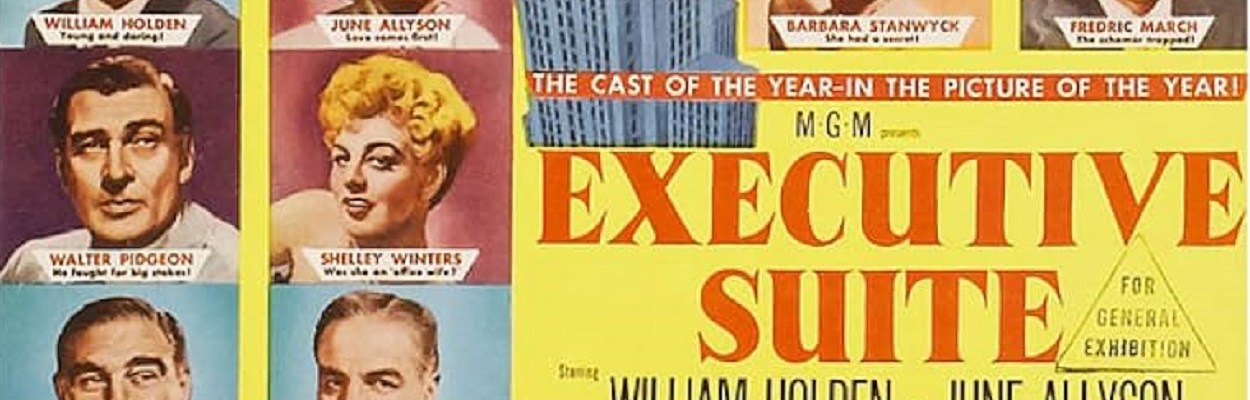
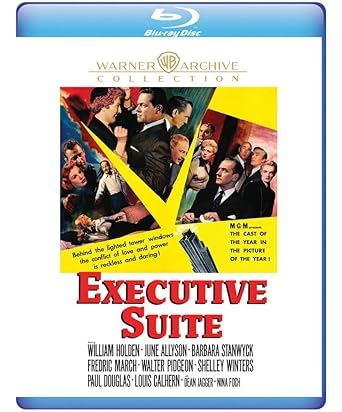
And you wonder why I escape into drink and movies and TV? I’ll get my fill of politics and sociology and economics and all that other boring shit distilled through Macallan 12 Year Old Double Cask and classic Hollywood, thank you. A few years back, Warner Bros.’ Archive Collection released Metro-Goldwyn-Mayer’s big 1954 hit, Executive Suite, the ultra-smooth, polished boardroom drama/sudser with something or other on its mind but who cares what it is because don’t the leads look wonderful? Starring a starry cast including William Holden, June Allyson (tight as a drum in that lingerie), Barbara Stanwyck (the pro of all pros in this kind of “forgotten woman” role), Fredric March (wonderfully slimy and sweaty-slick), Walter Pigeon, Shelley Winters (overwrought, what else?), Paul Douglas, Louis Calhern, Dean Jagger, and Nina Foch (achieves quite a bit with a deceptively superficial character), a clever script by Ernest Lehman (from Cameron Hawley’s smash bestseller), and clean direction from uber-straight Robert Wise, Executive Suite‘s super-slick production has “prestige” written all over it, creating a glossy, entertaining pic that holds up remarkably well over 70 years (!) later.
Click to order Executive Suite on Blu-ray:
(Paid link. As an Amazon Associate, the website owner earns from qualifying purchases.)
New York City, 1954. Having just sent a telegram to his Millburgh, Pennsylvania office tower, calling for an executive board meeting at 6:00pm that night, Tredway Corporation president Avery Bullard drops dead in the street…followed immediately by a proper New York City memorial: someone steals his wallet and ditches the i.d.

Investment banker and Tredway board member George Caswell (Louis Calhern) witnesses this tragedy from his office window, and follows up with a proper investment banker memorial: he instantaneously sells short 3700 shares of Tredway stock in the hopes of picking them back up again at a sizeable profit.

Meanwhile, back in Tredway Tower, the five vice-presidents for the nation’s third-largest furniture manufacturer assemble for the meeting: affable, weak number two man Frederick Alderson (Walter Pigeon); numbers-obsessed company controller Loren Shaw (Fredric March); back-slapper head of sales Josiah Dudley (Paul Douglas); old-school plant manager Jesse Q. Grimm (Dean Jagger); and hotshot engineer in R & D, McDonald Walling (William Holden).

When they discover that Bullard, the dynamo of Tredway Corporation who refused to groom a potential successor, has died, the jockeying for position begins, with profit-line Shaw eventually squaring off with idealistic Walling for the presidency.

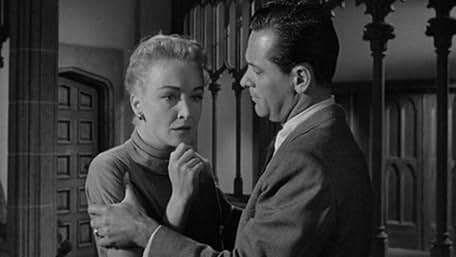
And, as always with such powerful men, the women behind them suffer: Mary Walling (June Allyson) fears her understanding husband will turn into another Bullard; secretary Eva Bardeman (Shelley Winters) fears her lover Dudley will dump her; major stockholder and member of the board Julia Tredway (Barbara Stanwyck) becomes suicidal when she learns her once-lover Bullard is dead; and executive secretary Erica Martin (Nina Foch) watches quietly to see who will be her next boss.
RELATED | Click for more 1950s movie reviews

Listening to director Oliver Stone’s mixed-bag commentary for Executive Suite‘s disc, one might be tempted—at first—to buy his assertion that the movie is primarily a socio-economic treatise on business in 1950s America, masquerading as a high-powered drama. Certainly the opening visuals suggest that possible theme, with the stark, quiet shots of the tall Wall Street towers as a bell ominously tolls: American commerce as religion (the interiors of the Tredway Tower go further, with its gothic stonework and arches, and an executive loft not at all unlike a pulpit).

As well, Holden’s final idealistic plea for “people-over-profits” before the board at the movie’s well-staged boardroom showdown is taken by some as the movie’s central theme, where Holden makes that familiar, consensus-building 1950s moviemaking pledge of the melding of science and heart as the answer to America’s spiritual/business woes (a message not at all unlike Henry Fonda‘s display of superior scientific logistics and corresponding saint-worthy humanity, to build the consensus of a “not guilty” plea in 12 Angry Men).
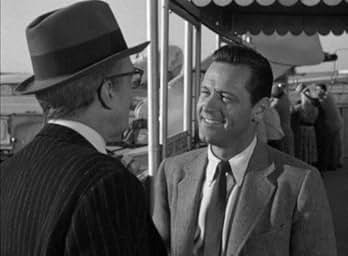
However, I don’t think Executive Suite‘s screenplay or its direction is really as concerned with what may or may not be undoing American business, as it is with presenting a superior soap, masquerading as an ideological war between profit-obsessed CPA March and quality-obsessed scientist Holden. Just as M-G-M’s entertaining 1947 melodrama The Hucksters was really more about Clark Gable and Deborah Kerr’s romance, rather than a complete attempt to skewer the relationship between advertising and the media, Executive Suite is exceptional melodrama first, rather than cautionary social message (if at all).
Just on hunch alone, if M-G-M suit Dore Schary and specifically hambone liberal producer John Houseman wanted a true “message movie” first, they wouldn’t have spent all that dough on such a large, all-star cast (the similar, harder-hitting Rod Serling message movie, Patterns, only bothered to muster up B-tier Van Helfin). Closer examination, though, reveals that for all of Executive Suite‘s talk about business, it’s talk that boils down to generalized observations that certainly weren’t even close to new in 1954 (Executive Suite‘s themes were being argued as soon as mechanized assembly lines revolutionized American production methods).

Holden’s end-game lecture is big talk, but it really only differs from March’s approach in terms of aesthetics and an extra screw for each table leg. He still wants profits (dirty capitalist!), and his desire for “simplicity” and “beauty” micro-budgeted down to the fraction of a penny through science…sounds like the beginnings of a very nice line of robot-produced IKEA tables.
Anyone buying as “real” the sunshine and lollipops that Holden promotes at the end of Executive Suite has to be dreaming. Funny how liberal director Stone doesn’t mention destructive unions and cheap foreign imports in his weirdly jumbled-up defense/attack of paternalistic 1950s factory management (he’s kinda smart sometimes…but mostly seriously dumb).

It’s hard to take a multi-millionaire “artist” seriously who frequently lets loose with howlers like, “At the heart of all money is a crime,” and “There is no truth,” but I do want to acknowledge Stone’s genuine appreciation on this commentary track for Hollywood’s golden era and the obvious pleasure he takes in repeatedly—and rightfully—praising performers and filmmaking styles from a time period that are normally snorted at by other contemporary artists of his political bent. And that’s what’s so fascinatingly screwy about him; here’s a guy that clearly loves old Hollywood and the “Hollywood happy ending,” and sees that artistic conceit as culturally valuable to emulate (he laments that as a society we no longer do so) while at the same time he publicly praises dictatorial murderers like Castro and Chavez (maybe it was all the drugs…).

Executive Suite‘s multi-faceted, intricate plot machinations of the various power struggles both in the boardroom and the bedroom, are frankly more compelling than any discussion about widgets and the state of the souls of the men who make them, with the romantic angles taking up just as much screen time as talk about profits and veneers (patrons buying tickets to see gorgeous superstars Holden and Alyson—no wonder Dean Martin was banging the s*** out of her every chance he got—weren’t looking for an economics lesson). Executive Suite‘s plot points are indeed tempered with exceedingly good taste…but they’re melodrama, just the same. And expertly executed melodrama, at that.
First and last, Executive Suite is about the melodrama (the main supplier here being the superlative Stanwyck) and the romance, not the tabletops and the ledger sheets and the proletariat’s pride. If you’re looking for “truth” about the decline of 1950’s American manufacturing sector in Executive Suite, you probably got your economics degree from Bullwinkle’s old alma mater, Wossamotta U.
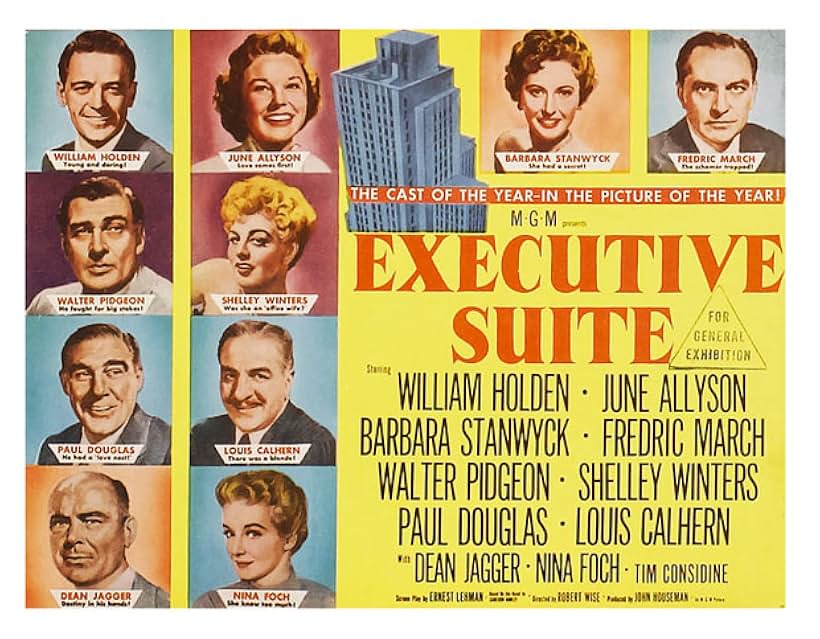
With that cast and that gloss, and all those easy generalities about “quality versus quantity,” it’s much better to just enjoy the pleasurably complex, insightful machinations of Executive Suite‘s power struggle plot, as well as the first-rate performances of the romantically-challenged couples, rather than try and glean anything terribly insightful about rapacious big business and America’s decline (leave that to the media every time their boy isn’t in office).

Read more of Paul’s movie reviews here. Read Paul’s TV reviews at our sister website, Drunk TV. Visit Paul’s blog, Mavis Movie Madness!…but mostly TV.
 Movies & Drinks
Theall star cast concept does not work for me, and ther ei snothgn wrong with the scenario. Pointedly the only actual star is Wiliam Holden, the others are past,especially Barbara Stanwyck who really stopped being astar in pictgures when she played thing like Sorry Wrong Number, a radio show that wasted Burt Lancaster.
LikeLike