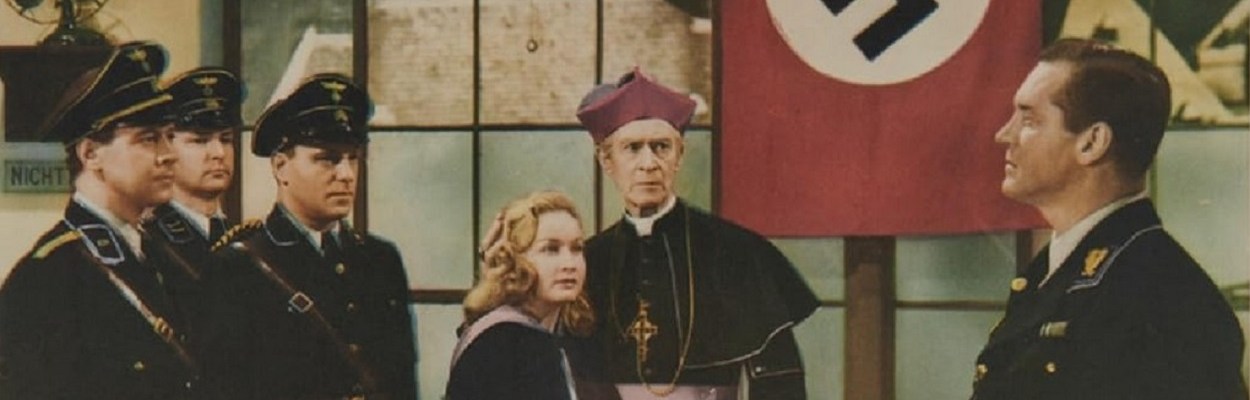
In my very few moments of sobriety, when the background fuzz partly clears and gives way to bits and pieces of actual audio/visual information that land, one of the constant drones I encounter lately is that I’m no longer living in a democracy (which is curious…since we’ve always been a constitutional republic), but rather a fascist state run by a slobbering, incontinent, half-mad dictator.
Dazed into sullen incomprehension, I shake my head to clear the cobwebs, and understandably respond, “but I thought Biden was gone?”…only to blissfully slip back into my semi-permanent vegetative state, as the black ink swirls around my head, bringing blessed oblivion.
By Paul Mavis
So. Since there’s a co-ordinated attempt to convince us that Der Fuhrer-Lite is running the show, I thought it might be instructive to look at some classic “B” programmers from WWII America, where audiences were given a glimpse at what true fascist oppression looks like (as opposed to today’s dire situation, which roughly translates into, “I going to scream, ‘America is coming apart!’ while doing my bit to help destroy it, simply because my side didn’t win and I always get my way!”). Let’s look at a couple of winners from 1943: Hitler’s Madman from Douglas Sirk, and Edward Dmytryk’s Hitler’s Children.
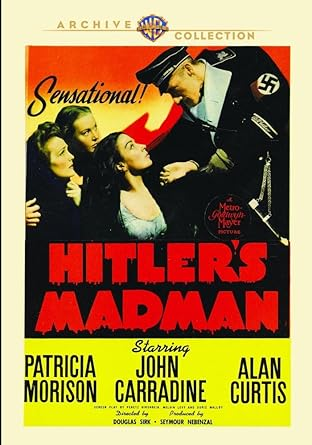
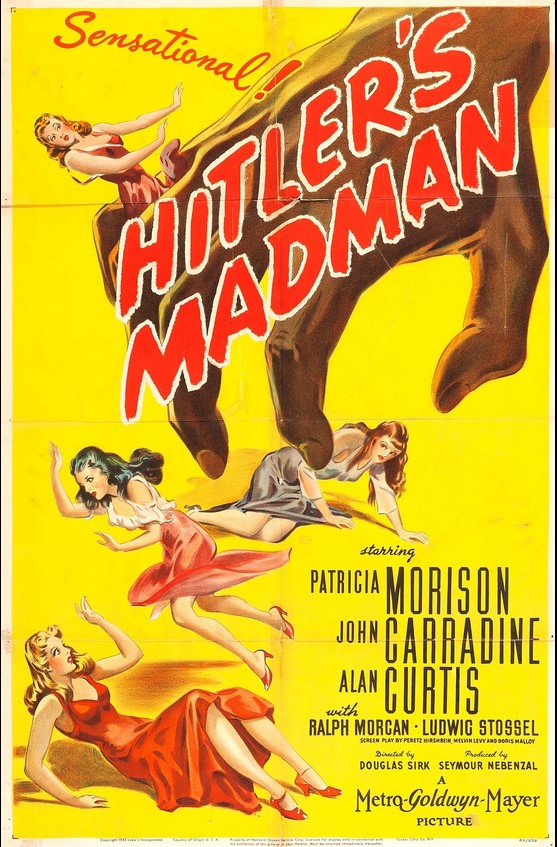
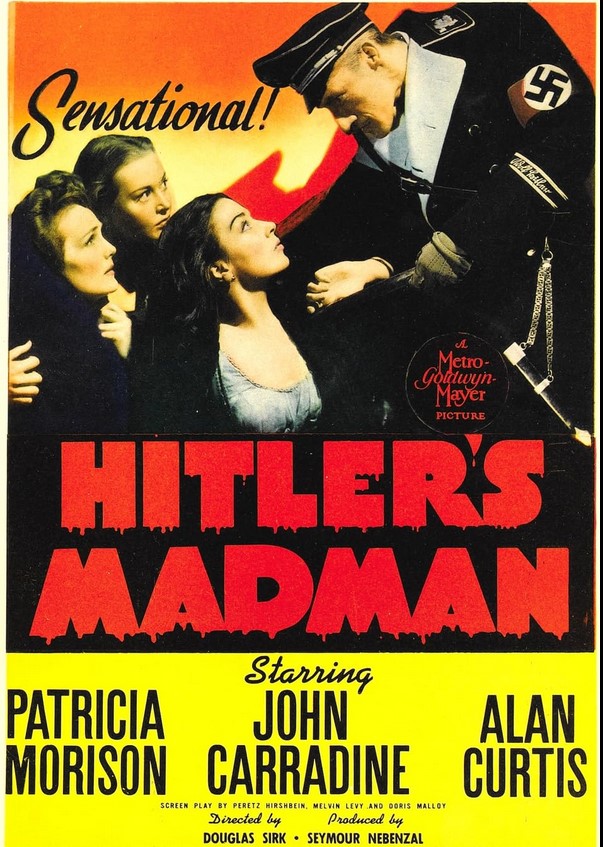
A few years back, Warner Bros.’ Archive Collection released Hitler’s Madman, the 1943 Producers Releasing Corporation /Metro-Goldwyn-Mayer co-production directed by Douglas Sirk and starring Patricia Morison, John Carradine, Alan Curtis, Howard Freeman, Ralph Morgan, Ludwig Stossel, and Edgar Kennedy. A brutal B-programmer concerning the infamous WWII atrocity—1942’s Operation Anthropoid, where Czech assassins took out SS-Obergruppenfuhrer Reinhard “the Butcher of Prague” Heydrich, and the resulting horrific Nazi reprisals against the city of Lidice—Hitler’s Madman mixes director Sirk’s complex subtextual concerns with straight-ahead (for its time) horror, in a B shocker that still packs a considerable punch.
Click to order Hitler’s Madman on DVD:
(Paid link. As an Amazon Associate, the website owner earns from qualifying purchases.)
In the occupied Czechoslovakian village of Lidice, a small farming community 20 miles outside of Prague in the Nazi Protectorate of Bohemia and Moravia, life for the citizens is simple: do what their German overlords say…or else. Young people like brother and sister Rupert (John Good) and Jarmila Hanka (Patricia Morison) pray for deliverance and freedom, but their father, Jan (Ralph Morgan), like the rest of the scared townsmen, advises caution: peasants like themselves have survived one yoke or another for centuries.
Ex-patriot-turned-English guerilla fighter Karel Vavra (Alan Curtis) has other ideas. Parachuting into his old hometown, Karel’s mission is to bring hope to the townspeople by stirring them into action; if millions of American and English boys are leaving their farms to fight for Czechoslovakia’s freedom, then the Czechs must do their part, too…with sabotage. Childhood sweetheart Jarmila is game, but the rest of the townsmen chicken out, conveniently abiding by the town priest Father Semlanik’s (Al Shean) balm that God is with those who suffer in silence.

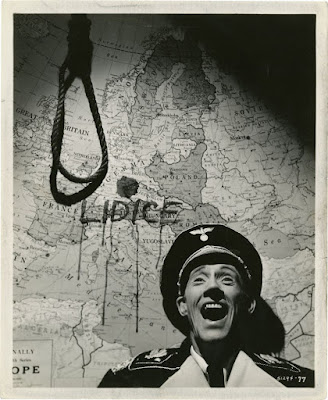
That silence is soon shattered when Bohemia and Moravia’s Gestapo “Reich Protector,” Reinhard Heydrich (John Carradine), decides that Lidice’s obedience isn’t “total” enough. Inhuman brutality follows, as Reinhard “the Hangman” Heydrich orders the execution of young father Anton Bartonek (Richard Bailey); the forced white slavery of pretty Prague college students like Clara Janek (Jorja Curtright), who jumps to her death rather than suffer the rape of hundreds of German soldiers; and finally the execution by Heydrich himself of Father Semlanik.
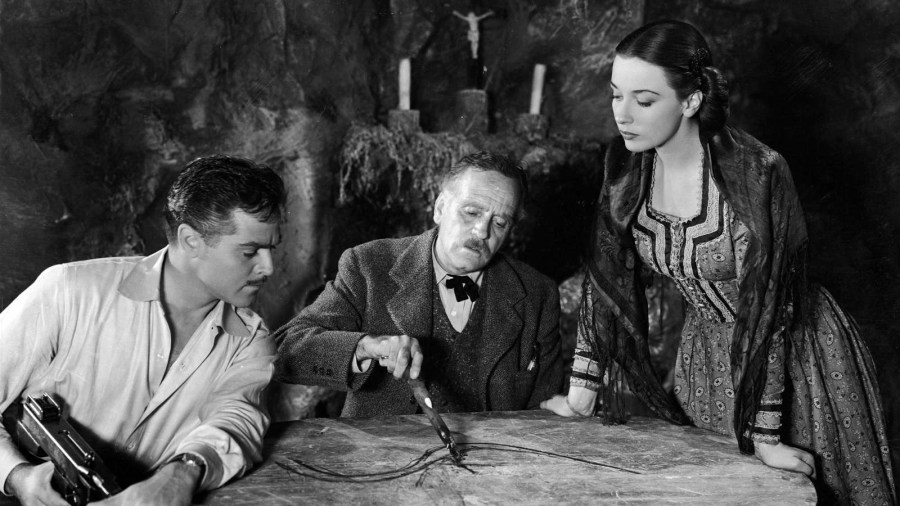
Now it’s time for the village to fight back, beginning with Clara’s father (Victor Kilian) blowing up the town’s mine and himself (depriving the Germans of much-needed coal in the process). Ironically, it’s Mrs. Marta Bauer (a moving Johanna Hofer), the grieving wife of German town mayor/weasel Herman Bauer (Ludwig Stossel), having just lost her two solider sons to the Fatherland, who tells Jan Hanka where the hated Heydrich will be on a certain fateful morning: on a deserted part of the road outside of town, where a car has to slow down to a crawl to navigate the turns. When Jan, Jarmilla, and Karel succeed in zapping Heydrich, they have no idea what’s in store for them…or for the village of Lidice.
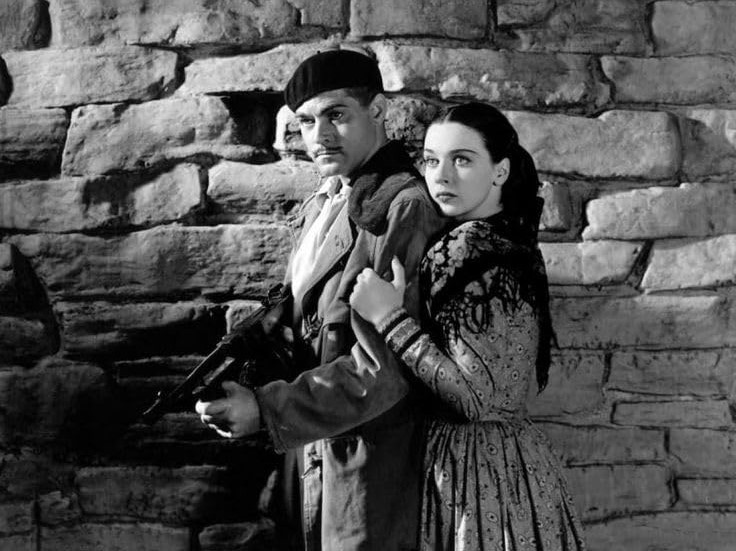
The raising of Lidice and the almost total slaughter of its inhabitants elicited worldwide revulsion when its story was brazenly touted by Hitler’s Third Reich in June, 1942. Widely-feared SS officer Heydrich, a chief architect of Hitler’s “Final Solution,” was an embarrassingly high-value target to get taken out by opposition guerrillas, so an enraged Reich Furher Adolph Hitler and SS Chief Heinrich Himmler believed an overpowering response was needed to quell any potential rising tide of rebellion among the Reich’s occupied people.
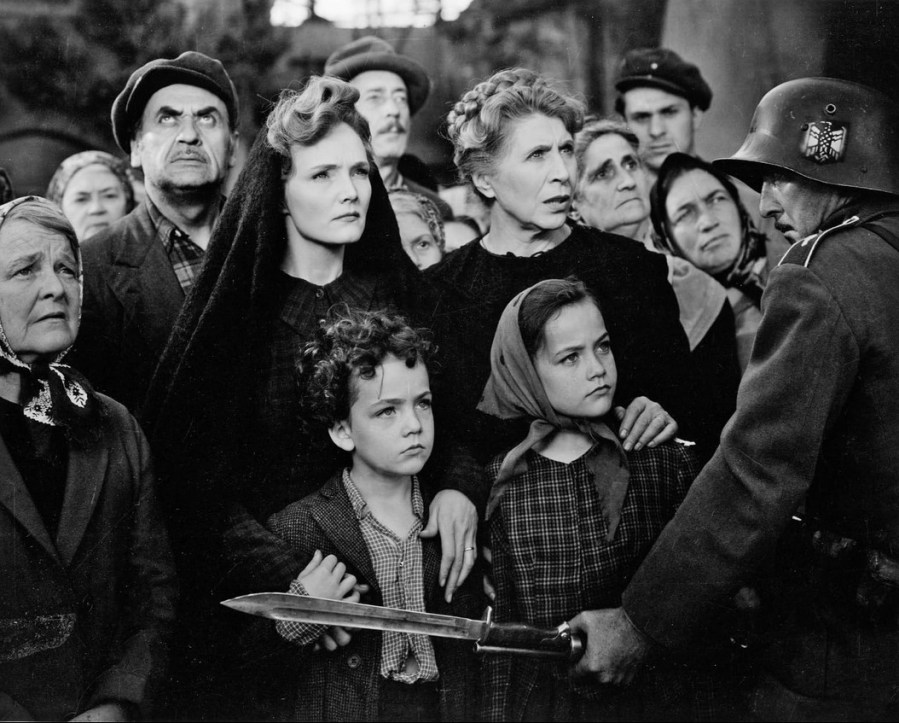
When incorrect Gestapo intelligence linked the towns of Lidice and Lezaky to the British Special Operations Executive-trained Czech guerillas that killed Heydrich, reprisals against both towns were sickening in their barbarity: all males over 16 were summarily shot; the women of Lezaky were also killed while the women of Lidice were sent to concentration camps where most later died, as were all the children (81 of whom were gassed immediately).
Every last animal in the villages was slaughtered, and both towns were completely razed, with Lidice’s remains covered in soil and planted with crops,as if it never existed. Final death toll: over 1,400 people taken in revenge for Heydrich’s assassination. It was an atrocity particularly stunning in its heartless calculation, during a time of seemingly daily similar outrages (after reading this description of just one of the thousands of similar Third Reich atrocities: if you’ve posted online that “Trump is a Nazi,” you should be thoroughly ashamed of yourself…which I highly doubt you will be).
And so of course, this tragedy, unapologetically, was a natural for Hollywood exploitation. What gives Hitler’s Madman a decided weight over similar programmer fare of the time is its florid-yet-deadly serious tone, no doubt due to the people involved in the production, many of whom were refugees themselves from Nazi Germany—first-hand witnesses to the nightmarish German state.
RELATED | More 1940s movie reviews
Producer Seymour Nebenzal (Lang’s M and Pabst’s Pandora’s Box), uncredited co-scripter and production designer Edgar G. Ulmer (The Black Cat, Detour), story writer Emil Ludwig, cinematographer Eugen Schufftan, and of course brilliant director Douglas Sirk, had all been forced out of Germany when Hitler and the Nazis came to power (half of the tiny budget for this programmer was reportedly supplied by a Germany emigre to the States).
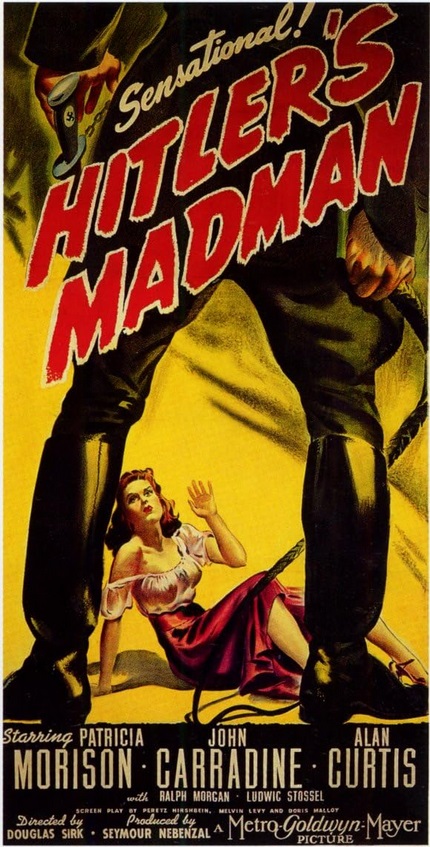
That this low-budget Hitler’s Madman (shot in seven days just four months after the real events by Nebenzal’s tiny Angelus Pictures indie, through PRC) struck some kind of powerful chord with the bigger studios—if not morally, then at least financially—is evident when first Republic Pictures took out an option to release it, and then Metro of all places, a then-unheard of proposition for the Tiffany studio (Louis B. Mayer was fanatical about what he slapped Leo the Lion on…and that never included cheapjack, out-of-house product).
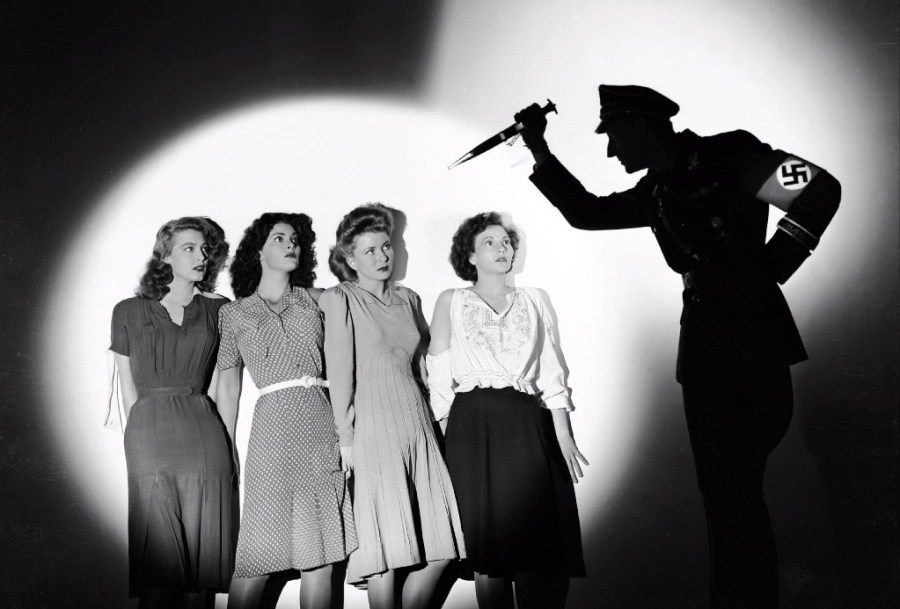
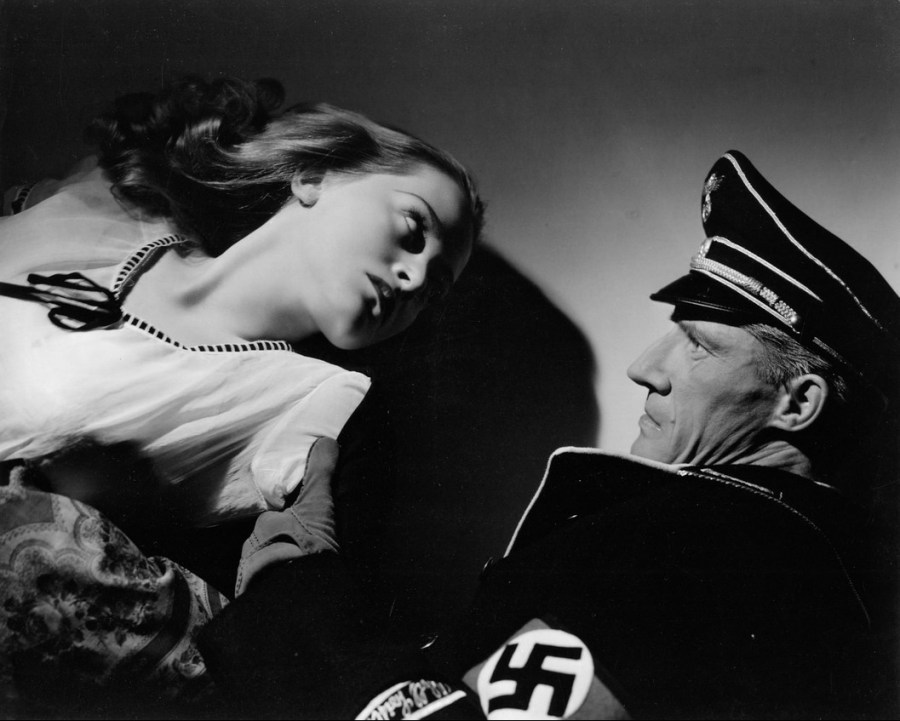
Mayer promptly remedied that situation by ordering retakes and added scenes, plugging into this new material a little self-promotional cheesecake, as well, with gorgeous Metro starlets Ava Gardner, Leatrice Gilbert and Mary McLeod sexually threatened by Nazi Carradine. All this tinkering led to Hitler’s Madman getting beaten to the punch by United Artists‘ similar Hangmen Also Die!, which came out in March, 1943. Sirk’s movie, however, did solid business (in the face of unimpressed reviews), and is now arguably the better-remembered of the two.
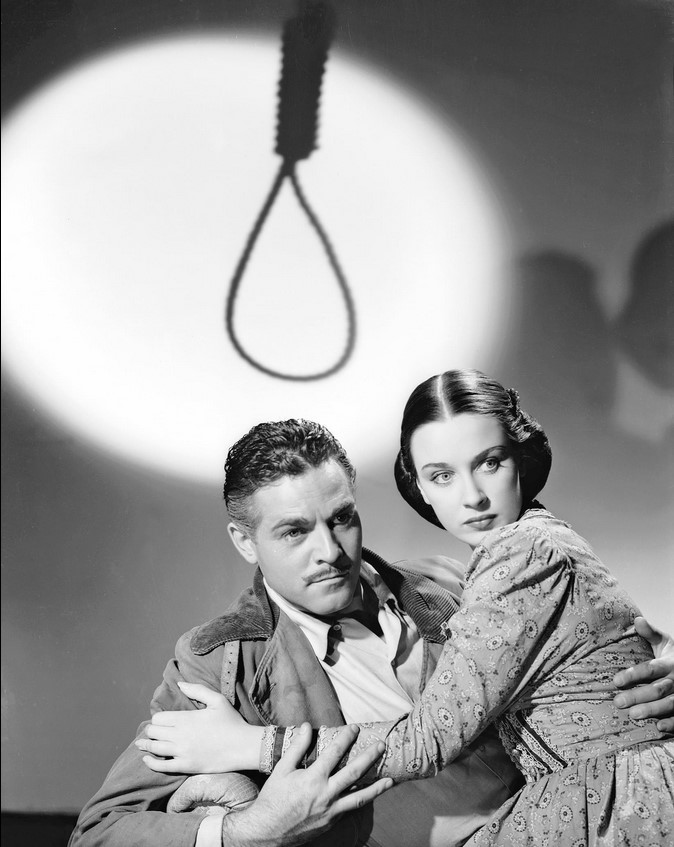
Seen today, Hitler’s Madman has not only a lurid, pulpy drive to it that’s certainly unusual for a Metro B of the time, it also features a fairly sophisticated, layered subtext that’s typical of Sirk, even at this early juncture of his Hollywood career. While the movie’s opening should give anyone pause, as narrator Carey Wilson intones Edna St. Vincent Millay’s banal The Murder of Lidice, Sirk quickly establishes that Hitler’s Madman is going to be more than just cardboard speechifying and crude propaganda.
In the Hanka household, the tense dynamics between the cowardly, resigned father and his yearning-to-be-free children is just the first of many such fraught families, battling along generational lines, that Sirk would depict in his subsequent American dramas. Sirk’s and the screenwriters’ take on appeasement and the threat of violence may at first glance seem equally complicated, but it plays out as bracingly simple (particularly viewed against today’s dangerous, quivering “moral equivalency” movement).
It takes the murder of innocent, brave Father Semlanik for Jan to finally realize that “those who suffer in silence” will suffer in vain; that his younger days of searching for the gray between the black and white of all issues and problems, doesn’t work when the stakes with the Nazis are so stark: kill or be killed. Sirk drives this home with one of Hitler’s Madman‘s most grotesque—and grotesquely funny—scenes. As stolid German dope Mayor Bauer is himself dragged off by the Gestapo, after giving his two boys’ lives for the Fatherland, his frenzied, terrified response perfectly captures the idiocy of pledging misguided loyalty to a murderous regime that will eventually turn on its own, should it prove convenient: “Mama! Mama! They’re taking me! Heil Hitler! Heil Hitler!”
And while one or two scenes smack of tawdry men’s magazine titillation (the Metro-demanded scene of the young girls lined up for sexual inspection), Sirk and the screenwriters give unexpected shading to most of the exploitation proceedings here. Ironically, another Metro scene—Heydrich’s death—tricks us into thinking that he’s having a change of heart, declaring he doesn’t want to die for anyone, including Hitler, while predicting Germany will lose the war.
However, we’re yanked back to reality when he states his only mistake was not killing nearly enough Czechs in reprisals. Hitler’s Madman‘s fade-out may strike some as hopelessly melodramatic, as the ghostly victims address the audience through the fires of Lidice’s remains, declaring they will prevail. However, Sirk’s determination to keep Hitler’s Madman‘s tone relentlessly grim from the start (the screams of the women being dragged off to the camps will chill you in their realism), allows it to be a powerful coda that works perfectly within his brutal, outraged narrative schematic.
Far more pulpy—but no less serious—RKO’s 1943 smash WWII meller, Hitler’s Children has everything: home-grown Nazi horrors. Doomed romance. And Nancy Drew’s fertility threatened by the Fuehrer. Sensationalism directed with lurid eye by Edward Dmytryk and starring Tim Holt, Bonita Granville, Kent Smith, Otto Kruger, H.B. Warner, Lloyd Corrigan, Erford Gage, Hans Conried, Gavin Muir, and Nancy Gates, Hitler’s Children quite simply delivers the exploitation goods for fans of “Golden Age” B programmers.
Click to order Hitler’s Children on DVD:
(Paid link. As an Amazon Associate, the website owner earns from qualifying purchases.)
Germany, 1933. A small, dusty Berlin lane—and mile-wide ideologies—separate the American Colony School, run by Professor Nichols (Kent Smith) where happy, laughing kids play baseball and ping pong, and the Horst Wessel School, where row after row of sullen, ramrod-straight Hitler-Jugend listen to lessons about how Germany was betrayed by the Versailles Treaty, and how the Fatherland must one day rule the world.
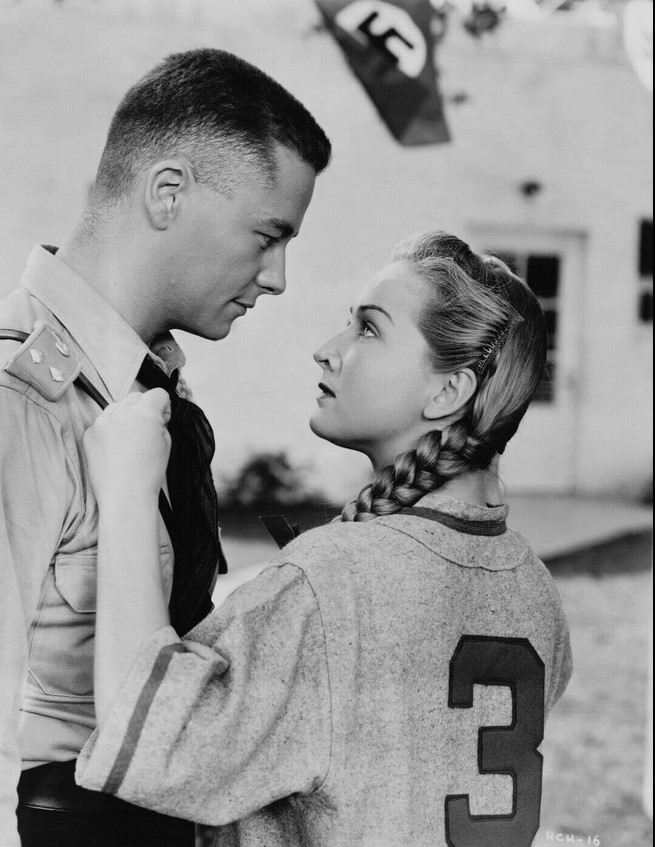
American-born but German-raised Karl Bruner (Tim Holt) can’t help but be attracted to German-born but American-raised Anna Muller (Bonita Granville) when she cracks him over the head with a baseball bat, an attraction Anna returns whenever Karl shows up in his Nazi-style hiking shorts. However, Sunday picnics with her and the Professor, and reams of freedom-loving Goethe can’t sway Karl from the Fuehrer’s grip, and he’s soon swept up in the storm of Nazism on the march.
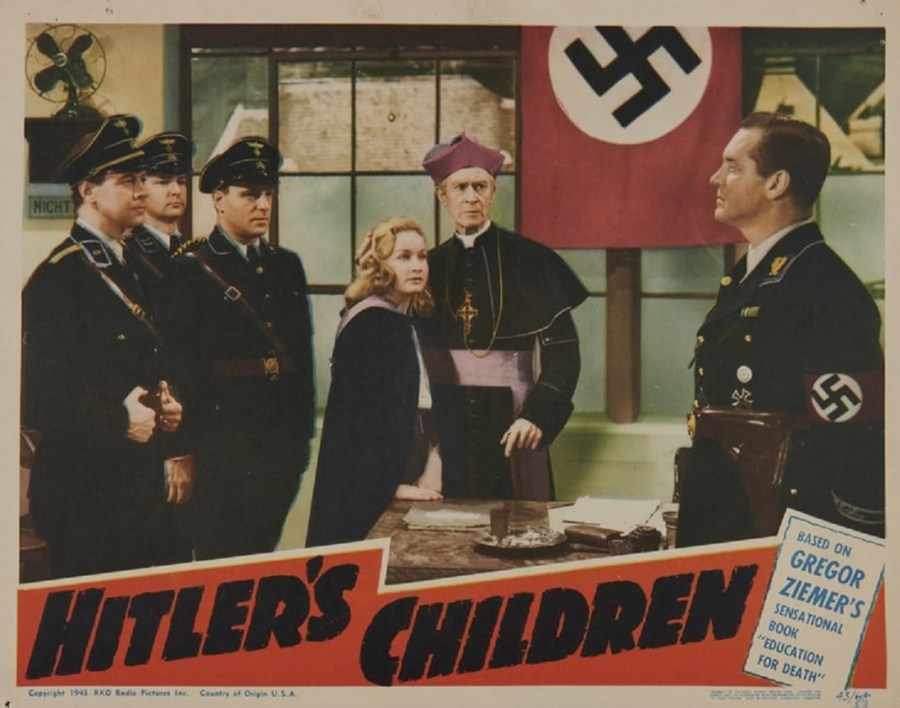
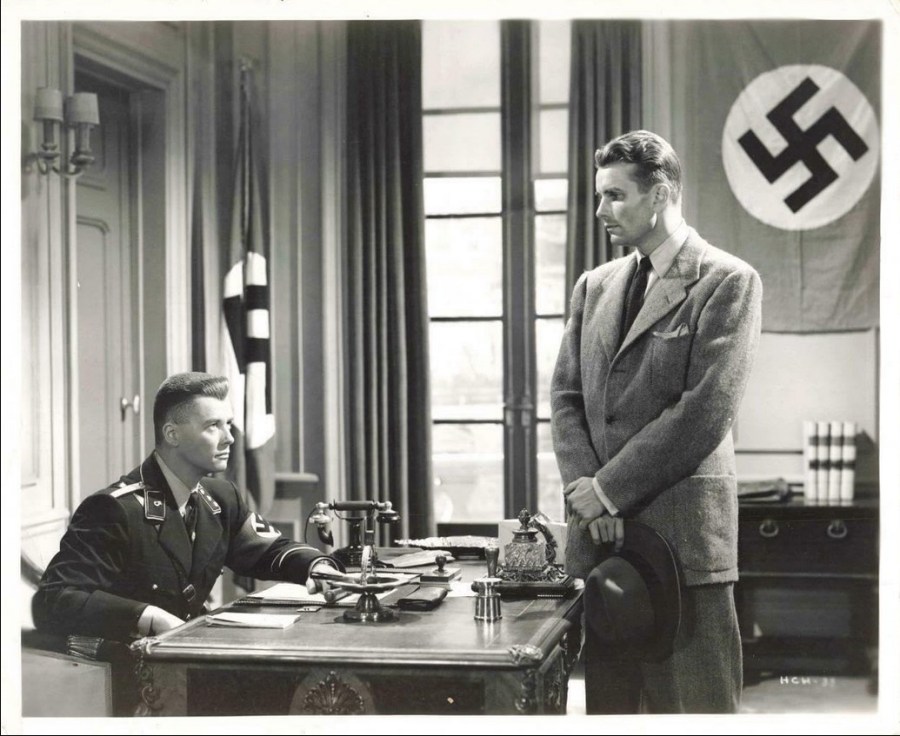
Germany, 1939. Lieutenant Karl, now an aide to silky, evil Gestapo Colonel Henkel (Otto Kruger), is drawn back into Anna’s world when Anna is declared a German citizen and forcibly removed to a woman’s camp where she’ll be trained as a mother/soldier for Germany. With the help of frightened journalist Franz Erhart (Lloyd Corrigan), Professor Nichols tracks her down, but she insists he leave her alone, lest he be punished—a sentiment seconded by a conflicted Karl.
When Karl tries to help make life “easier” for Anna by putting her name up for spy school, she balks, and is sent back to camp, this time as a common laborer. Karl, still in love, begs her to have his baby for the Fatherland, to save herself. Anna, still in love, refuses to have a child for the Fuehrer, and escapes the camp. Now on the run, will Anna and Karl find happiness in the Third Reich?
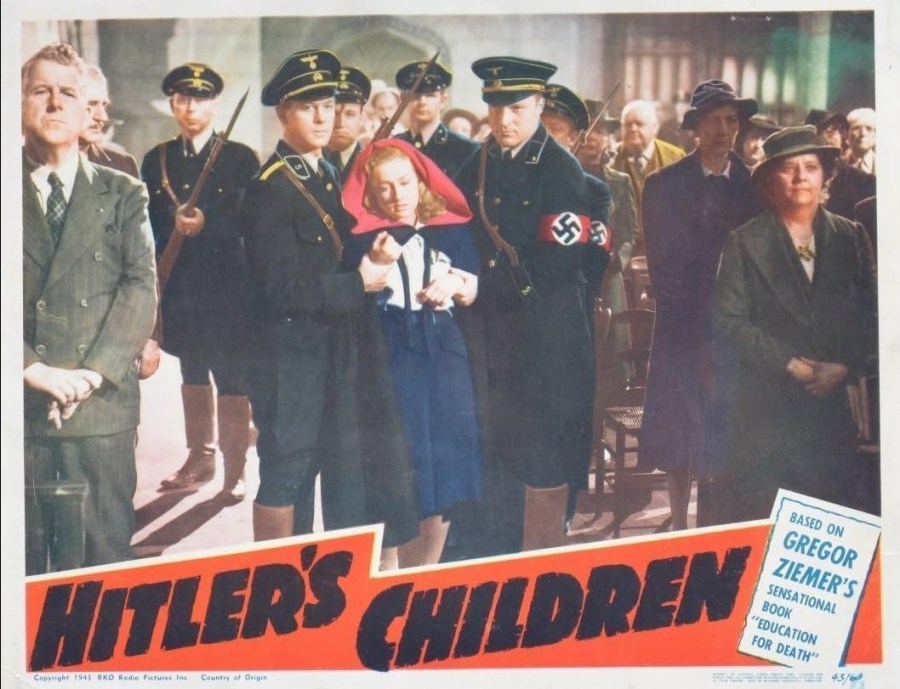
Hitler’s Children was a massive hit when released in January, 1943, bringing in for RKO over $3.5 million dollars in rentals (off an $8 million dollar U.S. gross), on a paltry $200,000+ budget. It was one of the top ten grossing movies of 1943, and certainly the most profitable (budget to gross ratio) movie in RKO’s history. Figuring out why a movie was such a boffo ticket seller is frequently a guessing game, particularly when so many decades have since passed (and back when there was little if any reliable audience data from the studios).
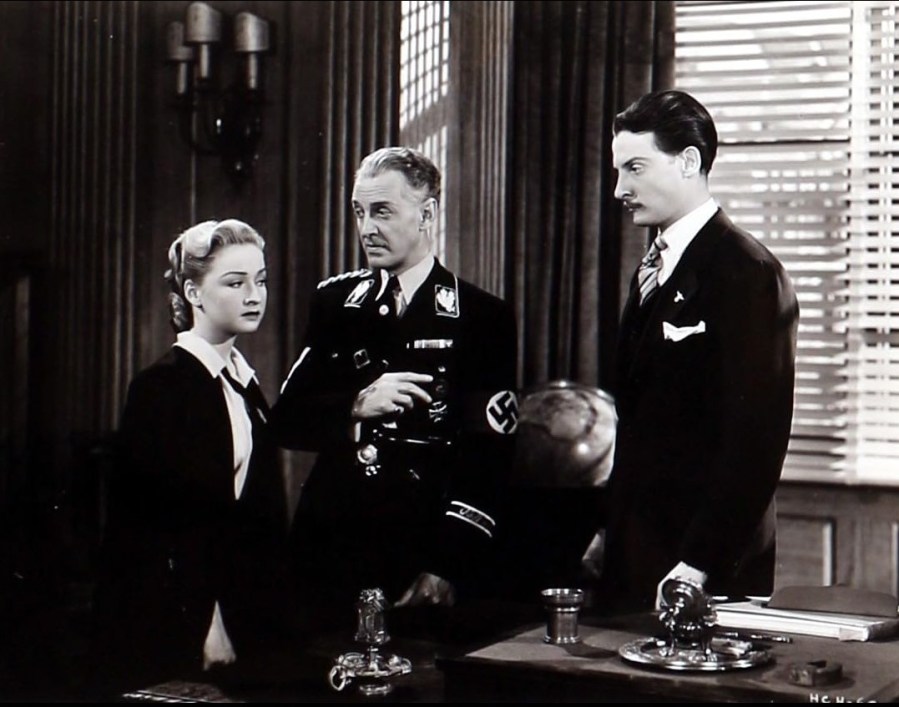
While it’s tempting to blow off Hitler’s Children as sensationalistic hyperbole that captured a titillated war-time audience, it’s important to remember the storyline had a basis in then-timely fact: it was very loosely adapted from journalist Gregor Ziemer’s well-regarded book, Education For Death, detailing his ten years as an American teaching school in Nazi-run Germany (anyone who’s read even a little bit about Nazi Germany will see that the “sensationalistic” material in Hitler’s Children comes off as positively quaint compared to what really happened there…while recognizing that calling America 2026 a “fascist state,” is a repulsive, grotesque lie).
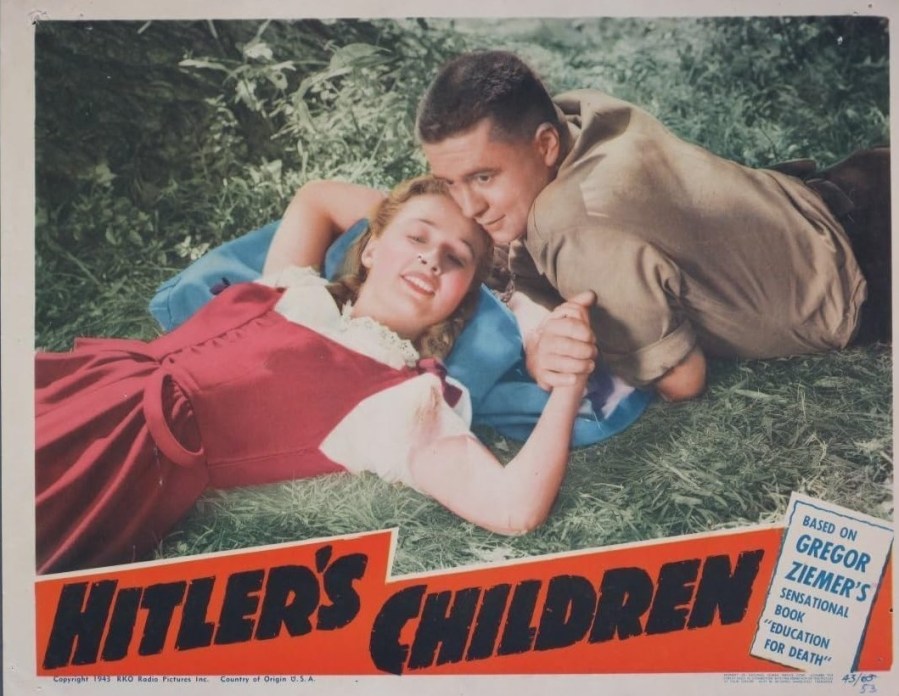
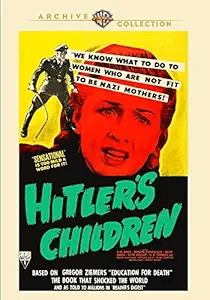
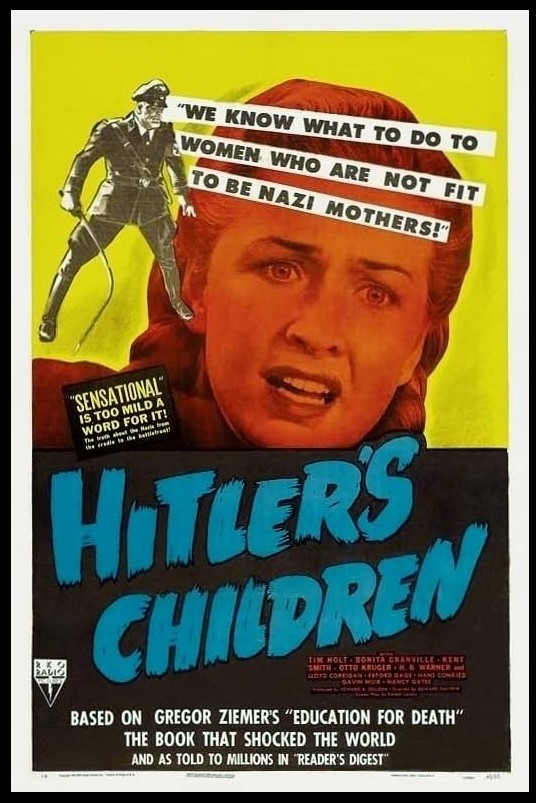
There’s no question, though, that RKO sold Hitler’s Children from a shocking mens’ magazine angle; the one-sheet movie poster copy screams, “WE KNOW WHAT TO DO TO WOMEN WHO ARE NOT FIT TO BE NAZI MOTHERS!” over the image of a jack-booted thug holding a whip (it could easily be an Argosy or True cover). But shocking melodrama alone probably didn’t account for this cheap B’s huge crossover appeal to A-level audiences and grosses; its doomed love affair between feisty, pretty Bonita Granville and wavering sadist/sensitive lover Tim Holt (the unfairly underrated Holt is terrific here) must have intrigued the increasingly female-centered home front audiences that didn’t mind a little Nazi perversion to spice up their dime store romance.
Except for one or two instances of obviously slipped-in Commie propaganda from admitted Reds Emmet Lavery and director Dmytryk (who took over for fired Irving Reis), the script sticks to a basic Nazi-meets-girl, Nazi-loves-girl, Nazi-loses-girl romantic melodrama framework, with a (now fading fast) all-American context of God-given individual freedom threatened by an all-powerful, dangerous State (“Hollywood Ten” Dmytryk wasn’t lying when he eventually turned rat for HUAC; Communist agit-prop was present in a lot of his early outings—just listen to a strident Granville calling for people to “unite,” because “the whole world is everybody’s business now,” after a fellow student questions the League of Nations’ worth).
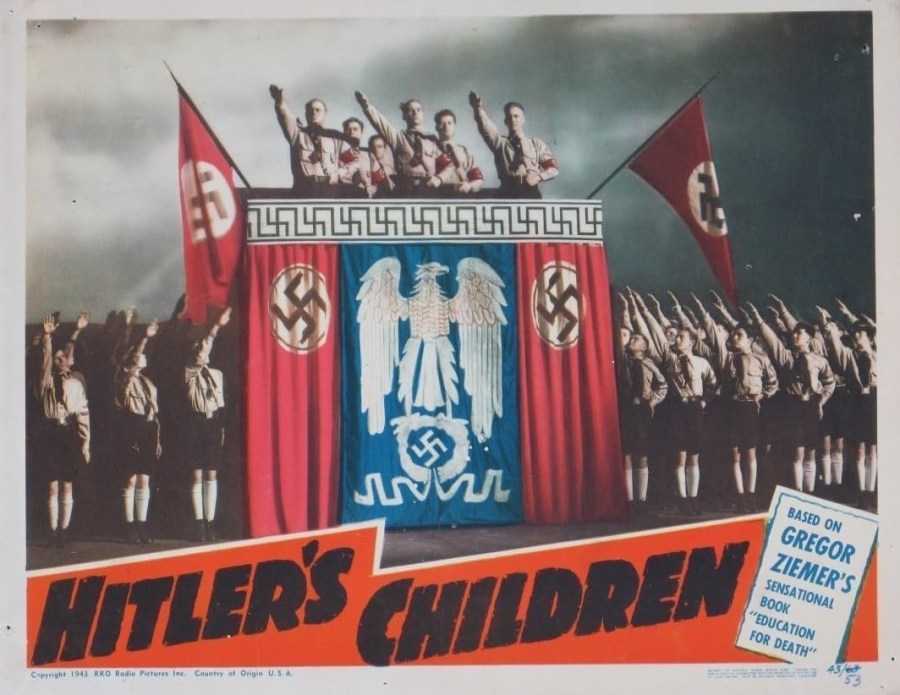
After director Dmytryk’s opening visual rip-off of a Leni Riefenstahl-style Hitler Youth consecration ceremony (cinematographer Russell Metty nails her fascist schematic, before turning to a noirish, high-key lighting design), scripter Lavery wisely pulls back with several humorous scenes…along with the unintentionally funny assertion from strangely passive narrator Kent Smith that Germany was, despite “some unpleasant moments,” “still a pretty nice place” right before 1933.
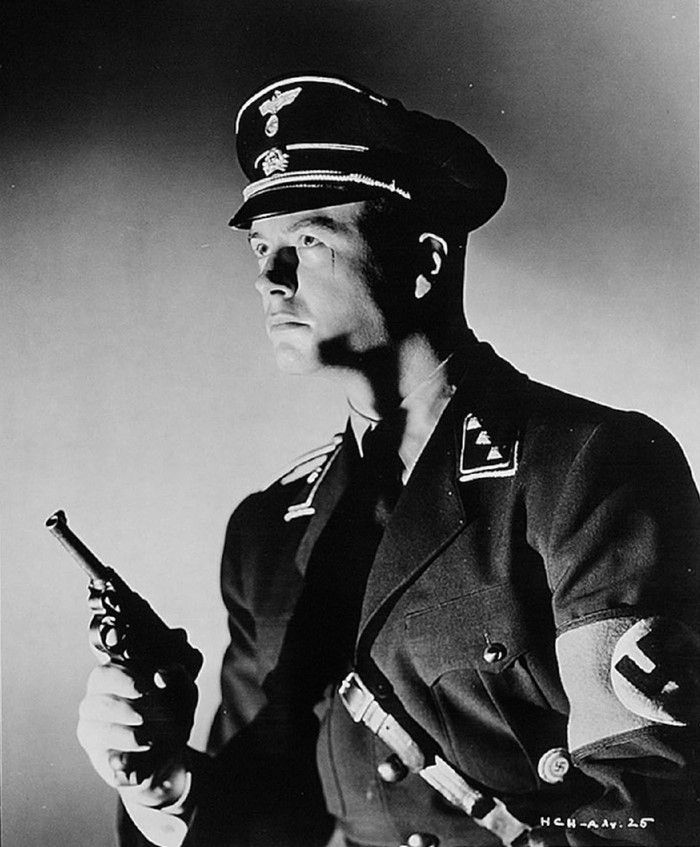
Granville and Holt “meet cute”—she tricks him with a “Heil Hitler” before bashing him—and the audience is effectively put off guard as to what tone Hitler’s Children is going to eventually strike. Gradually, Lavery and Dmytryk quite nicely start pulling out the rug from under the viewers’ expectations, building their uneasiness with an assured, steady rhythm as we’re shown how quickly the rot is spreading in Hitler’s Germany, where debts to the Fatherland are paid off by mothers having babies, only to have those Hitler Youth children grow up and terrorize their parents as they declare their undying loyalty to their Fuehrer.
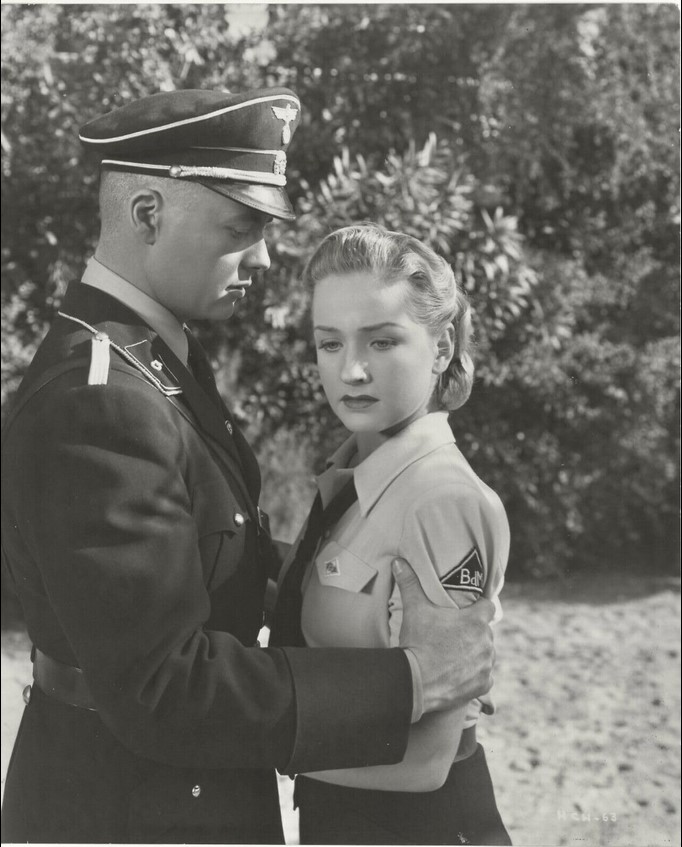
Beginning with S.A. officer Peter van Eyck demanding from Smith the custody of Polish, Jewish, and German students—including Granville—from the American school, and the American Embassy’s helplessness to rescue Granville from the clutches of the Nazi state, the movie effectively conveys a sinking feeling that things aren’t going to work out for pretty, increasingly threatened Granville.
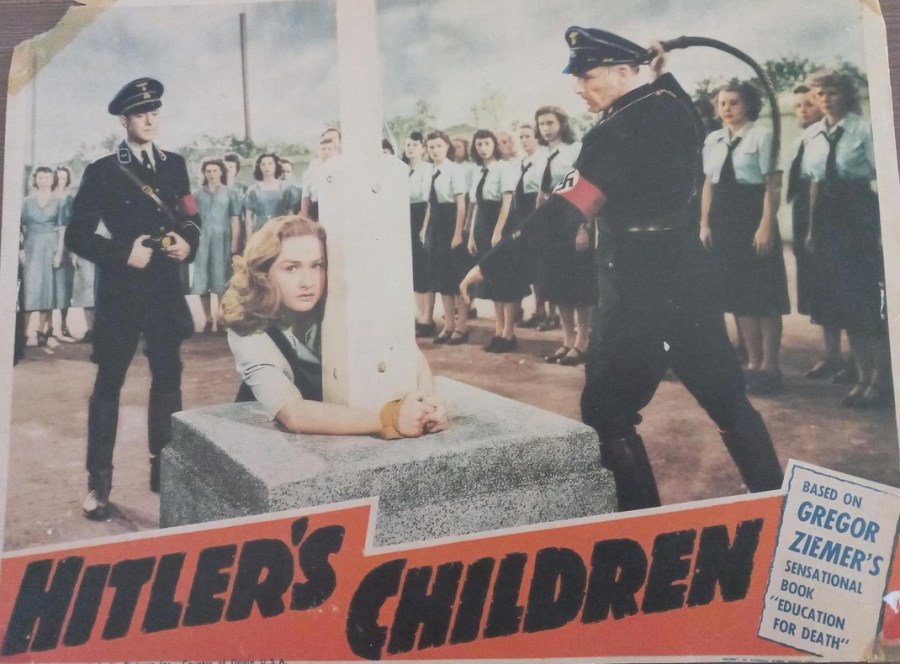
By the time fey Nazi manipulator Otto Kruger is leering at Granville, telling her he’ll find “duties for her that fit her…capacities,” and Holt asking her to have a child with him out of wedlock to save her skin (a pretty shocking suggestion to come from the “hero” in a 1943 movie), Hitler’s Children goes into full, deliciously pulpy exploitation mode, with trips to the sterilization hospital (where Kruger chillingly—and accurately—sums up the range of Aryan-determined “crimes” that can land a woman there: “color blindness to political thought”), culminating in Granville being tied to the whipping post, her shirt torn from her back, as lover Holt nods for a Nazi goon to begin the fun.
If Hitler’s Children had only been that, it would have made money, to be sure. However, the faintly ridiculous, marvelously swoony/tragic wrap-up that satisfies the viewer both romantically and propagandistically, is probably what kept word of mouth going so strong for this energetic, nervy little B.

Read more of Paul’s movie reviews here. Read Paul’s TV reviews at our sister website, Drunk TV. Visit Paul’s blog, Mavis Movie Madness!…but mostly TV.
 Movies & Drinks
You tied up all the loose ends beautifully.
LikeLike