We have a joke around the Mavis digs (besides myself) that whenever a royalty check from my publisher arrives in the mail, it’s even money at best that the postage paid will be more than the check amount…if a royalty is even generated that particular quarter. Such is the fate of the author of a spy filmography that may, indeed, be found in libraries all over the world…but, alas, on almost no one’s coffee table.
So imagine my surprise when just a few weeks ago, a rather ridiculously large pay-out (by comparison to the typical “.29 cents and 00/100 dollars” affront) landed. Had some poor befuddled college “film professor” (blecch) mistakenly selected it for his class’ required reading list? Had the CIA finally seen the light, and started issuing it as part of their “Junior Spy Supplies Kit,” along with the exploding chewing gum and that cool “De-vo” gun that Dennis Hopper used in Super Mario Bros.? Possibly.
Whatever the mistake, it did prompt me to do something I never do, and that is to take down my own forgotten copy of The Espionage Filmography, blow the inch of dust off the head block, and flip through it, just to see how spot-on my reviews were (and how misguided were–gulp–some of my pre-9/11 politics).
By Paul Mavis
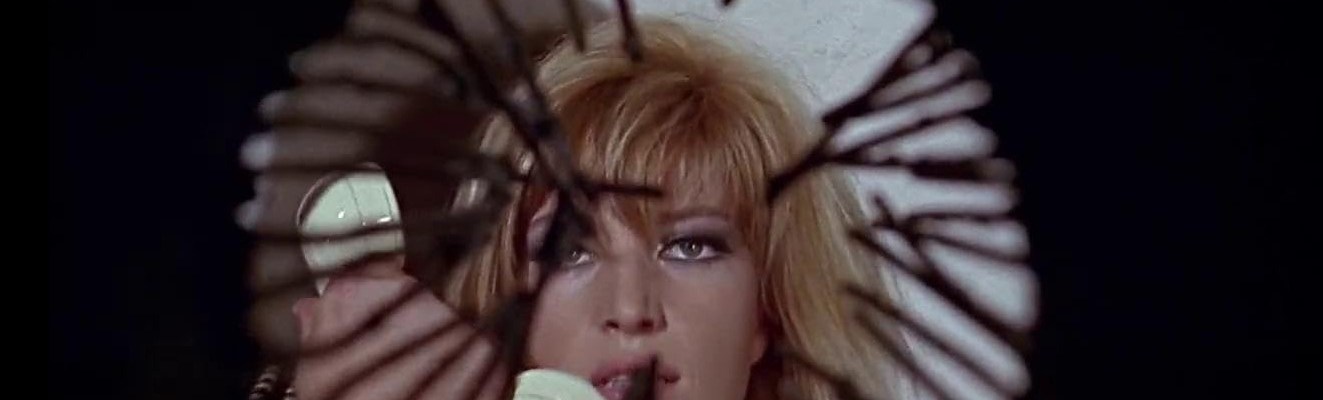
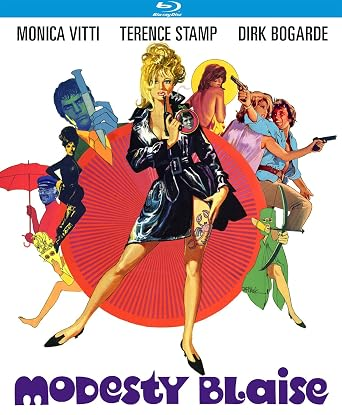
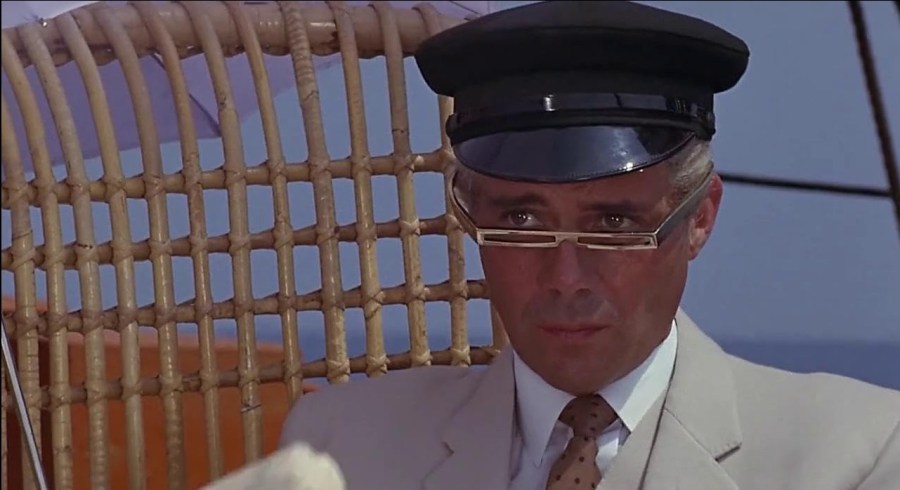
Being in a rather musty, grumbly mood, I had just re-watched several Joseph Losey titles, ending up, inexplicably, with Modesty Blaise (Kino Lorber released a nice Blu-ray a few years ago), his 1966 super-spy satire from 20th Century-Fox, starring Monica Vitti, Terence Stamp, Dirk Bogarde, Harry Andrews, Michael Craig, Clive Revill, Alexander Knox, Rossella Falk, Scilla Gabel, and Tina Aumont. Very loosely based on Peter O’Donnell’s wildly popular comic strip, Modesty Blaise was purposefully conceived by producer Joseph Janni and Fox as a potential big-budget Bondian franchise.
Click to order Modesty Blaise on Blu-ray:
(Paid link. As an Amazon Associate, the website owner earns from qualifying purchases.)
However, a badly miscast director (Losey ain’t exactly “Mr. Laughs”) and female star, stuck with a constantly fiddled-with script and a superficially flashy–but-ultimately-empty production, failed to generate positive notices and box office. Apparently, aside from Dirk Bogarde’s amusingly arch villain and some of the supporting cast, I didn’t have too many fond memories of Modesty Blaise when I wrote about it years ago for my Espionage Filmography book.
Watching it now, I’m less inclined to be so antagonistic about the waste of matching such an interesting director as Losey with the potentially rich material of a 1960s spy spoof…but that doesn’t mean I’m now going to say the movie works, either. Modesty Blaise is a failure (a verdict given by everyone speaking on the bonuses included with this Kino Blu-ray), but like many high-expectation movies featuring heavyweight participants that somehow miss their marks by a mile, Modesty Blaise can, perversely, be reverse-enjoyed for its numerous miscalculations.
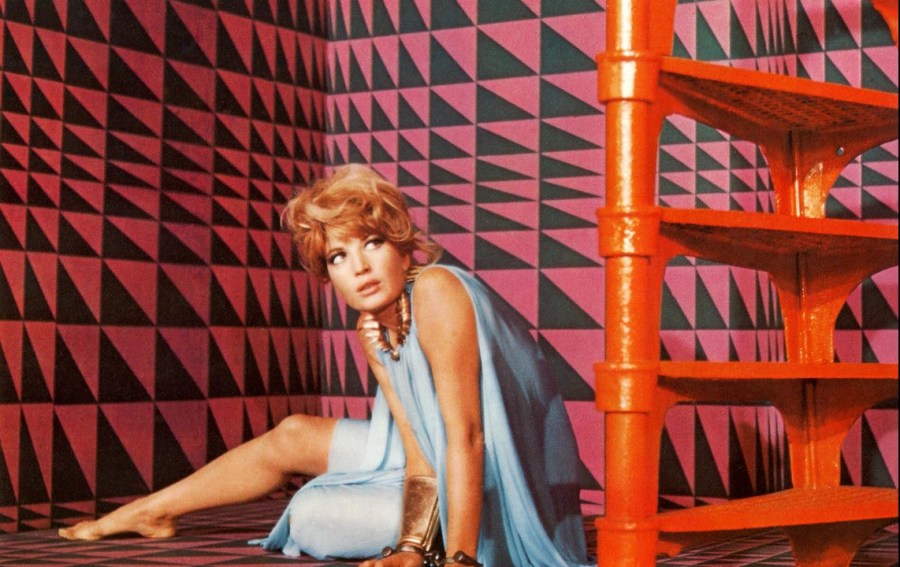
When English Secret Service’s “best man” (Robin Fox) is blown up in Amsterdam, British Minister (Alexander Knox) and Head of Service Sir Gerald Tarrant (Harry Andrews) now need a thief to catch a thief: international adventuress, Modesty Blaise (Monica Vitti). It seems someone wants to crab England’s oil concession deal with Middle East potentate Sheik Abu Tahir (Clive Revill) by swanning off with their $50,000,000 in diamonds payment.
Independent, supremely confident, absolutely deadly Modesty is wooed by Tarrant, and agrees to help, but on her terms: if she’s lied to, or double-crossed, she’ll take the diamonds herself. Her other condition? She demands the aid of an old, trusted friend: Cockney man-of-action, Willie Garvin (Terence Stamp).
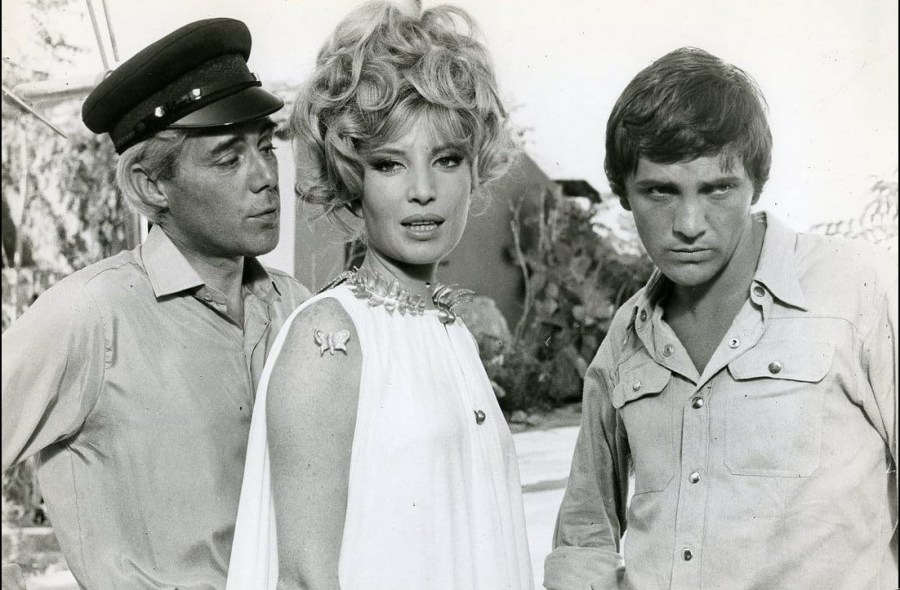
In Holland, Modesty reconnects with old flame and Tarrant’s second , Paul Hagen (Michael Craig), while Willie taps previous hook-up Nicole (Tina Aumont), both doing so in order to sniff out who’s working against the British. When arch nemesis/effete queen Gabriel (Dirk Bogarde) is revealed as the mastermind behind the proposed heist, and when Modesty discovers that Tarrant has lied in order to use the sexy spy and her sidekick as decoys, Modesty’s and Willie’s mission changes to one of profit…and payback.
It was inevitable that a movie version of British writer Peter O’Donnell’s internationally published comic strip, Modesty Blaise (with illustrations by Jim Holdaway), would be produced, particularly as it was launched right around the time the first big-screen James Bond adventure, Dr. No, was breaking box office records in the U.K.. According to several sources, the strip was a hot property soon after its newspaper debut, with British Lion Films contracting writer/director Sidney Gilliat to craft a movie version starring Julie Christie and Michael Caine (a mistake, I think, in casting cold, unsexy Christie).
In 1965, producer Joseph Janni bought the strip’s movie rights from Mim Scala (that producer wanted Barbara Steele–much better–and Michael Caine), for his clients Joseph Losey and Italian actress Monica Vitti. According to Michael Caine’s autobiography, his roommate, Terence Stamp, was offered Caine’s breakthrough role in Alfie, too, but took Modesty Blaise instead (one assumes it was a swap for the actor friends…one that worked out spectacularly well for only one of them).
Expectations for a Modesty Blaise movie were high. O’Donnell wrote the first screenplay, and then turned it into a novel, publishing it a year before Modesty Blaise was released, a novel that sold extremely well while receiving good notices—excellent promotion for the upcoming movie (O’Donnell subsequently disavowed the movie version, since all of his script work had been jettisoned).
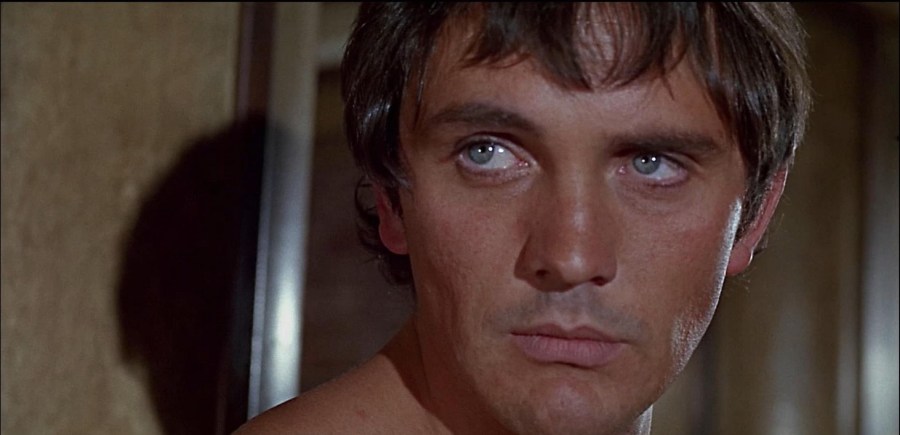
British-based American director Joseph Losey was coming off a string of art house smashes such as The Criminal, Eva, and The Damned, culminating in the one-two punch of the brilliant psychological drama, The Servant, and the well-reviewed military courtroom drama, King & Country, both starring Losey favorite, Dirk Bogarde. Relative newcomer Terence Stamp had become an international star with just two movies: 1962’s Billy Budd and 1965’s The Collector, for which he won the Cannes Best Actor award.
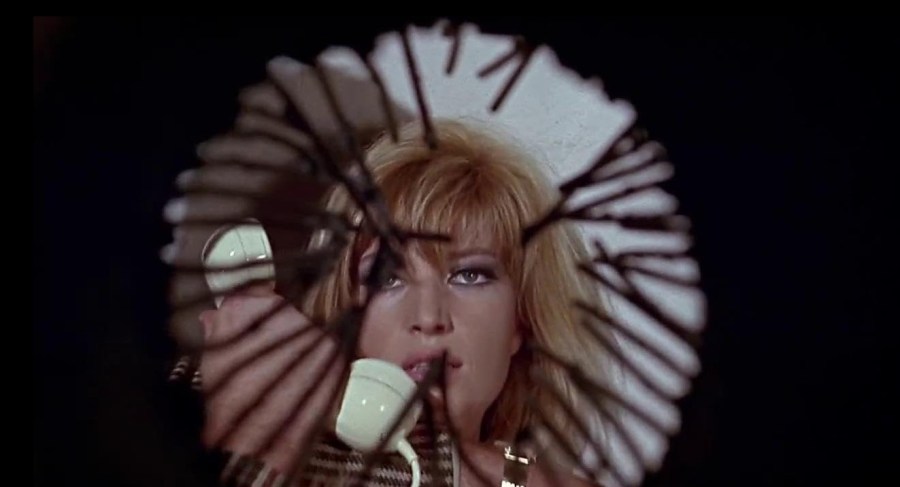
And headliner and Michelangelo Antonioni veteran Monica Vitti, a superstar in her native Italy and in European and American art house theaters (L’Avventura, Red Desert), was being touted as that rare combination of serious actress and sex symbol. All outward signs pointed to a potential big hit for Fox.
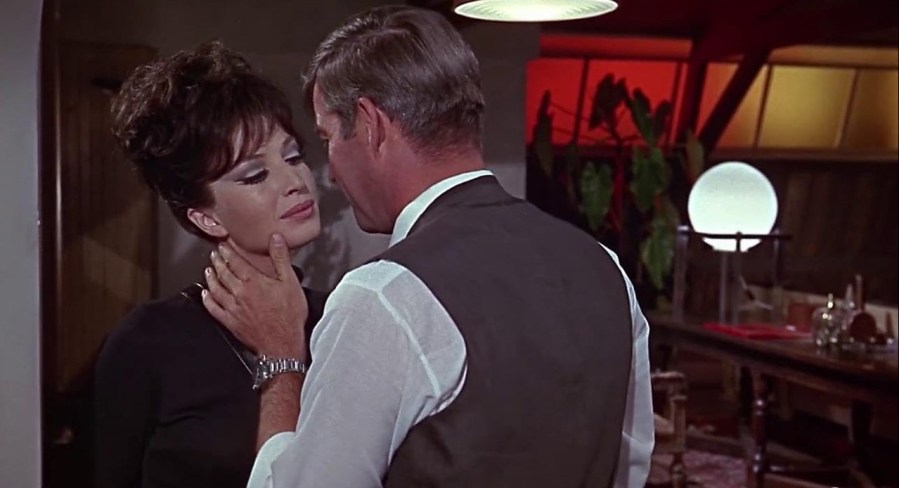
It sure didn’t work out that way. By almost all accounts from actors and crew members, Modesty Blaise was a chaotic, “troubled” production from day one, with Evan Jones’ (Funeral in Berlin, Night Watch) script being reworked daily, as the actors and the director became increasingly frustrated with each other (the general consensus: nobody but Losey thought the material was particularly funny).
When Modesty Blaise was rolled out to American screens in the spring and summer of 1966, it had already been beaten to the spy spoof punch a few months earlier by Fox’s own critical and popular smash hit, Our Man Flint, with James Coburn, and Columbia’s big money earner, The Silencers, with Dean Martin as Matt Helm. Grosses for Modesty Blaise were relatively anemic (once spoofs start coming out, ticket buyers only want to see so many, and that’s it), and the critics were nonplussed, with many perplexed as to what the hell Losey was doing directing this kind of material…and then directing it so badly.
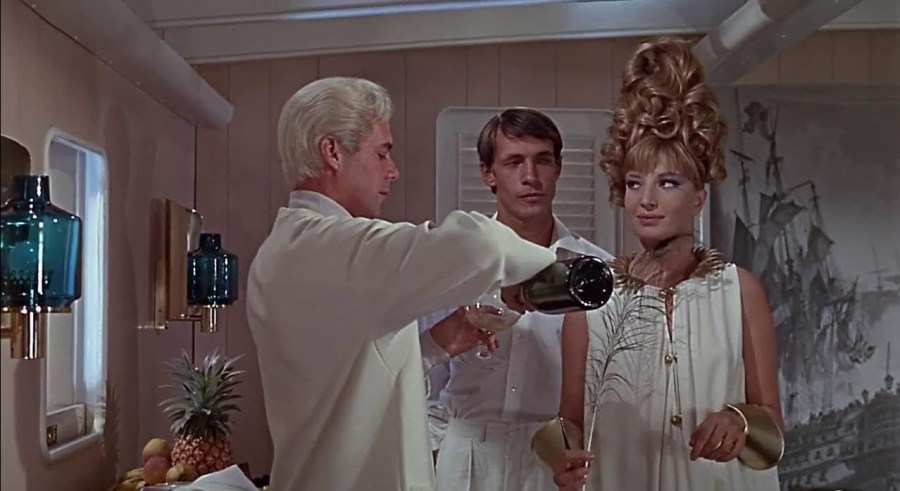
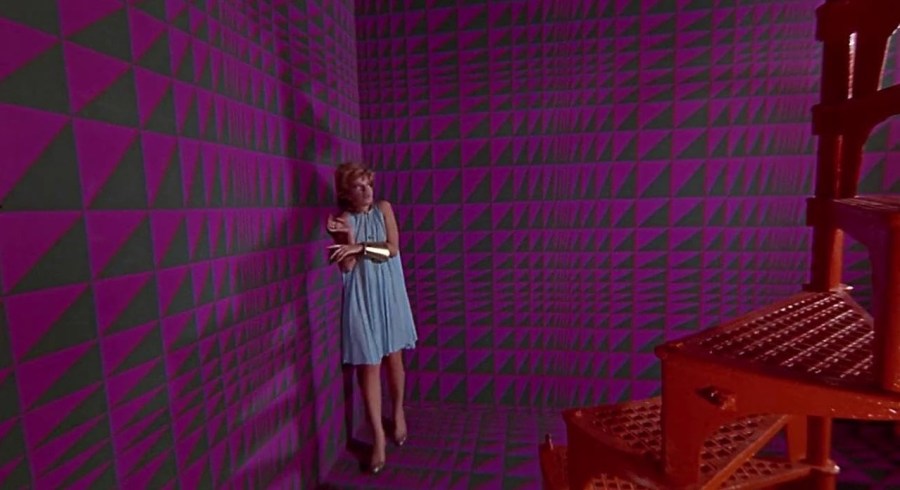
Critics then and now single out Modesty Blaise‘s Op Art stylings for praise (with some going so far as to say they’re enough to solely recommend the movie). The sets and cinematography appear striking at first, and the high level of coordination throughout the visual schematic is typical of Losey.
However, you can’t continually impress a viewer with pretty pictures and unusual frames for a full two hours if there isn’t something ultimately backing them up (that may be Modesty Blaise‘s biggest, most obvious fault: its ungodly length. 90 minutes tops for a soufflé like this). Closer examination of the sets and production values reveals, however, a rather cheapjack look that was typical of Fox’s mid-line, post-Cleopatra endeavors (it has nothing of the sleek, glossy, tactile, luxurious heft of a Ken Adam Bond production).
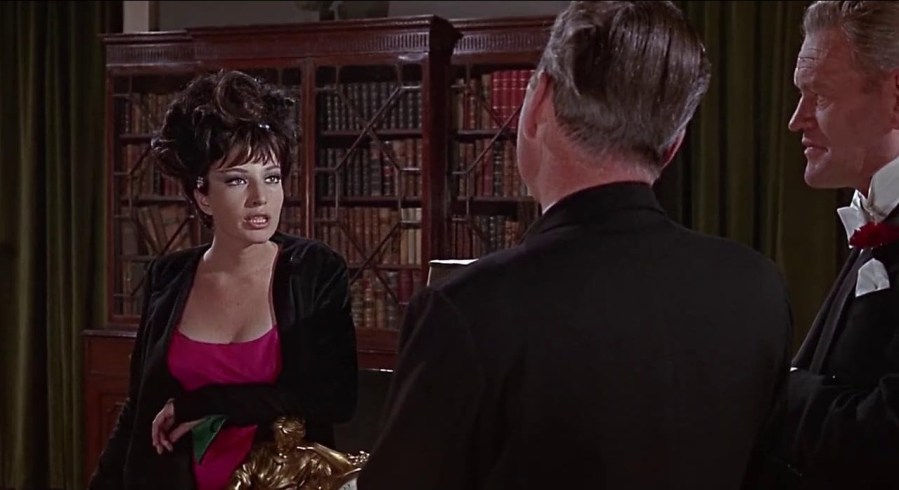
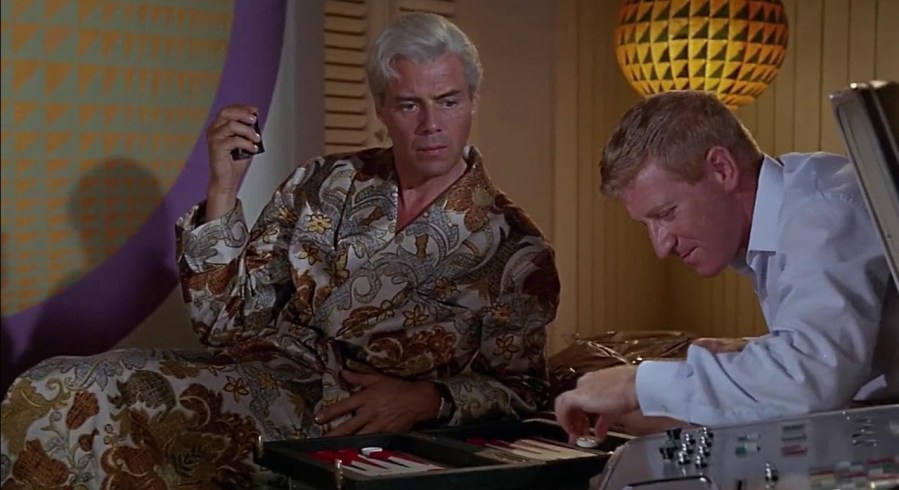
A three million dollar budget was respectable in 1966, but considering how the disorganized, location-heavy production was fraught with last-minute script and set changes and additions, I suspect quite a bit of Modesty Blaise‘s budget never made it to the screen (instead of making sure the minutest details match up, like color-coordinating Gabriel’s yacht’s block and tackle for a two second shot…how about hiring a decent fight coordinator for your Bond spoof?).
RELATED | More 1960s movie reviews
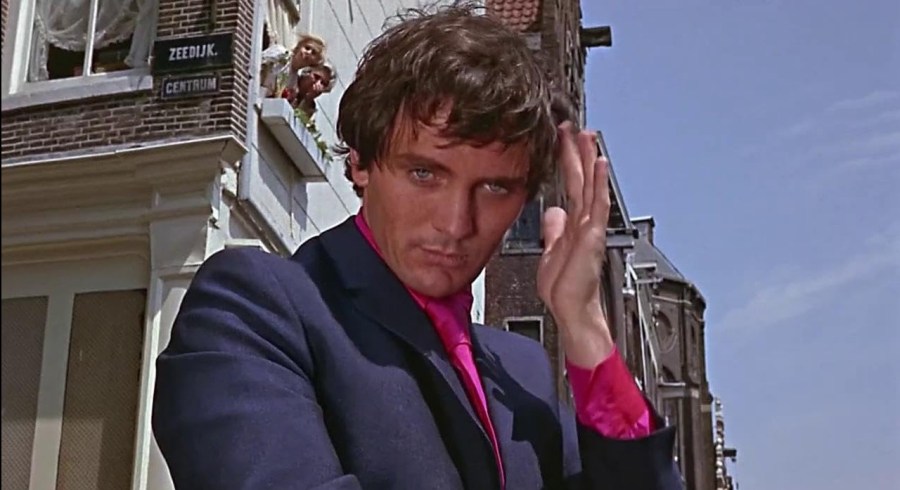
Ignoring the movie’s quite lame opening, as Vitti nonsensically laughs as her computer spits out punch cards (that chintzy, plastic set wouldn’t have passed muster on TV’s Star Trek), before Losey boringly apes Antonioni with his long tracking abstract architecture title shot, we do get a brilliant little sequence—Robin Fox blown up in Amsterdam—that seems to promise so much for Modesty Blaise.
Shady characters including a mime and a magician exchange inexplicable/hilarious glances and unheard confidences as they dart in and out of a Red Light district alleyway, before Silvan produces a magician’s wand to a drum flourish, ending with a Looney Tunes-worthy blast that sends Fox sky-high and brings down an entire building. It’s a scene that perfectly encapsulates what you hope Losey is going to do with Modesty Blaise: illusion (of course there’s a Losey mirror shot), trickery, impenetrable inside jokes, and cartoon violence within the apt supporting framework of a double and triple-dealing spy story.
Unfortunately…it’s all downhill from there, with occasional upswings anytime Dirk Bogarde or Harry Andrews and Alexander Knox pop up. Many critics questioned whether Losey had the comedic temperament to do a project like Modesty Blaise in the first place (including his son and screenwriter on Kino’s bonus interviews). That argument seems manifested on the screen itself: Modesty Blaise is a jumble of ill-fitting comedic tones, from broad, mostly unfunny slapstick, to perverse violence (Rosella Falk strangling mime Joe Melia with her knees), to lame satire (Losey’s flat-footed musical interludes and that god awful Arab assault finale), all trying to find purchase, and all fighting against the movie’s spy structure.
Why Losey didn’t stick with O’Donnell’s proven formula is anybody’s guess (he had a built-in audience with the critically-heralded strip—why throw that all out?), but it’s clear that Losey’s underlying tone is one of contempt for the material—a fatal flaw when doing a spoof (for example: movie fan Mel Brooks loved Westerns and old Universal horror movies, hence the stellar results with Blazing Saddles and Young Frankenstein).
And since Modesty Blaise‘s satire is diffused because the director doesn’t really have a passionate affinity for the material he’s poking fun at (and perhaps not a strong personal sense of humor to exploit it), we neither get the laughs we would expect from a smart director like Losey, nor do we get, at the very least, the simple pleasures of the 1960s spy genre conventions that should come as easily to Losey as falling off a log (the action scenes, whether by accident through incompetence or by design to further invert the spoofery, are shockingly inept).
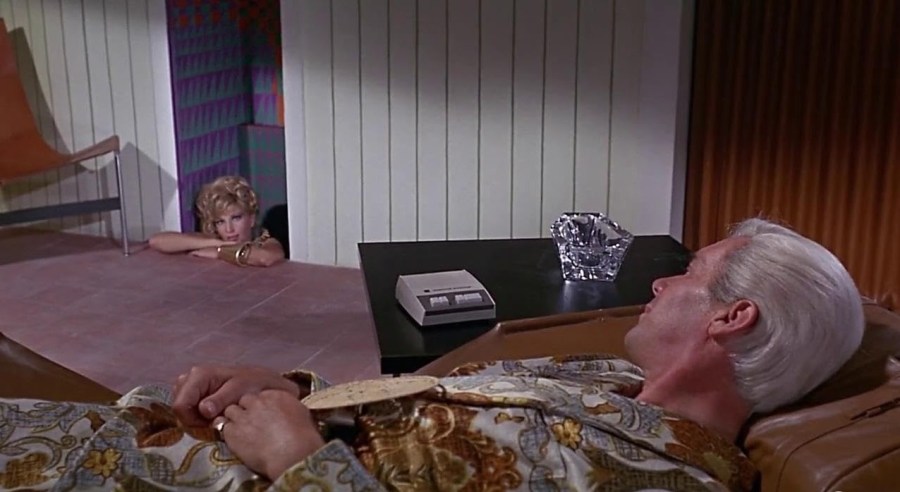
When Losey presented Modesty Blaise at the Cannes Film Festival, he pompously stated it would “out Bond James Bond”…right before he admitted he had only seen one-half of one James Bond movie. How can you satirize what you don’t really know (ten bucks says he never followed the comic strip, either). His intellectual exercises in New Wave jump cutting and spatial displacement here (in the supposed service of skewering our expectations in watching a big, glossy spy goof), fall ridiculously flat.
Vitti’s hair instantly changing color within a shot, like Endora blinking “Durweed” into oblivion on Bewitched, simply don’t work because we don’t find what Losey is attempting as amusing, or groundbreaking, or worthwhile. It’s not organic, and it’s not particularly funny. It’s a wheezy gag on we the viewers, and when that’s the director’s dismissive take on his material and audience–”I’m smarter than you, and I’m above this crappy material, so I’m going to goof on you and your petty bourgeois pleasures and expectations,”–the audience is going to turn on the material.
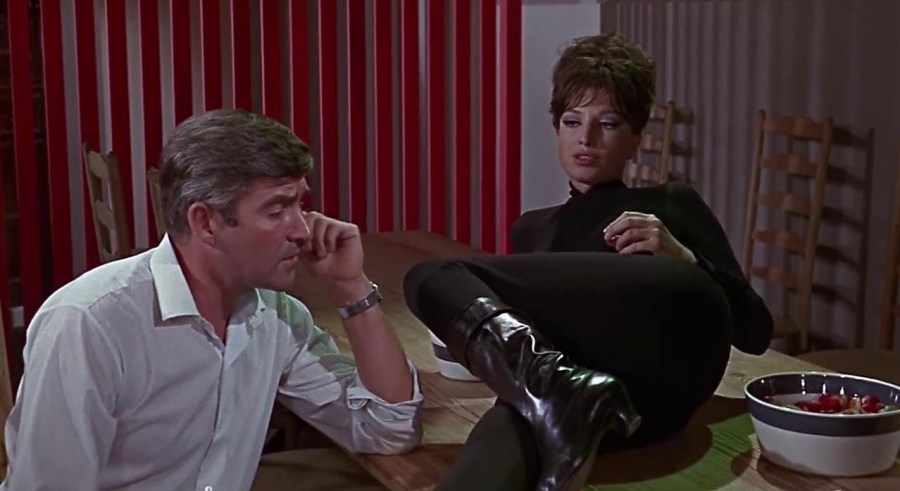
That attitude, combined with a shaky production marred by indecisiveness and too much input from other sources (apparently, Losey eventually just let everybody throw something into the already watered-down pot), the actors are going to get nervous and uptight (reportedly, once-friends Vitti and Losey weren’t speaking to each other after just a few weeks of shooting. She even walked off the set at one point).
Everyone nails Vitti as “miscast” here, which is probably true; her rather indolent physicality suggests nothing of the strip’s athletic, deadly Modesty, and that accent is too thick for more than a line or two of dialogue she’s given. To be fair, though, she has very little to work with, considering that Losey fails to create an even two-dimensional Modesty Blaise (does the character actually do anything in this movie? It’s called “Modesty Blaise,” but there seems to be a big black hole where the character should be).
Poor Terence Stamp has it even worse; his Willie Garvin sidekick character, an essential component of the strip, is as useless as a decorative background bit of tail in one of Dino’s crude-but-funny Matt Helm outings (the failure of Modesty Blaise began the immediate dampening of Stamp’s international rise, not helped by the subsequent b.o. failures of Poor Cow, Far From the Madding Crowd, and The Mind of Mr. Soames…while Alfie “friend” Caine seemed to do alright…).
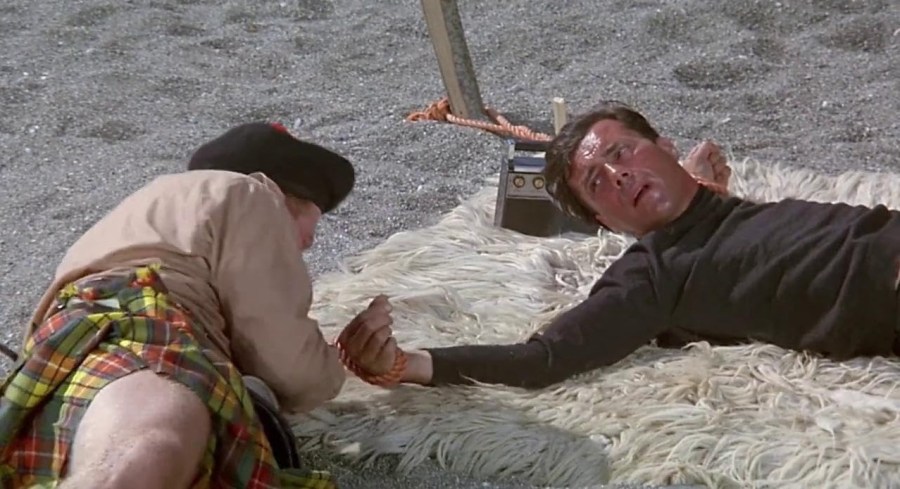
Genuine pleasure, aside from laughing at the movie, can be had in Modesty Blaise whenever Dirk Bogarde and some of the supporting cast wander through this mess. Clive Revill has not one but two dubious roles, both of which he overplays (the notion of a super-villain like Gabriel having to submit to constant, petty cost-accounting supervision by a Scottish penny-pincher like McWhirter is a pretty amusing idea…once. But not when it’s beaten into the ground).
Handsome Michael Craig (he would have been a good Bond) is given a character we can’t figure out at all (he’s the equivalent of the “second” disposable Bond girl in any Eon epic), but Harry Andrews and Alexander Knox have a witty double act going (Losey is on firmest ground when he’s satirizing England’s war-loving, unfeeling aristocracy and bumbling political class). Rossella Falk shows real style and dash as the fearsomely butch Mrs. Fothergill; it’s just too bad Losey can’t lead her into an overall coherent turn.
Best of all, and worth the price of Modesty Blaise alone, is Dirk Bogarde as bitchy queen super villain Gabriel, the Bond villain the Bond franchise could only have dreamt of having (can you imagine Connery trading quips with Bogarde’s withering put-downs? Heaven). Heavy on the gay camp (before we were ordered by humorless P.C. guardians not to enjoy such droll comedy), Bogarde gets big laughs with just the slightest withering sigh and the mere suggestion of an eye roll (his rejection of a fertilized egg for his breakfast is a beautiful, beautiful bit of snot comedy).
Captured at the end, staked out (on an afghan rug) in the desert to die of thirst, and yet calling out weakly for, “Champagne! Champagne!” (a brilliant bit of business Bogarde invented), Bogarde’s bone-weary, disgusted, fey, thoroughly bored super-villain Gabriel contains all the Bondian envelope-pushing Losey could have wanted in 1966. What a shame he didn’t build a worthwhile movie to properly showcase it.
A quick word on Kino Lorber’s Blu-ray extras. First up is a commentary track from David Del Valle and moviemaker Armand Mastroianni. I’ve reviewed other Del Valle commentary tracks, and this one didn’t disappoint…and you know what I mean. Del Valle has his movie trivia and interesting anecdotes about Modesty Blaise down cold; he always has fascinating little tidbits he’s gleaned from his years interviewing.
But there’s no getting around the fact that after about an hour, he and Mastroianni begin repeating themselves with the same generalized observations (it’s amusing to hear how upbeat and engaged Mastroianni is at the very beginning of the track, clearly eager to discuss Losey…before he’s quickly worn down by Del Valle’s interruptions, dismissals, and subject changes). Del Valle reads some of Losey’s fascinatingly self-serving, pompous quotes on the subject of Modesty Blaise‘s failure (in a nutshell: it was everyone’s fault—the cast, the crew, the audience, the cosmos—except his), before Del Valle cuts through the bull and flat-out states (to his credit): “Let’s face it: this is all very gay.” Hilarious.
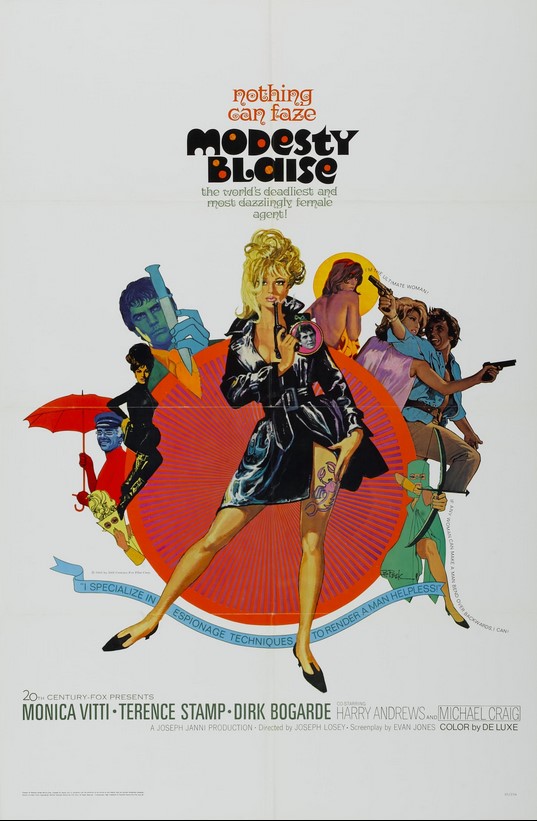
Mastroianni and Del Valle have their own strange moment where they try and determine what is and isn’t “dated” anymore (as if there’s an objective, all-encompassing, codified general consensus they’re clued into), before everything breaks down and Del Valle double, triple and even quadruple backtracks on what’s wrong/right with Modesty Blaise (it’s a failure…it has major flaws…Losey didn’t know what he was doing…then it’s misunderstood..then Losey did know what he wanted but was denied it by the studio…then it’s the cast’s fault…then it’s a mere two scenes cut from the final print that ruined the movie…). In other words: scattershot Del Valle is the perfect guy to do the commentary track for Modesty Blaise.

Read more of Paul’s movie reviews here. Read Paul’s TV reviews at our sister website, Drunk TV. Visit Paul’s blog, Mavis Movie Madness!…but mostly TV.

