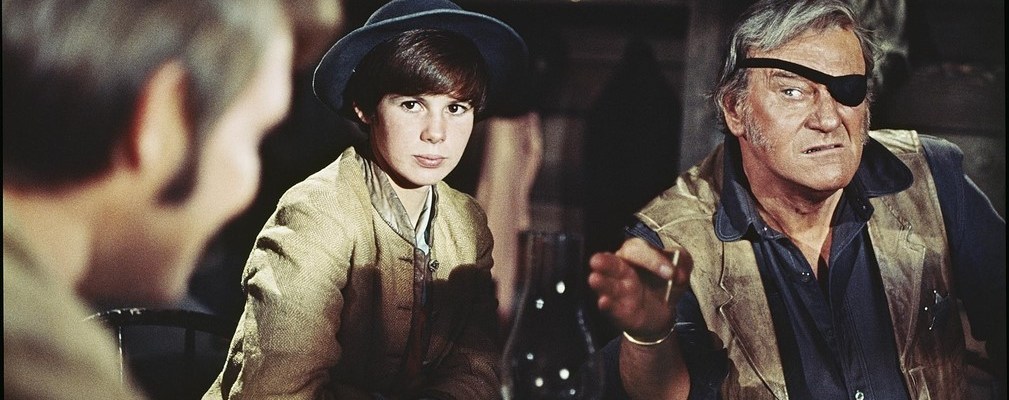
I was trying to think of a movie that reminded me of my old man (to celebrate this upcoming Father’s Day), and since I couldn’t find anything titled, Hilariously Funny/Psychopathically Maladapted Depressive with Sadistic Personality Disorder and Suicidal Tendencies, I turned to ‘ol John Wayne. My old man used to laugh at him…but he loved him, too, and never missed one of Wayne’s pictures—particularly if he could see it at the drive-in, where he could smoke like a chimney while looking out his window at the night sky and stars, maybe to escape himself for a few hours; maybe to dream a little bit of other, better things.
By Paul Mavis
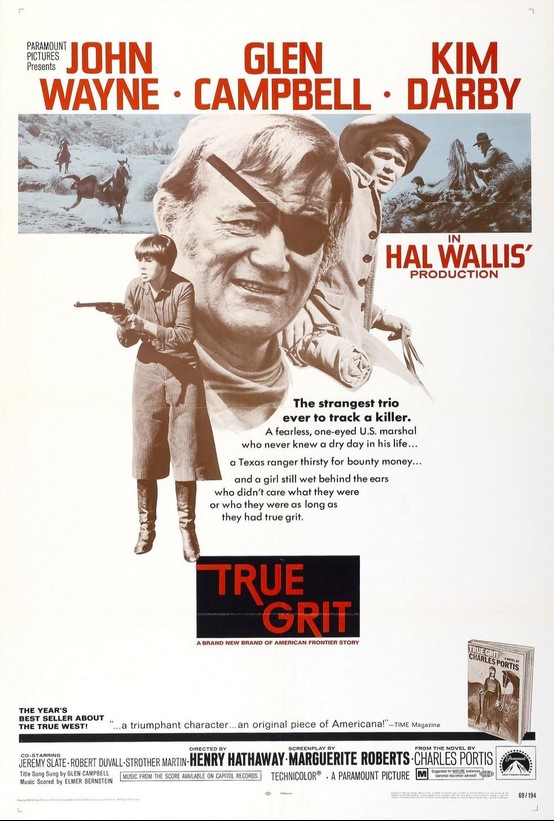
As fresh and funny and exciting as it was almost sixty (!) years ago, True Grit remains one of the Duke’s fans’ favorite titles, a smash hit at the box office featuring a marvelously skilled comedic performance by Wayne that most deservedly won the 1969 Oscar. Directed by Henry Hathaway, written by ex-Commie scripter Marguerite Roberts (based on Charles Portis’ novel), spectacularly photographed by Lucien Ballard, and co-starring Glen Campbell, Kim Darby, Jeremy Slate, Robert Duvall, Dennis Hopper, Alfred Ryder, Strother Martin, Jeff Corey, Ron Soble, John Fiedler, James Westerfield, John Doucette, Donald Woods, Edith Atwater, Carlos Rivas, H.W. Gim and Hank Warden, True Grit is a masterpiece of elemental, Western mythos aligned with Wayne’s consummate burlesque of his two most recognizable screen incarnations: the rugged, melancholy loner and the big-hearted farceur. Director Henry Hathaway creates an iconic mixture of family adventure and comedy, while never shying away from the brutal violence and Old Testament retribution of the righteous in this hugely entertaining evocation of the cinematic Old West.
Click to order True Grit on Blu-ray:
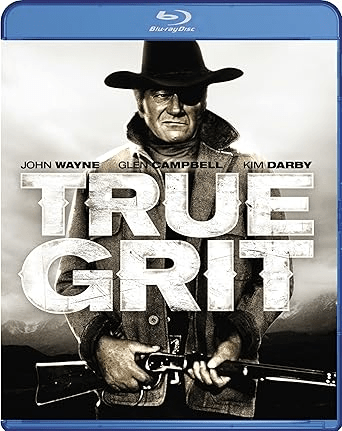
(Paid link. As an Amazon Associate, the website owner earns from qualifying purchases.)
The plot is of the utmost simplicity (as all good Westerns should be). In post-Civil War Arkansas, Mattie Ross (Kim Darby), a no-nonsense, sensible, yet annoying and controlling 14-year-old, sends her father Frank Ross (John Pickard) off with spending money for his business trip to buy breeding horses.
Taking along shifty ranch hand Tom Chaney (Jeff Corey), Frank arrives in Fort Smith, and tries to keep the gambling Chaney out of trouble, but the shifty Chaney loses control and shoots Frank dead in the street. Accompanied by hired hand Yarnell (Ken Renard), Mattie arrives at Fort Smith to retrieve her father’s body, and to see what’s being done about finding his murderer.
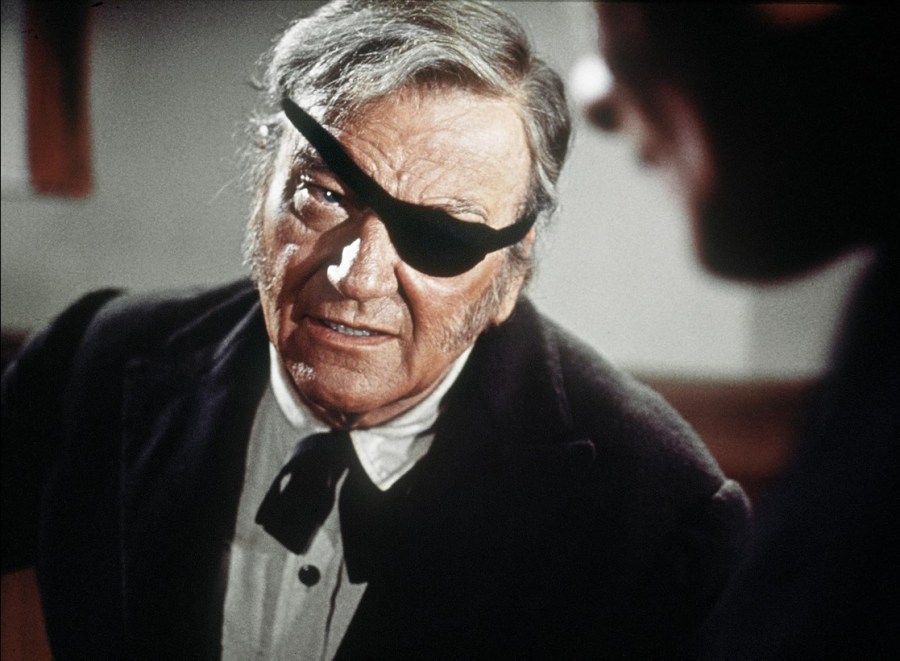
Once she learns that Chaney has thrown in with “Lucky” Ned Pepper (Robert Duvall) and his gang, now hiding in the Indian Territory (Oklahoma), she realizes she needs a U.S. Marshall to track Chaney down. Looking for a man with “true grit,” she’s told Marshall Reuben J. “Rooster” Cogburn (John Wayne), is the meanest, most determined marshal in the state, and she demands that he help her—for a fee, of course.
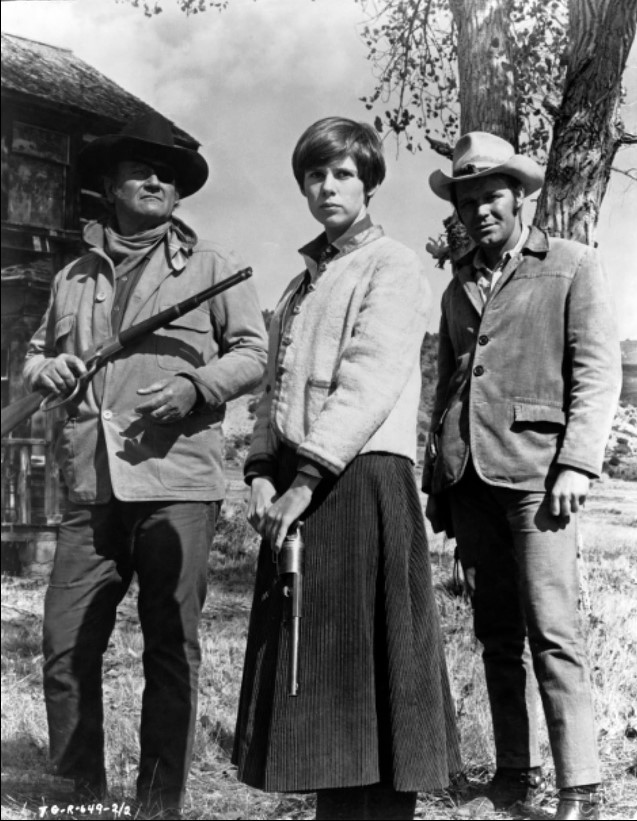
Rooster, an ornery old cuss with only one eye and predilection for getting drunk, agrees to her proposal—and then promptly abandons her (after spending her money) when Texas Ranger La Boeuf (Glen Campbell) offers quite a bit more money to track down Chaney, who’s wanted in Texas for the murder of a state senator.
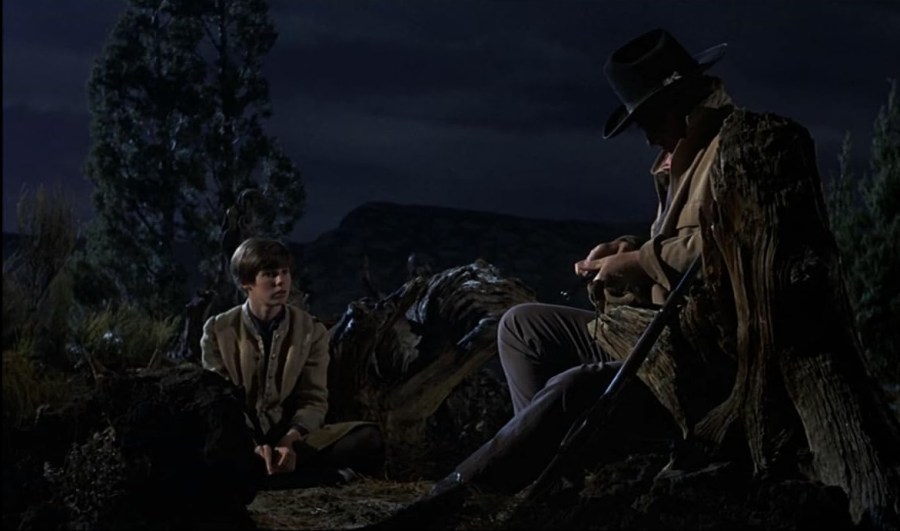
Mattie, disgusted as much with Rooster’s loose living as with his subterfuge, tries to tag along, but the men ditch her. Showing her determination, and earning the growing respect of Rooster, Mattie fords a deep river on horseback, and tracks them down, eventually convincing the duo that she should come along on their trackdown.
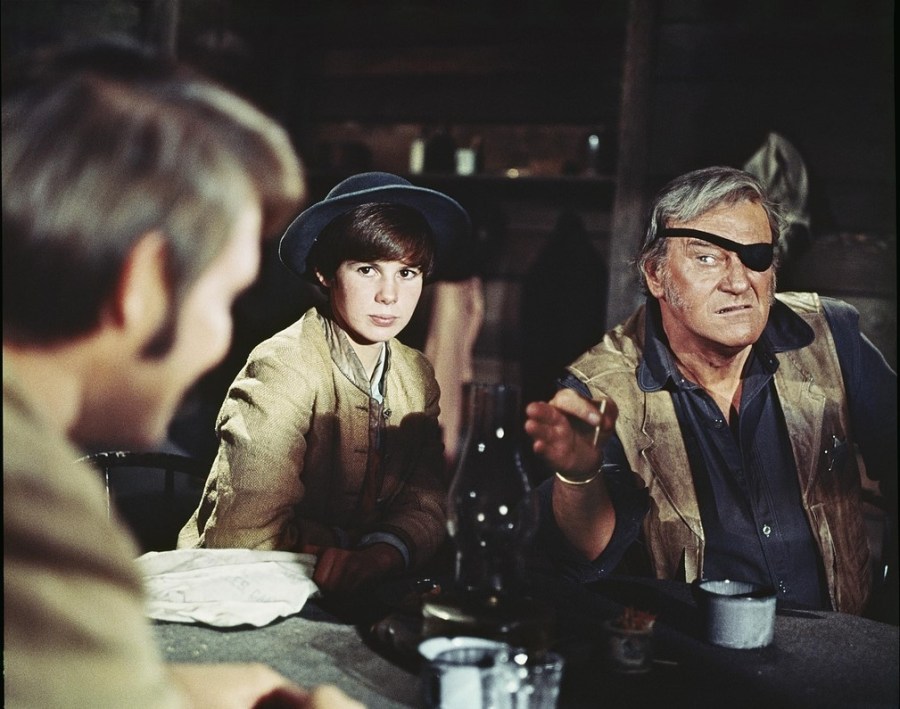
But the initial high spirits of this adventuresome group quickly dies down, as the seriousness of their mission becomes clear. Encountering two of Ned’s gang in a ramshackle cabin by the river (Dennis Hopper and Jeremy Slate, as Moon and Emmett Quincy), Rooster baits them, trying to get information about when Ned is due to meet up with them.
In his growing rage, Emmett fatally stabs Moon before being shot, and Moon gives up the information about Ned before he dies. Laying in wait at the cabin for Ned, La Boeuf jumps the gun and fires on the group, scattering them, and allowing Ned to escape. With Ned now wise to Rooster’s presence, Rooster, Mattie and La Boeuf have a much more difficult time in tracking down the cornered Ned, resulting in an action-filled climax that has tragic results for one of our heroes.
As anyone who follows Oscar history knows, the accepted mantra for John Wayne’s True Grit Best Actor win is that somehow he “stole” it from the more deserving Dustin Hoffman turn as Ratso Rizzo in Midnight Cowboy. Always pitted in articles and books as some kind of reactionary “career vote” from old timers in the Academy who resented new talent “hippies” like Hoffman, what those authors always forget is that Jon Voight was also nominated for Midnight Cowboy, and that more than likely, they split their votes, allowing Wayne a clear shot at victory (Richard Burton, for Anne of a Thousand Days, and Peter O’Toole for Goodbye, Mr. Chips, never had a chance).
As well, the party line also seems to want say that Wayne wasn’t nearly as “deserving” as Hoffman, because he just merely parodied his own screen legend. After all, Wayne was still coming out of the critical nadir of his career, where he had earned universal scorn from the largely liberal movie critics who saw his previous box office smash, The Green Berets, as a buffoonish call-to-arms in support of the Vietnam War (as usual, the American public couldn’t have cared less what the critics said).
Clearly, the critics (who, at the time, couldn’t help but grudgingly recommend True Grit) saw Wayne’s win as some kind of further betrayal by an actor who they increasingly either openly despised or condescendingly patted on the back.
Which, of course, is all hogwash, because there’s nothing artless or simplistic in Wayne’s performance here. In Rooster Cogburn, Wayne distilled almost forty years of acting experience into one of his most memorable performances, creating a character that was a skillful combination of his rugged, loner hero from movies like The Searchers and The Man Who Shot Liberty Valance, and the big, lovable lug comedian from such he-man spoofs as North to Alaska and McLintock!.
Quite a bit of the backhanded compliments Wayne received for his Oscar mentioned he won it only because he was willing to look old and fat while wearing an eye patch (a notion perhaps exacerbated by Wayne’s own words during his Oscar acceptance speech, where he said he should have put on that eye patch a long time ago).
There’s no denying that the Academy loves to give out awards for actors who significantly alter their appearance in their bids for Oscar gold (Ben Kingsley in Gandhi, Charlize Theron in Monster). Even Hoffman exploited the extreme wardrobe and hairstyles of Ratso Rizzo—along with a club-footed limp—in Midnight Cowboy.
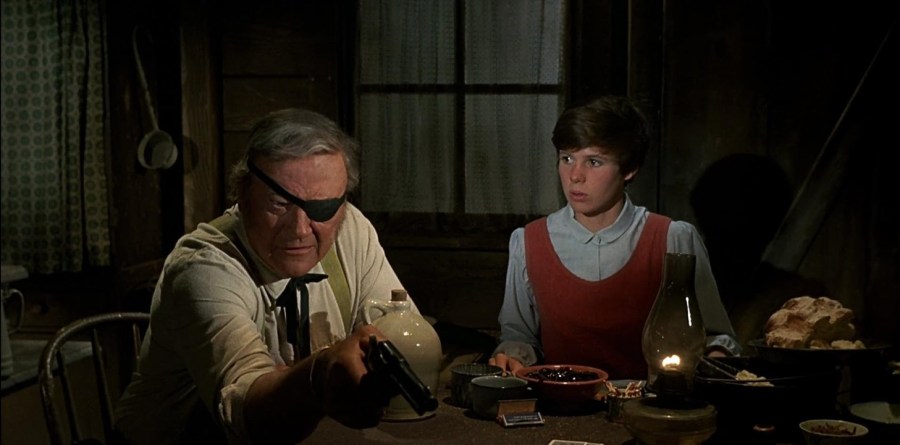
Watching Wayne here, he doesn’t look any fatter or thinner than he did in other movies, but he does use that eye patch to marvelous effect, goggling that one good eye around, swiveling his head about like a wounded bear, and jutting out his jaw like some pugnacious brawler. His whole physical being in True Grit is a sight to behold.
Far looser (and even more confident in his instrument, if that’s possible) than in previous outings, Wayne becomes the character actor he always should have been. Standing like a peg-legged gargoyle in the cabin scene with Moon, baiting him into giving out information on Ned, or whining an imitation of Mattie, screeching, “Mama! Mama!”, Wayne the superstar lead becomes Wayne the masterful character actor.
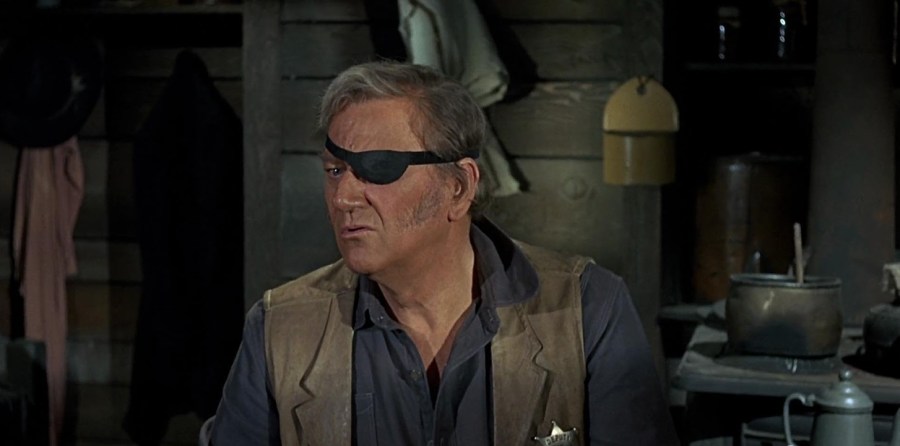
Watching him do his celebrated “rat speech” (“Now, this is a rat writ, writ for a rat…”), or hearing him booming about not being “afraid of no booger-man,” you start to wish that Wayne could have left his standard “John Wayne” performance more often for comedic diversions in character parts. There’s nothing simplistic or easy in this accomplished farceur‘s performance here. Seen today, Wayne’s Rooster Cogburn more than matches Hoffman (if that’s even fair to compare, anyway, considering how different the roles and actors are).
RELATED | More John Wayne movie reviews
If we only had Wayne’s performance to recommend True Grit, I’m not sure it would have the enduring popularity it enjoys to this day (don’t even bring up the silly, ridiculously overpraised remake). Director Henry Hathaway, who had worked before with Duke (North to Alaska, The Sons of Katie Elder, among others), has an elemental simplicity to his compositions, a gravity and squareness to his blocking, that creates almost a mythical environment in which his characters interact.
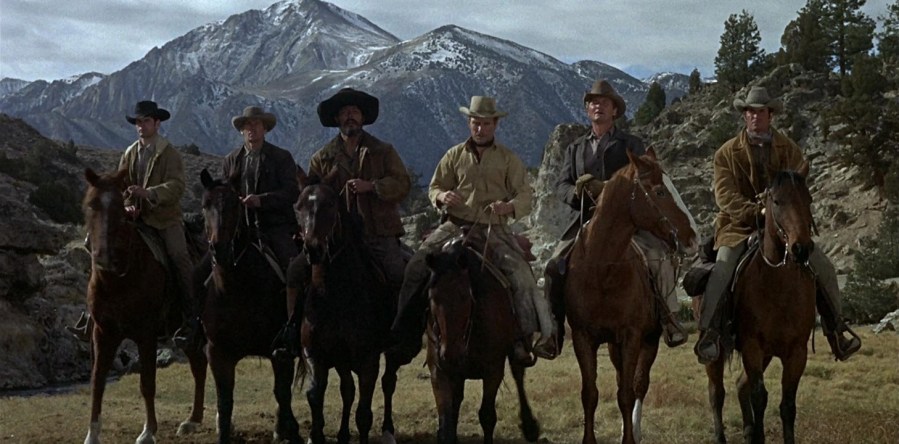
With stunning, deep depth-of-field cinematography by Lucien Ballard, many scenes in True Grit pop out with an almost 3D effect. This is the West the way we imagine the “West” to be in movies; it’s a fantasy land of whispering Aspens and jagged peaks, outsized to match the iconic image of Wayne topping the hill on his big American stud horse (even though the story is set in Oklahoma, they filmed it in Colorado…an artifice that’s perfectly illustrative of what movies are all about). The sky is crystal blue, the clouds purest white, and the rivers all sparkle.
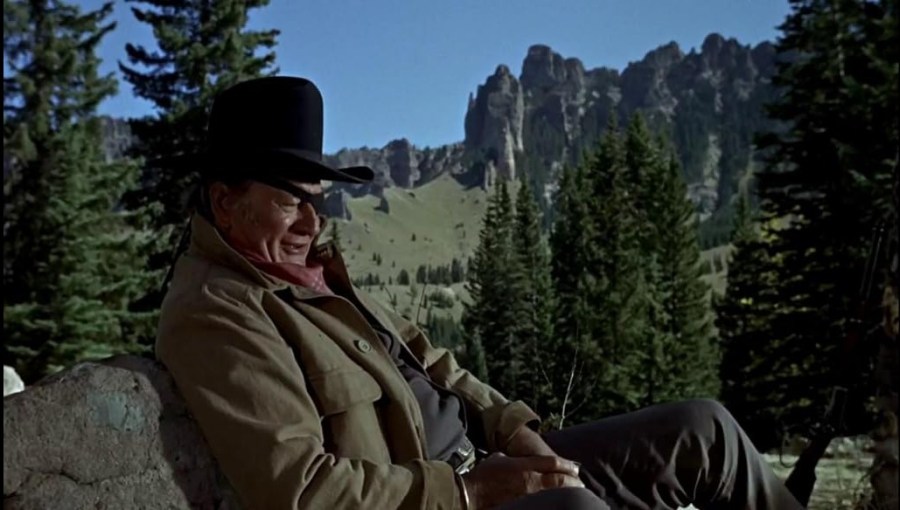
And that conspicuously hyper-realistic production design sets up an intriguing contrast with the relatively gritty screenplay of True Grit. Based on the popular novel by Charles Portis, Marguerite Roberts’ screenplay, despite all the stops along the way for Wayne to delight us with his expert mugging, never strays from the central seriousness of the group’s endeavor.
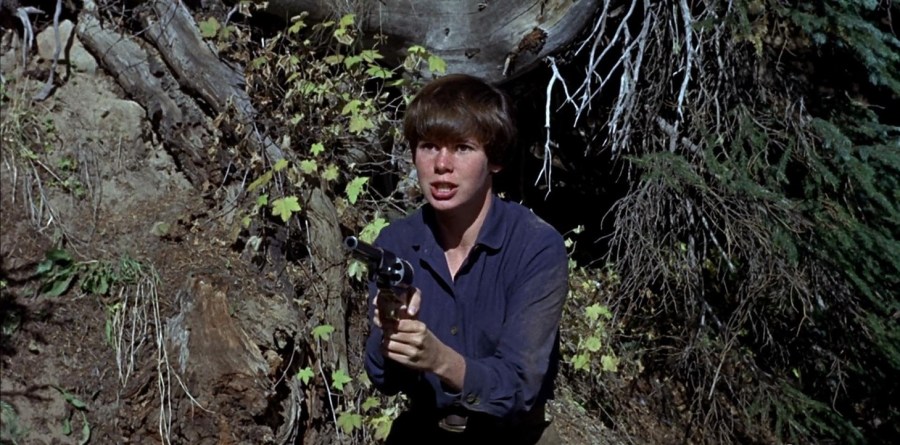
Aided immensely by Kim Darby’s charming, winning performance as Mattie (something that can’t be said about TV-charming Glen Campbell’s awkward first time in front of the movie camera), Roberts’ screenplay never avoids the harsher realities of life in the old west (the death of her father, and the plainness and matter-of-factness of his funeral), nor, significantly, the brutal violence always ready to break out.
A particular favorite with families when it was released, True Grit is the damnedest G-rated movie you ever saw. Even though the original trailer indicated the movie was first rated “M” for mature audiences, it ran in wide release under a “G” rating, with all the violence still intact (according to the AFI catalog, some “four-letter words” were cut to get the “G” rating). Most notorious, certainly, is the gruesome maiming of Moon by Emmett (watch those finger tips fly right off the table), and the subsequent gory stabbing of Emmett by Moon (it’s a scene worthy of Peckinpah).
RELATED | More 1970s movie reviews
While some critics questioned this depiction of extreme violence in an ostensibly comedic family title (as they would always question the violence in Wayne’s movies…but never in their liberal critical darlings, like Peckinpah or later, Tarantino), I can assure you that most Midwestern audiences at least, back in the late ’60s, saw absolutely nothing wrong in this rather sturdy Old Testament depiction of righteous retribution in Wayne’s movies.
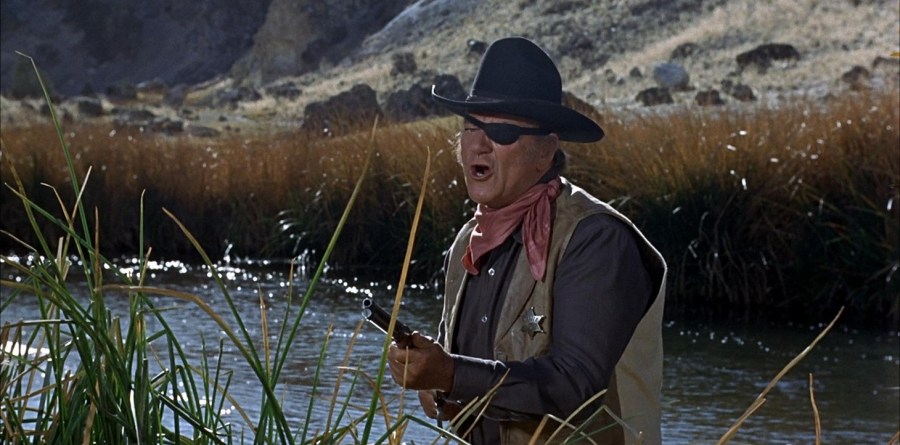
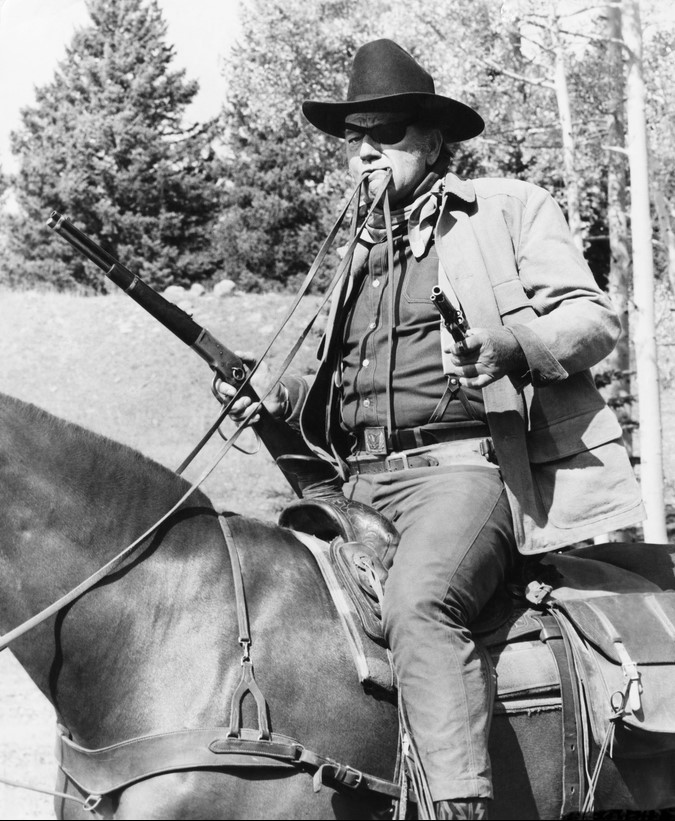
Call it reactionary, or quaint, or a philosophical sop for nervous audiences who saw all aspects of society in upheaval in 1969, when Wayne discusses what to do with rats/criminals (“You can’t serve papers on a rat. You either have to kill him or let him be.”), many citizens nodded silently along with Rooster in their dark theaters. True Grit‘s most iconic sequence, where Rooster faces down Ned and three other bandits, firing a pistol in one hand and a rifle in the other, with his horse’s reigns in his teeth, epitomizes not only this take-no-prisoners form of justice, but also neatly spoofs—and amazingly at the same time, enlarges and amplifies—Wayne’s own mythic image.
I can clearly remember sitting at the appropriately monikered Jesse James Drive-In (a strip mall and trailer park now squat their dirty haunches on that once-hallowed ground), watching this scene when the movie was brought back for one of its seemingly endless summer returns. When Duvall calls out to Wayne’s simple declaration that he means to kill him, answering Wayne, “I call that bold talk for a one-eyed fat man!” the other drive-in patrons, muffled in their cars, yelled and laughed when Wayne responded, “Fill your hands, you son of a bitch!” What a marvelous sound of a pleased audience directly connecting with a performance, an almost childlike sound of delight, wafted along by the nighttime summer breezes.
Improbable, magical scenes such as that are why Wayne was always the larger-than-life fantasy hero to the average filmgoer, forming a powerful attraction with viewers based on wish-fulfillment and nostalgia, that most film critics never completely understood (or if they did, they then spewed vitriol on him—as only liberal critics can—because despite their politically-motivated efforts, they couldn’t sever his connection with his huge fan base). I hope—a thin hope, I admit—that Wayne still occupies a semblance of that position somewhere among moviegoers. Or at the very least, in their memories.

Read more of Paul’s movie reviews here. Read Paul’s TV reviews at our sister website, Drunk TV. Visit Paul’s blog, Mavis Movie Madness!…but mostly TV.


We did nto laugh at John Wayned,we liked him a lot, escpiacially lin The Quiet man and The Cavalry Trilogy. Anyone who watched thises films or any other an felt superior is an asshole. I had a quarrel with a creep from New York who posited that William Wyler was the most honored film director and got pissed off at me when I pointed out thatJohn Ford won six Academy Awards, how many didWyler win?The answer: three. The concept is applicable lto all.
LikeLiked by 1 person
Make room for my typos please.
LikeLiked by 1 person
Who cares about typos, Barry — glad to keep hearing from you!
LikeLiked by 1 person
Kisses, kid.
LikeLike
[…] © Movies & Drinks […]
LikeLike