Amiable, mindless (…and mostly inexplicable) thick ear for fans of 70s all-star international co-productions.
By Paul Mavis
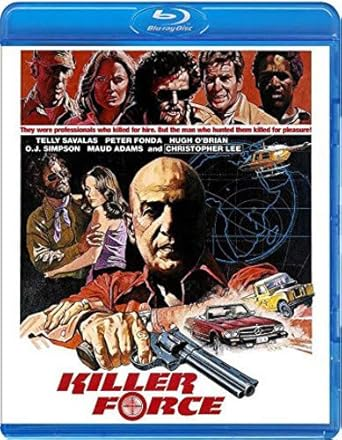
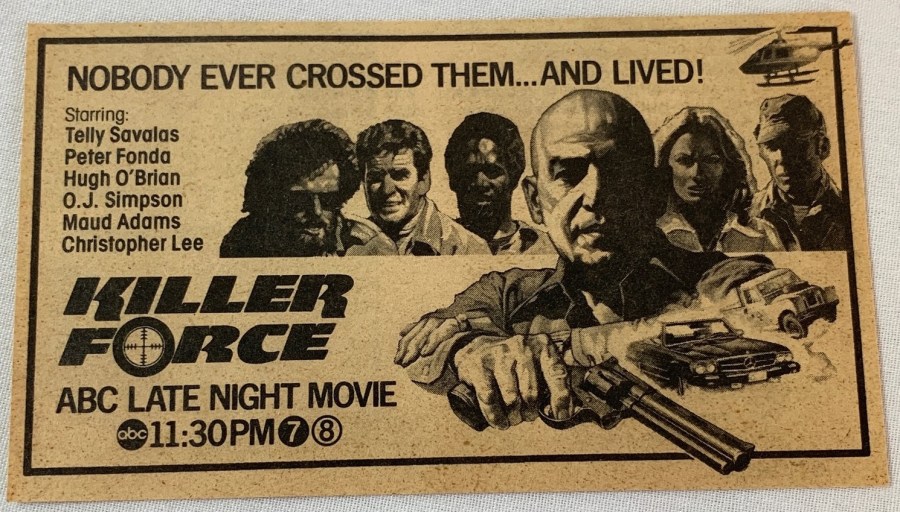
A few years back, Kino Lorber released on Blu-ray Killer Force (a.k.a.: The Diamond Mercenaries), the 1976 South African diamond heist actioner released here in the States by American International Pictures, directed and co-written by British helmer Val Guest, and starring Telly Savalas, Peter Fonda, Hugh O’Brien, O.J. Simpson, Maud Adams, and Christopher Lee.
Anyone looking for the kind of intricate, razor-sharp plotting that defines a superior heist movie…will not find it in Killer Force. However, those who want a lot of explosions and machine gun fire and failing name actors clearly collecting a paycheck the IRS can’t touch, will find Killer Force just to their liking (make sure you check out the Blu release, not just for the stellar transfer, but also for the alternate, better ending that wasn’t used here in the States).
Click to order Killer Force on Blu-ray:
(Paid link. As an Amazon Associate, the website owner earns from qualifying purchases.)
The Syndicated Diamond Corporation mining compound in the South African desert. The mine’s second-in-command security officer, Mike Bradley (Peter Fonda) has been dispatched to an “airborne intruder” alert picked up by radar on the mine’s desert perimeter.
The SDC’s Chief of Security, Harry Webb (Telly Savalas), making a surprise visit, is convinced someone is stealing diamonds from the complex, and he suspects everyone, including the mine manager’s daughter, beautiful international model Clare Chambers (Maud Adams), who’s there visiting Bradley, her long-distance lover.
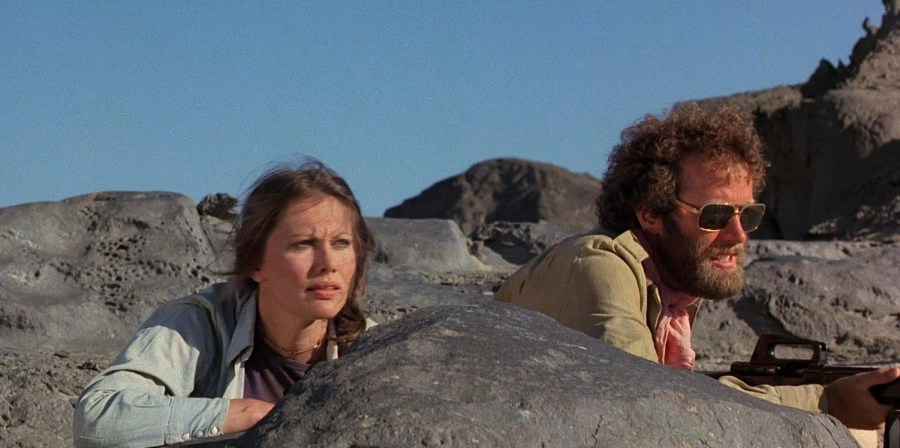
The airborne alert is further proof for deadly-serious Webb that security is lax at the mine; he orders a helicopter to take him to the scene, where he orders the summary execution of wounded diamond thief Pop Keller (Frank Shelley), even though Bradley already has the situation in hand. The complex’s head security chief, Ian Nelson (Victor Melleney, River of Death, Cyborg Cop II) has his own plan to capture the thief: he wants Bradley to go rogue and “steal” a diamond, escaping and becoming bait for the thief in the hopes of drawing out into the open the illegal operation.
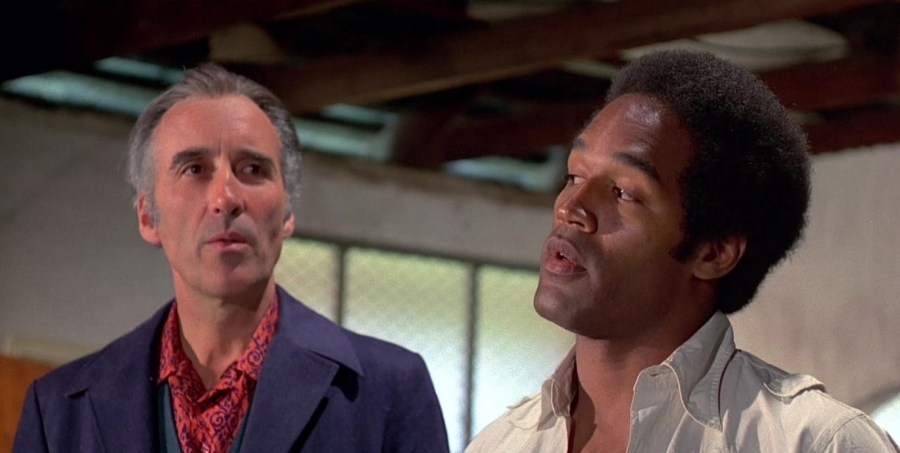
Bradley reluctantly agrees, and sure enough, after eluding Webb, Bradley is contacted by John Lewis (Hugh O’Brien), a retired Army major, who plans on attacking the compound with fellow mercenaries Major Chilton (Christopher Lee), “Bopper” Alexander (O.J. Simpson), and Paul Adams (Michael Mayer), all of whom served with Lewis in the Congo and Vietnam. But all isn’t as it seems with Bradley and Lewis, complicating their mission of hitting the heavily-fortified mine commando-style, and boosting $20 million worth of ice.
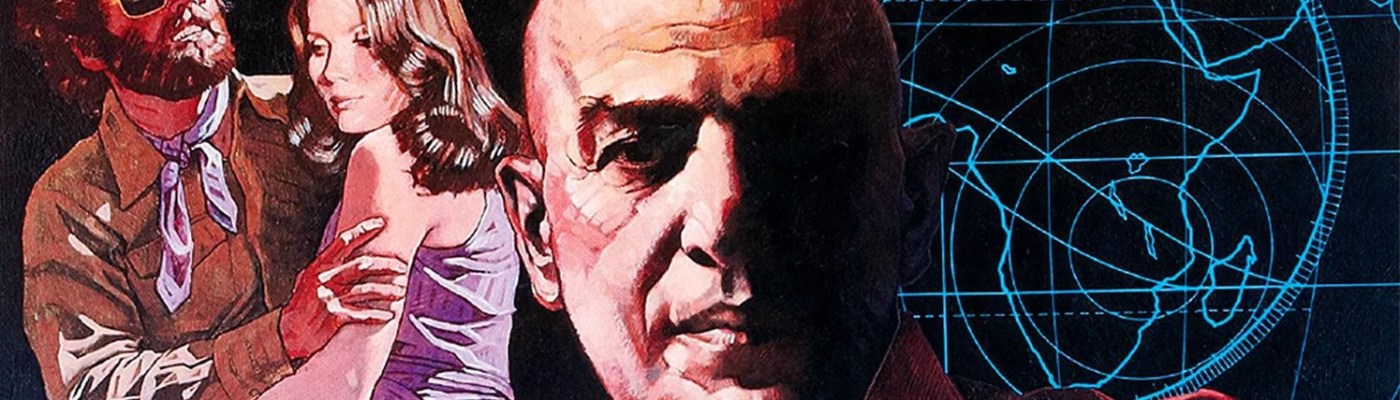
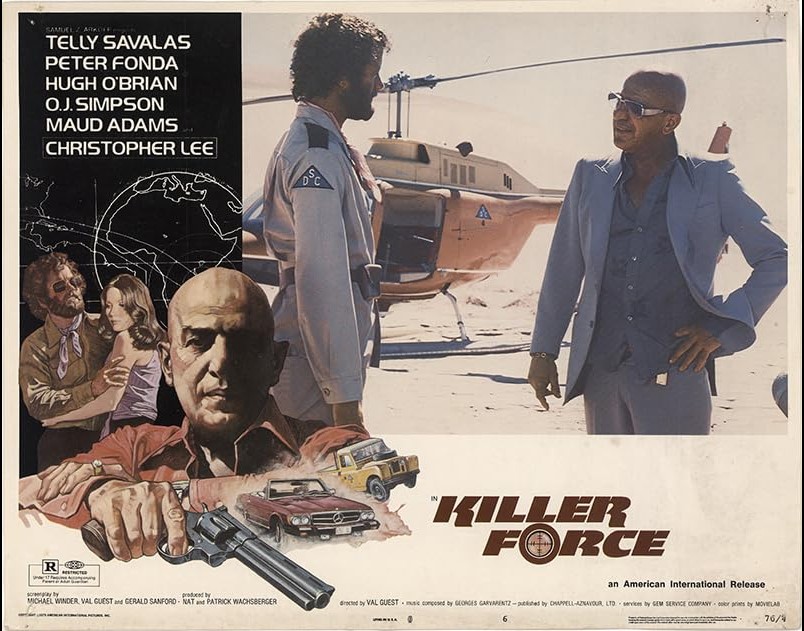
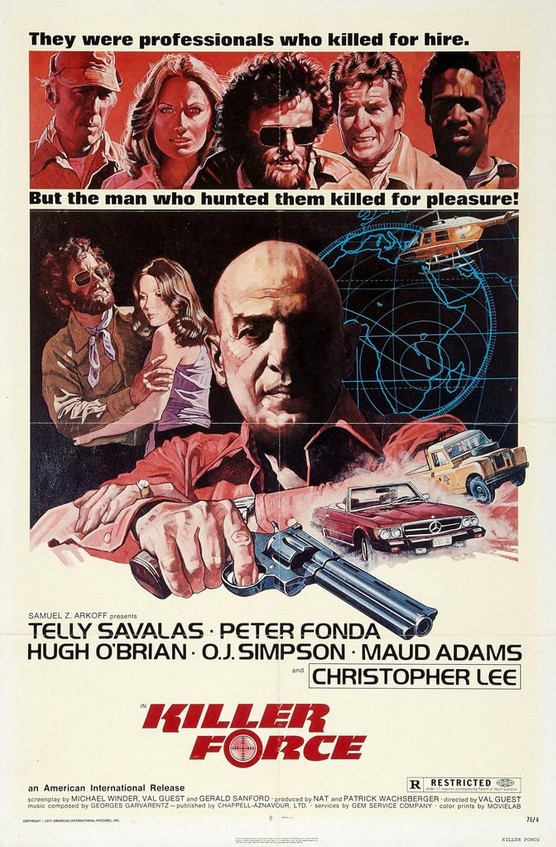
Who didn’t see Killer Force‘s original one-sheet poster art back in ’76 and think, “We’re seeing that at the drive-in on Friday night!” And like all really good, pulpy exploitation movie artwork, it does its job: it makes Killer Force look like some kind of epic bad-ass action classic…regardless of whether or not the actual movie measures up to the visual hype.
Well…Killer Force isn’t any kind of “epic” or “classic,” nor is it even particularly “bad-assed,” but it does satisfy in an amusing, nostalgic way for viewers who grew up on these kinds of 70s outings. Short of sorting through some print biographies of the principles (director Val Guest did talk about the production…which he said was “troubled”), there isn’t exactly a lot of online information on the actual production of Killer Force.
The few details I could find were that Killer Force was an international tax-shelter co-production for companies in the Republic of Ireland, Switzerland and the United States, and that Jack Palance may have had Hugh O’Brien’s role prior to shooting. That’s it. Oh…and Peter Fonda was (no surprise) a total jack-off during production, holding up filming until his special blender was choppered in to the remote desert location. Oh…and Telly Savalas (rightfully so) hated his guts, calling Fonda “the amateur” for all his Easy Rider pauses and “ums” and “yeahs” mixed in with his lines.
Killer Force isn’t a title that readily comes up when discussing 70s action exploitation fare. I’m not aware of it having any small cult following here in the States (overseas…who knows?). I’m not sure what kind of money AIP had in it (did they kick into the production kitty, or was Killer Force strictly a pick-up?).
One could assume, though, that since Killer Force didn’t exactly set the U.S. box office on fire, that if AIP did indeed chip in some dough, it was one of those higher-than-normal budgeted/lower-than-expected performing “mainstream” AIP offerings (The Great Scout & Cathouse Thursday, Shout at the Devil, Island of Dr. Moreau, Meteor) that helped put the once-profitable exploitation studio on the auction block by the end of the decade (Guest claims it made a ton of dough…that the producer stole, failing to pay the director―which is a moviemaking story as old as time).
When I saw Killer Force back in ’76, it was a pretty sweet piece of drive-in B movie thrills…at least to a ten-year-old who actively followed those kinds of flicks. Seen today (after decades of increasingly frenzied, adrenalin-soaked actioners), it plays fairly tame by comparison: energetic to be sure, but mostly dumb, too, in plotting and character motivation, with an interesting cast that’s not at all used well―both elements of which, happily, result in some unintended “bad movie” pleasures.
RELATED | More 1970s movie reviews
And the first of those dated pleasures comes in the opening title sequence: you know you’re back in the 1970s when composer Georges Garvarentz cranks up that chirpy, peppy, disco-flavored theme, in total contrast to the visuals of the earth movers and Land Rovers traversing the vast mine operation and South African sand dunes.
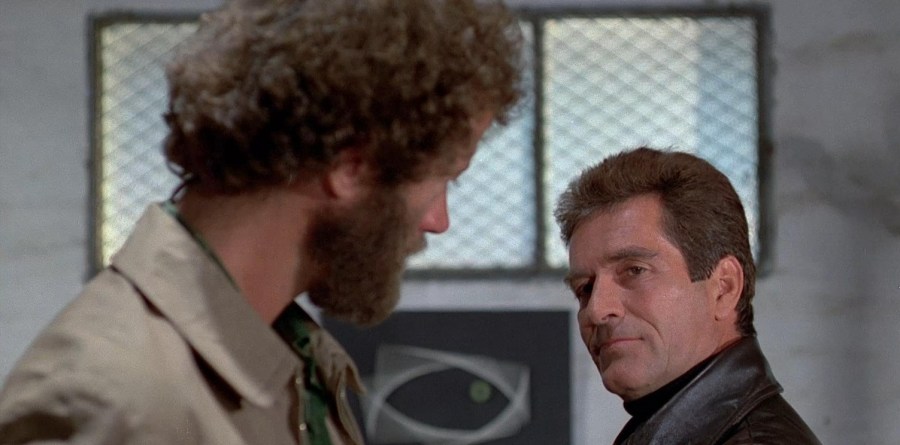
Old pro scripter/director Val Guest (the original Casino Royale, The Creeping Unknown, Jigsaw), with the help of writers Michael Winder (episodic Brit TV series like The Avengers and The Saint) and Gerald Sanford (U.S. episodic TV series like Barnaby Jones and Knight Rider), thankfully gets right down to business, giving us some nice crosscutting between Fonda’s airborne threat maneuver in the desert, and Savalas’ creepy intimidation of Adams back at camp. During those first nicely laid-out fifteen or twenty minutes, we’d be forgiven in thinking Killer Force might be a reasonably killer actioner in the making.
However, things go wobbly right when they should take off—the curiously enervated “planning of the assault” scene, usually one of the highlights of the heist genre—particularly with that ungainly jump cut from Telly discussing the camp’s security measures, going right to O’Brien and his gang talking about the raid, without even the slightest introduction to their characters or their set-up (we’re supposed to root for these guys when they just suddenly pop up out of nowhere without any kind of cinematic build-up?).
A bigger sign of trouble (or just plain poor post-production editing) is when Guest fudges the scene where Fonda gets the diamond out of the complex, thus establishing his cover; after a big buildup of the involved medical procedures everyone is subject to, we cut to Fonda laughing at some store in town while he pops the diamond into a cheap necklace. Uh…how’s that? You simply can’t cheat the audience that way in a heist movie; you have to show them how he did the supposedly impossible.
And once O’Brien’s meager plan is put forth—jumping over a tiny 5 foot wide “pressure strip” set in the desert sand, turning off the power to an electrified fence, and blasting away with guns—we grudgingly accept that Killer Force is going to be a fairly standard, if thinly plotted, “assault on a fortress” type exploiter…and so we might as well enjoy the ride, however familiar.
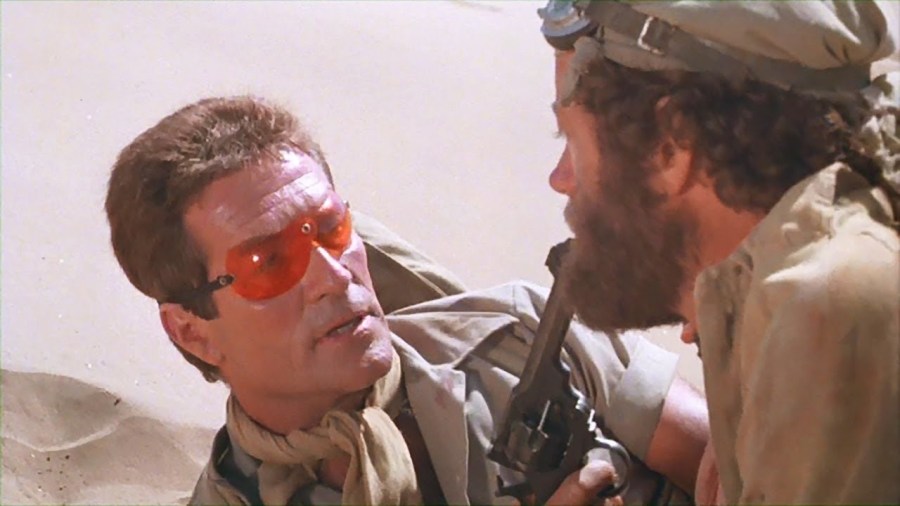
Thankfully, that’s not hard to do, once Killer Force‘s mistakes and miscues really begin to pile up. Lame, faux-cynical/tough guy one-liners pepper the screenplay, making us laugh for the wrong reasons (when Fonda is asked to join the mercenaries, he replies with his usual flat, droning delivery, “Thank you for the invitation, gentlemen, but I prefer to join the Girl Scouts.” Har…dee), while genuine laughs are generated by the increasingly strange proceedings.
Why again does Lee slit the throat of that gorgeous blonde contact, Danny (Marina Christelis, insanely fine in her lingerie), when he was told to cool it by O.J. (now there’s a switch for you…)? And why in the world would security expert Telly, who already suspects someone is planning to hit the complex, believe the girl’s framed assailant, Nelson, committed suicide by slitting his own throat?
How can highly-sought diamond thief Fonda calmly walk around town without getting busted (…by having zero cops on the streets, apparently)? And what’s with that bizarre scene with Telly and Adams, where he threatens her before suddenly claiming to know where her G-spot is (I gotta try that…), tearing off her skirt to prove it and then, just as abruptly, walking out on her (even Adams looks confused)?
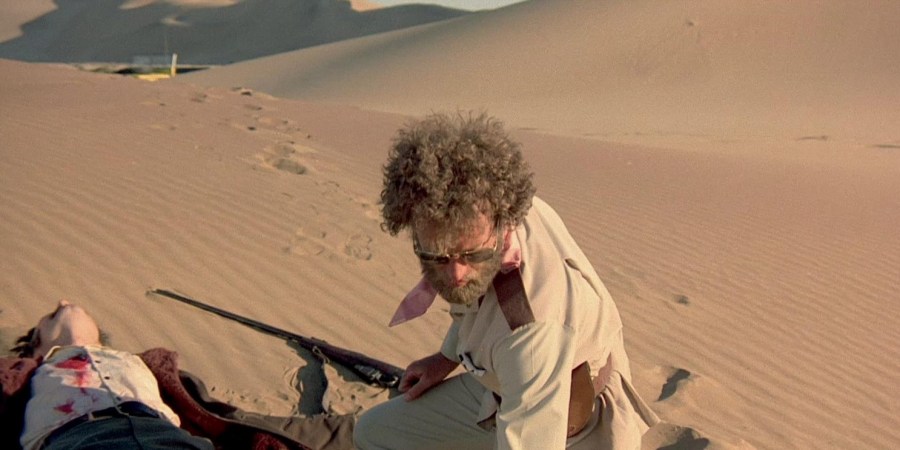
And of course there’s Killer Force‘s most notoriously goofy scene: the “thrilling” pressure strip sequence, where the stars do these terrible little hoppy jumps in the nondescript sand while Guest stays back 20 yards and films this nail-biter like it was a camcorded middle-school track meet (he couldn’t even give us the cliched “leap-over-the-camera-in-the-sand” shot?). This has to be one of the lamest—and most giggle-inducing—action set pieces I’ve seen in 70s genre work.
Killer Force‘s performances are all over the map, too, further upping the viewer’s amusement quotient. If the movie had been made ten years before, TV star Hugh O’Brien would have been top-billed, rather than third here. As it is, he seems to be telegraphing in a blandly stalwart, generically heroic performance from twenty years prior (he’s not in on the joke at all).
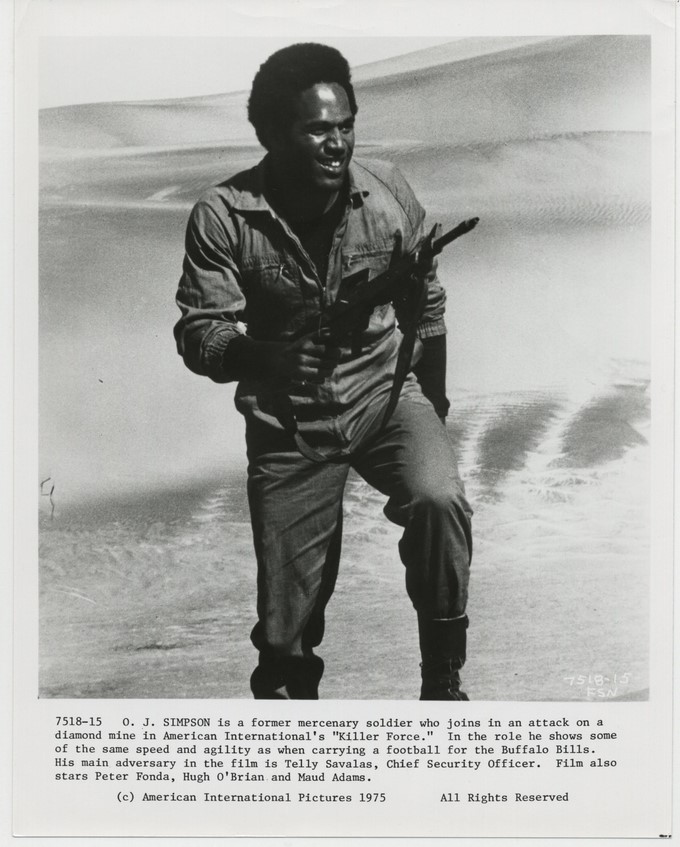
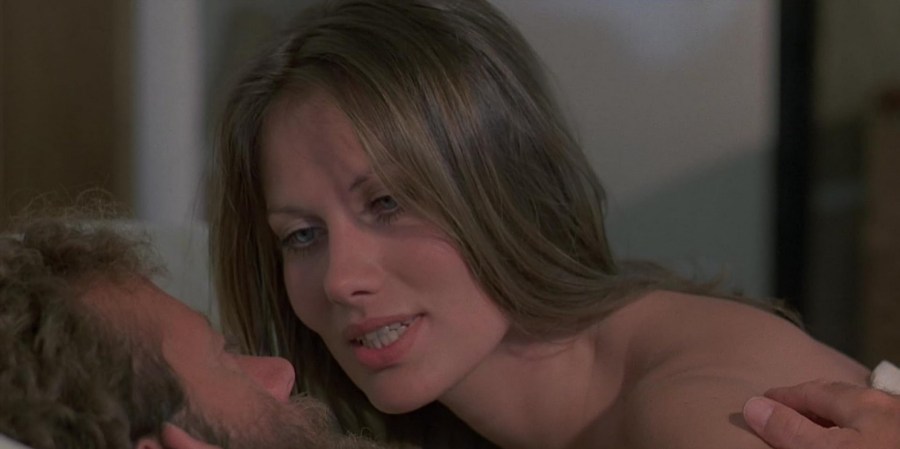
O.J. Simpson, learning absolutely nothing from his previous appearance in a bigger all-star outing, The Towering Inferno, does his standard “painfully willing to please” bit (he’s never funny or charming or amusing―my god he’s an awful actor), backed up by the silly shtick of bopping people on the head with a truncheon. Talented, beautiful Maud Adams is again wasted in a movie where the scant material offers no room for her to show what she can do. In that too-chaste bedroom scene, she’s far more credible than she has any right to be (considering the script), briefly pondering her romantic situation with Fonda.
However, the movie weirdly cuts off any potential unconventional sparks she might have had with predator Savalas (the kind she showed with Christopher Lee in a similarly strange sexual relationship in the Bond outing, The Man With the Golden Gun). Lee, perhaps Killer Force‘s biggest draw today because of the iconic actor’s wide fan base, seems to be in another movie, as well, and the effect is one of him eventually disappearing off the screen (he’s a Nazi? A psycho killer? We might as well guess “vampire,” since his character is so peculiarly vague).
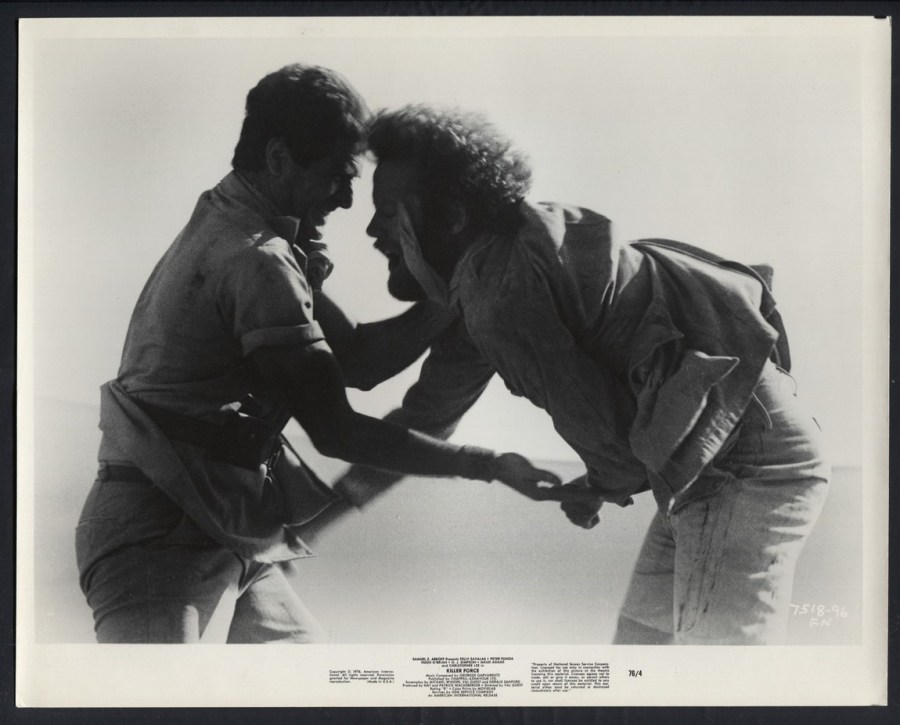
Fonda, riding the last bits of exploitation B movie star fame he leveraged thanks to hits like Easy Rider, Dirty Mary, Crazy Larry and Race with the Devil, is by this point in full sell-out mode, outrageously attired in a safari jacket, pink choker scarf, bushy beard, and what looks to be Avery Schreiber’s perm, droning through his lines as if he knows he better score these bigger paychecks while he can because very soon he’ll be appearing in grade Z fare like It’s All Right, My Friend, Peppermint-Frieden, and Dance of the Dwarfs (never heard of them? Exactly). Flippant, rakish man-of-action Fonda ain’t.
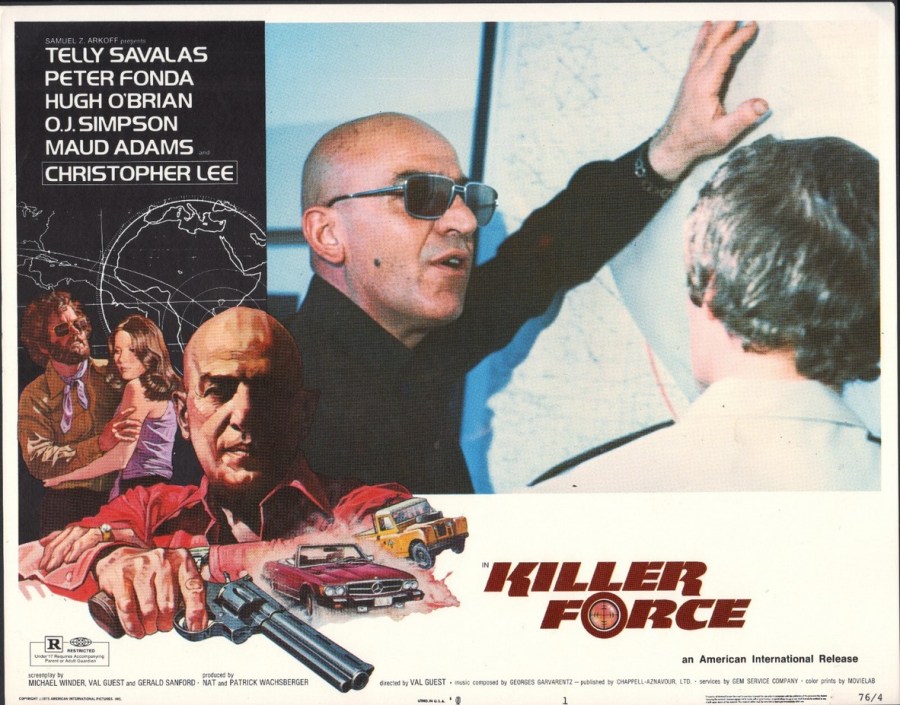
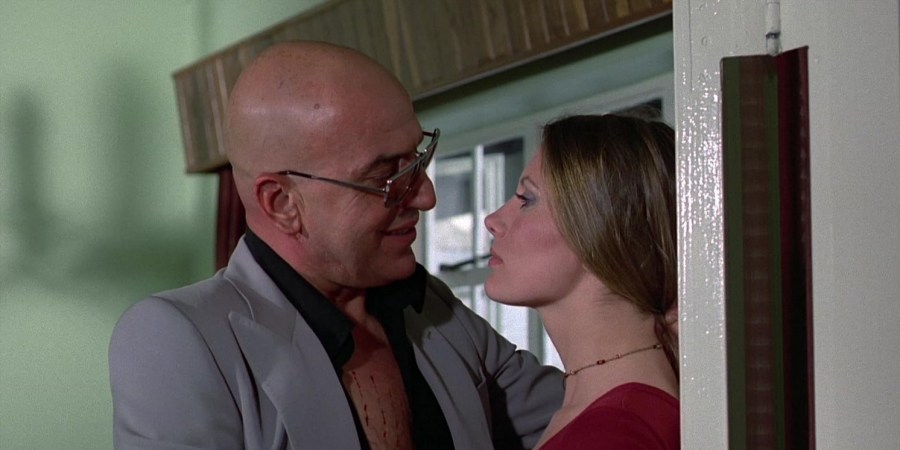
As for Telly, his turn is the most disheartening in Killer Force—you want to laugh the minute you see his silk dress shirt unbuttoned to his navel, hoping he’ll pull out his “Who loves ya, baby?” jive just to curry favor with the audience…but he perversely refuses.
Savalas, probably wondering why he was being offered crap like this when he was finally a world-wide phenomenon thanks to TV’s Kojak, alternates between boredom and utter contempt for the material, as he inexplicably develops a fondness (?), a kinship (??) some sort of emotional connection (???) with the fleeing Fonda and particularly Adams (there’s zero foundation in the script for this turn of events).
It’s an ugly, sour performance for the talented, criminally underutilized actor, further marred by unaccountable actions and motivations (rolling up his sleeves…rolling down his sleeves; sweet talking Adams…ripping off Adams’ skirt…walking out on Adams…looking wistfully at Adams). By the movie’s final desert chase (lots of cool Land Rover porn), after Guest gives us a thin but noisy The Guns of Navarone/The Dirty Dozen retread assault on the compound (complete with Harry Alan Towers “shake the bloody gun ’cause we can’t afford blanks!” cost-cutting techniques), we can’t for the life of us figure out why Telly is so reluctant to nail the soon-to-be-successful diamond-snatching couple. That’s why the alternate ending works so much better for this ultimately juvenile, loud hackwork. That alternate international ending may not tie up any narrative strings, but it’s way more satisfying, and truer to Savalas’ character, when he SPOILER ALERT whips out a shotgun (!) and blasts Fonda’s and Adams’ helicopter out of the sky as it roars by him at a hundred and fifty miles per hour (nice shootin’, Tex!). That’s the kind of hilariously goofy ending AIP needed for the equally harebrained Killer Force.

Read more of Paul’s movie reviews here. Read Paul’s TV reviews at our sister website, Drunk TV. Visit Paul’s blog, Mavis Movie Madness!…but mostly TV.

