
There’s this smug little reel going around Facebook that shows pissy, insufferably superior, utterly humorless Christopher Reeve complaining to David Letterman (in 1982) that Marlon Brando wasn’t a “good role model” because he was mean to him and ignored him on the set of Superman. I’m serious.
By Paul Mavis
God knows why, but I broke my own rule of engaging with the half-wits, troglodytes, and hydrocephalics that seem to rule the roost on that platform, and tried to explain that it wasn’t Brando’s job to be a mentor to failed actor Reeve, but of course I was shouted down by the VSC (“Virtue Signaling Corps”) who reminded me that Christopher Reeve was indeed a better actor than Brando because 1) Brando was fat, and 2) Reeve wound up in a wheelchair. This is, after all, Facebook.
So…in an admittedly pathetic attempt to strike out viciously and ineffectually at people who aren’t going to read this because it’s too long and uses too many big words, I’d like to childishly rip apart one of Christopher Reeve’s many, many laughably bad movies: the hilariously inept meller, Monsignor. Predating The Godfather Part III by 8 years, this 1982 clerical stiff from 20th Century-Fox about the Vatican and the mob starred Reeve, Genevieve Bujold, Fernando Rey, Jason Miller, Adolfo Celi, and Robert Prosky.
Click to order Monsignor on DVD:
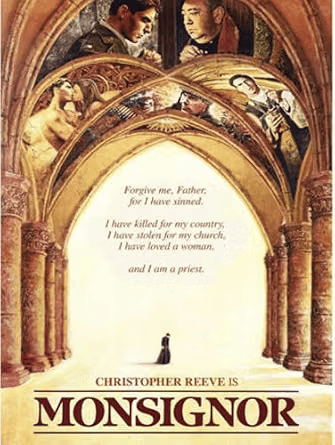
(Paid link. As an Amazon Associate, the website owner earns from qualifying purchases.)
Despite being written by heavyweights Abraham Polonsky and Wendell Mayes (from Jack-Alain Leger’s novel), and directed by Mommie Dearest hit helmer Frank Perry, Monsignor didn’t stand a chance in hell with angry critics and disinterested audiences back in ’82 (everyone associated with this notorious flop saw their careers set back).
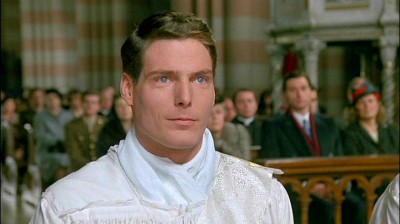
Ill-conceived from the get-go, the story elements for Monsignor may be solid, but the execution is timid and weak, emphasizing phony gloss and stiffness-of-performance in a failed bid for Lean-esque solemnity, while ignoring the possibilities of its real allure: pulpy, lurid melodrama ripe for exploitation. Christopher Reeve is hopelessly bad here…as expected for anything he did on-screen without a cape, proving yet again he couldn’t carry a non-Superman movie, even with a 40-ton crane.
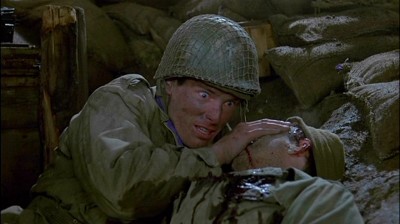
WWII America. Newly-ordained Brooklyn parish priest Father John Flaherty (WASPy Manhatten-born Christopher Reeve here…supposedly born in Brooklyn. Let the giggles begin), having enlisted as an Army chaplain, performs his first sacred duty: officiating at his best friend―and soon-to-be “wiseguy”―Ludovico “Lodo” Varese’s (Joseph Cortese) wedding.
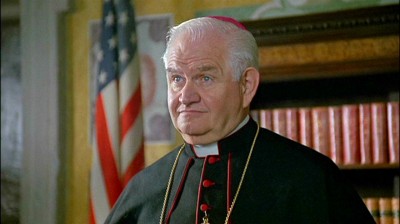
Cut to the battlefields of Italy, where Father John, after seeing Private Joe Musso (Joe Pantoliano) buy it despite the dogface’s entreaties for God to intervene, suddenly picks up a .50 caliber machine gun and mows down an advancing line of Germans, an act that gets him sent to the Vatican. Far from being disciplined, though, for this rather unorthodox method of sending souls to heaven, Father John is told by tough guy General/Bishop Walkman (Robert J. Prosky) that the American contingent of the Vatican wants him to succeed.
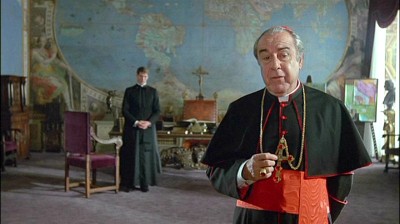
The American wing of the Catholic Church, Walkman asserts, is tired of playing second fiddle to distrustful, conservative Italians like Cardinal Vinci (Adolfo Celi), who view the Americans as interlopers to be kept out of the highest reaches of Vatican power. They want an American political pope who will be a propaganda shill for the powers that be, to fight Trump at every corner (oh wait…sorry: wrong pope).
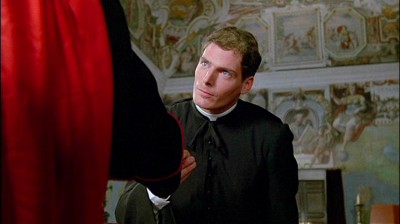
Bishop Walkman hands the ambitious Father Flaherty over to Cardinal Secretary Santoni (Fernando Rey), second only to the Pope (Leonardo Cimino), who needs Father Flaherty’s financial expertise to keep the cash-strapped Vatican from going under during the hostilities. Flaherty’s plan is to engage Lodo, now working for American gangster-in-exile Don Vito Appolini (Jason Miller), in black market activities to aid the Church financially, a dirty little sin that doesn’t come close to Father John’s other big transgression: a hot-and-heavy affair with postulant nun Clara (Genevieve Bujold).
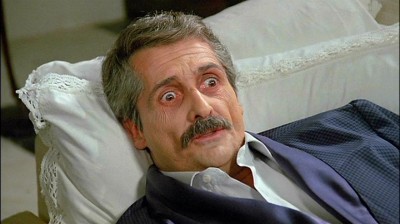
Monsignor holds a unique place in my teen movie-going memories because when I caught it at our local second-run Jerry Lewis Cinemas (converted) duplex…I promptly fell asleep ten minutes into the film (…and the last time that had happened, I was in my jammies at the drive-in). Watching it now, I didn’t conk out, and I was actually quite intrigued by the story’s possibilities…but let’s just say it’s fortunate I didn’t catch it at one in the morning after a tiring day.
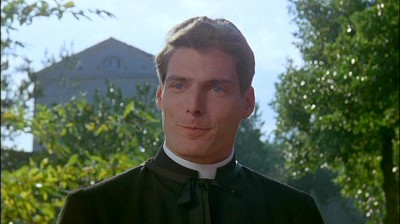
Half-heartedly reaching for the epic scope and would-be heavy-breathing scandal of Preminger’s The Cardinal, as well as hoping to exploit that intriguing combo of organized religion and political corruption that permeated the previous year’s far, far superior True Confessions, Monsignor comes up short on all three counts, curiously pulling its punches as it bogs itself down in too-slick, unemotional moviemaking.
RELATED | More 1980s movie reviews
It’s not like Monsignor is lacking in material; there are enough subplots for three good movies here: the ties between the tough Irish kid from Brooklyn who becomes a priest and his Italian hoodlum friend (like something out of an old Warner Bros. meller, with Cortese giving the film’s best performance); the ties between the Vatican and the mob during WWII and then as players in the international monetary market; and the romantic, sexual ties between a priest and a postulant nun.
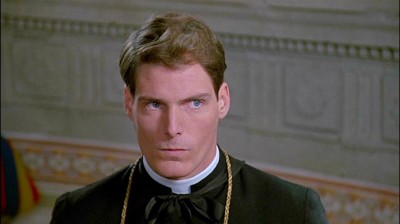
Yet each one is played with and toyed with…and then dropped as another tangent is picked up, never satisfying us with adequate motivations for characters’ actions, before we wonder how one scene connects with the other (obviously, big chunks of the movie were cut out at some point in post-production…or this was one disjointed script to start with).
I don’t particularly care if Monsignor is an “accurate” view of the Catholic Church and its dealings; I’m not looking for a history lesson here (besides, what good would a godless commie Marxist like co-scripter Polonsky have to say about the church?). I don’t care that Polonsky (Force of Evil, Madigan, Tell Them Willie Boy Is Here) and one of my favorites, Mayes (Anatomy of a Murder, Advise & Consent, Von Ryan’s Express, The Poseidon Adventure, Death Wish), have opted for straight cynicism at best for this tale of the Vatican and how big religion equals big money and big corruption.
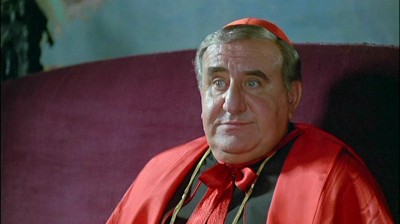
If anything, that sour attitude should be the perfect launching pad for a whopping, juicy, melodramatic exploiter not at all hindered (in 1982) by censorship problems. Monsignor, then, should have some moxie if it’s going to eschew True Confessions‘ downbeat realism for a more square, traditional approach. And that, unfortunately, is precisely what Monsignor doesn’t have.
It’s bad enough that we never get even an inkling as to why Reeve is as he is. Why is he so ambitious? A bad childhood? A yen for material goods? Overachiever? Ass-kisser? We’re never told or shown. We find out why he mowed down all those Nazis (he felt God had deserted the fighting men), but we’re in the dark as to why he takes up with Clara. Was he with women before her? Is this his “first time?” Did he do it as a result of the further corrupting of his soul? Or was the affair just a “perk?” No idea.
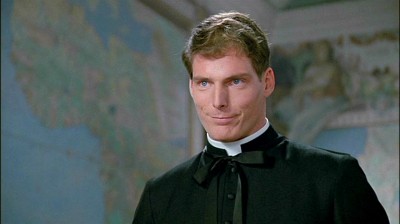
So…if we can’t get motivation in a serious drama, at least give us exploitation in a melodrama. I like the idea of the church and the mob getting close during the war, a hypocritical union that could have been amplified by the blasphemous coupling of priest and nun…but Monsignor treats both with a strange “hands off” bloodlessness that’s maddening at first, and then stultifying by movie’s end. We’re treated to matter-of-fact wheeling and dealing between priests and hoods, with Reeve as the conduit, but they might as well have been Rotary members jockeying for concession booths at a county fair, considering how their tribulations are so lifelessly and dully presented here.
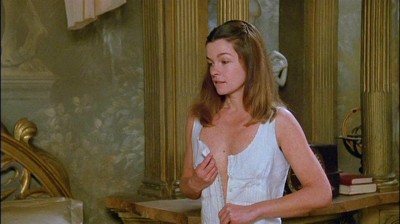
As for Reeve’s affair with Bujold, at least the movie’s poster shows them in bed together; in the movie we get an unfortunate topless scene with Bujold and that’s it―if a torrid love scene was filmed between the mismatched stars, someone must have chickened out in post.
Indeed, one can assume at least part of Monsignor‘s problems lie in post-production tampering (how else do you explain that jarring decades-long jump cut between young Reeve admitting to his sins…and then presto chango, he’s back with gray hair, hocking liras for dollars for Rey again?). Scenes kaleidoscope in and out from one event to the next with little or no set-up…nor pay-off.
According to what I’ve read, Reeve blamed the movie’s final edit for this debacle, but you can tell that most individual scenes are flawed internally, with stilted scripting and a weirdly out-of-synch timing to the performances that spells an ill-conceived project from the outset. For the one or two genuinely funny lines like, “One is never witty…unless one is a cardinal,” there are scores of howlers, like “You got faith. You got brains. You got balls. Use them discreetly,” or this exchange between lovers Bujold and Reeve: “Who are you?” “I’m your lover.” “You’re my mystery…and it attracts me.” (Oh, Mary!).
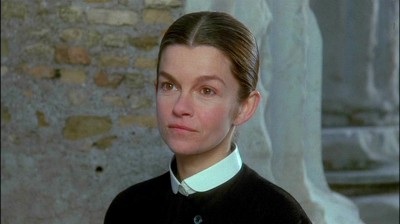
Dark intimations are put out there that somehow everything and everyone is linked in the story, but whether in pre or post, the dots aren’t connected up for us (the set-up for Prosky’s character is terrific…and then he just disappears). What’s worse is how we’re denied even the most basic (or base) pleasure of seeing unfettered moral corruption here; where’s the drama, where’s the conflict, where’s the fun, if every time Reeve does something wrong…a cardinal or a Pope comes along and pats him on the head and says, “Itsa alrighta, youra gooda boya” (the classic is the final scene where Rey, condescendingly forgiving Reeve when he’s just as guilty, hugs a teary-eyed Reeve as the camera pans over to a painting of Jesus…as if to say J.C. is ultimately cool with carnal lust, theft, corruption, and murder if it’s for the church)?
Monsignor‘s problems aren’t just at script level, though. Director Frank Perry’s (the hallucinatory The Swimmer and the perfectly outrageous Mommie Dearest) sometimes strange, odd, funereal approach worked brilliantly (or perhaps…inadvertently?) with the macabre Grand Guignol biopic, Mommie Dearest, but here, that same style is completely wrong for a story that should be purple with passionate bad taste.
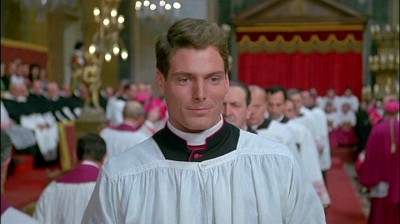
Why does Frank make everyone stand so stiff and motionless, acting as this garbage was actually serious drama when characters should be flying off the walls? This is a gangster movie, fercrissakes! It’s an exploitation meller with a priest banging a nun while he’s hustling black-market Hershey® bars and cigarettes between the Pope and Lucky Luciano-like Jason Miller! How hard is it to get some energy and some snap outta that set-up, you dopes?
And yet, the actors in Monsignor stand there as if they’re in a David Lean film, with all that careful, dreadfully tasteful cinematography and art direction, and ask us to believe that these bloodless automatons are enacting the bloodiest of sins. It’s ludicrous.
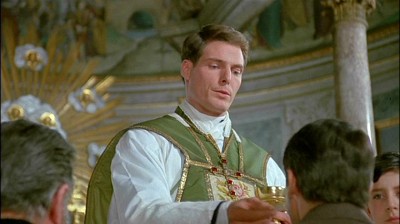
And none of this is helped by the miscasting of Reeve here as the Fiddling Father. I can sort of guess why he decided to take on Monsignor; after all, by 1982, his big screen career was already in serious jeopardy, what with all his non-Superman films performing less-than-optimally, to put it nicely, at the box office.
Monsignor probably looked like something “edgy” that could allow him some showy, Oscar-worthy moments of emoting―safely encased, of course, in a big, glossy, supposedly can’t-miss-hit studio effort. But why would producer Frank Yablans think the sniffy WASPy Reeve, who made no bones about implying he was “too good” for the movies he routinely appeared in, was a solid match for this particular character?
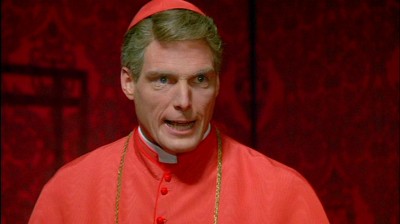
If distant, prep school polite, patrician Episcopalian Christopher Reeve is a tough Irish Brooklyn street kid-turned-tortured-Catholic Priest, then I’m a Chinese jet pilot. Reeve’s intrinsic callowness and insincerity, his slick superficiality, actually fits this chiseler punk-with-a-collar at first…until you realize they’re not going to explain how he got that way, or let the character grow or evolve in any believable manner.
Reeve constantly has an annoying smirk on his face (when he isn’t hilariously setting his stone face in an exaggerated, inadvertently comical Herman Munster frown) that’s either his approximation of a hustler, or his annoyance at playing a character he later admitted he never believed in for a second. We get zero sense that the obviously disconnected Reeve is having any kind of inner spiritual dilemma, so ultimately, what’s the point of his performance (at least poor Tom Tryon looked like he tried)?
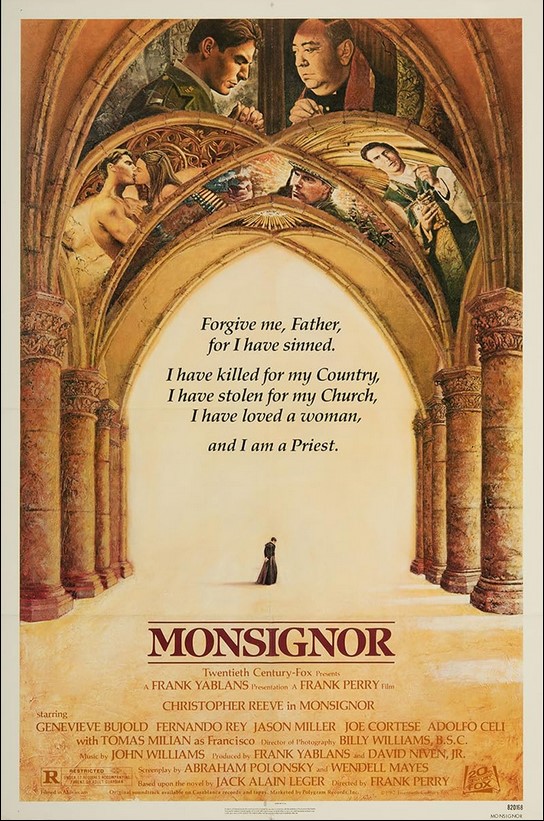
Reeve can’t achieve an arc with his character because you never believe his Father was “good” to start with, or that he even possessed a belief in God (in a publicity article at the time, the always reliably arrogant, pompous Reeve admitted his inability to summon up even the most basic artificial religious feelings for his character―I’ll bet the producers loved reading that), so how can we appreciate his character’s descent into moral turpitude? In two words, we can’t. Monsignor‘s dirty little exploitation thriller is piously, hypocritically all dressed up as solemn high drama, and yet it doesn’t have the faith, or the brains, or the balls, to be either.

Read more of Paul’s movie reviews here. Read Paul’s TV reviews at our sister website, Drunk TV. Visit Paul’s blog, Mavis Movie Madness!…but mostly TV.
 Movies & Drinks
What a relief to find that I am not the only person on Earth who found Christopher Reeve absolutely intolerable. When he was alive, both pre-and-post accident, I would declare my boredom with him in all his roles, and all my friends would react as if I had rabies.
I have never changed my opinion, and am relieved to report I never watched Monsignor nor have I any plan to do so in the foreseeable future. From my lips to God’s ears.
LikeLike
I thought Chris was pretentious creep. Good going
LikeLike
I take it you didn’t like the movie?
LikeLike