“You got any friends?”
“My guns.”
“Kinfolk?”
“My horse.”
By Paul Mavis
The tide’s turning, right? I mean…real men are coming back into vogue, aren’t they? Their terseness, their competency, their emotional unavailability, their capacity for violence, their disdain for just about everything? Their smelly-ness? We’re done with grotesques like Dylan Mulvaney and David Hogg and Travis Kelce and John Cena and Alan Ritchson and most of Biden’s cabinet picks, yes? Thank god.
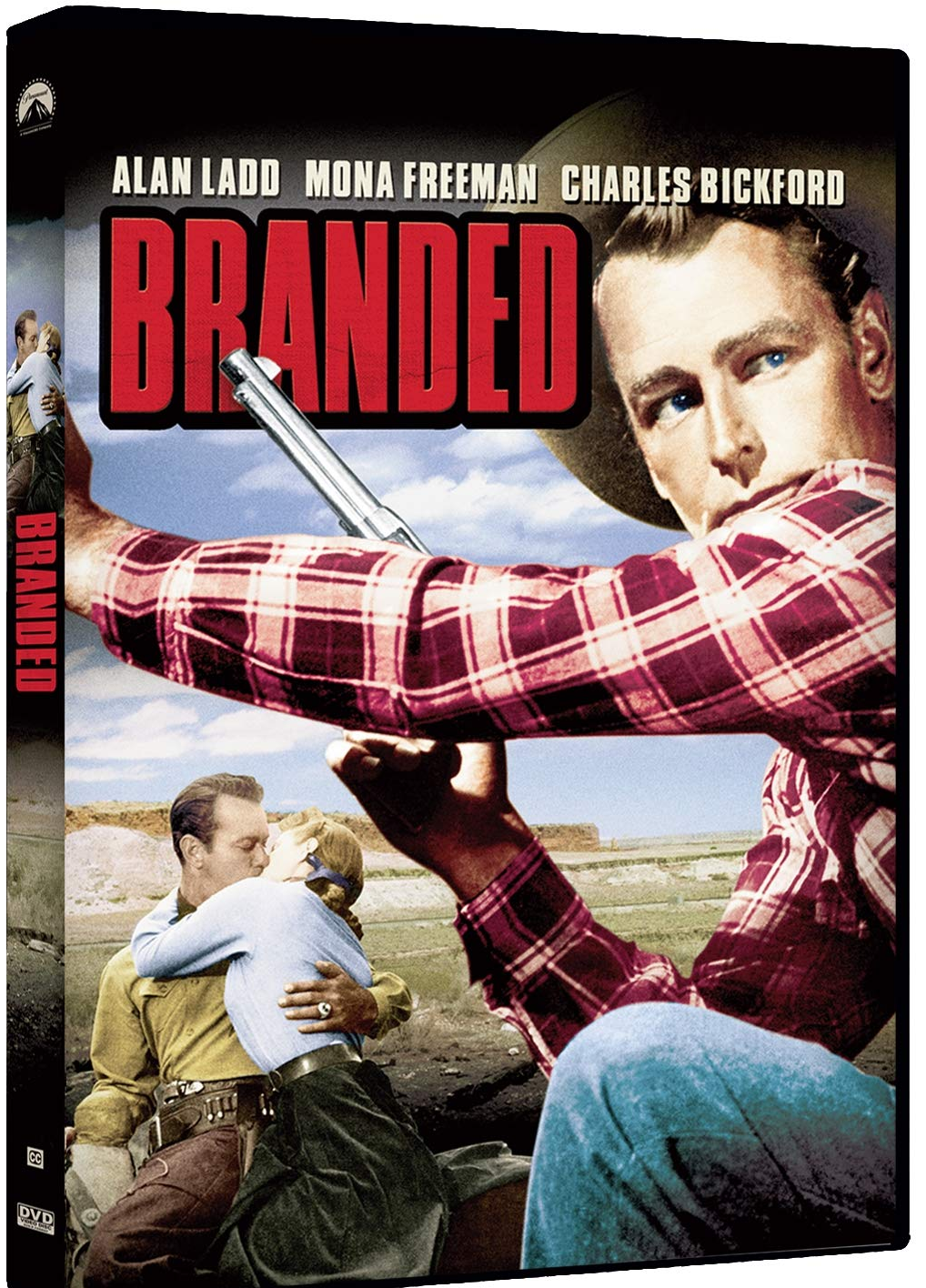
And nowhere could you find more real “real men,” than in an old-timey Hollywood Western. A few years ago, Warner Bros.’ Archive Collection released Paramount’s 1950 actioner Branded, a tough, no-bullshit oater (based on a Max Brand novel), aided greatly by star Alan Ladd’s ultra-cool presence, co-starring Mona Freeman, Charles Bickford, Robert Keith, Joseph Calleia, Peter Hanson, Selena Royle, and Tom Tully.
Click to order Branded on DVD:
(Paid link. As an Amazon Associate, the website owner earns from qualifying purchases.)
Beautifully proto-nihilistic (until 1950s conventions demand the family is brought together again), Branded combines director Rudolph Mate’s invigorating, straight-ahead storytelling technique with seminal icon of American cool Alan Ladd’s scary/handsome, ice-cold remorselessness. It’s truly a neglected gem of 1950s Westerns.
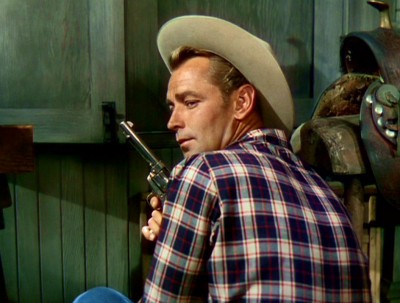
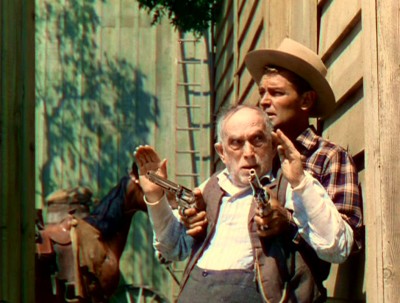
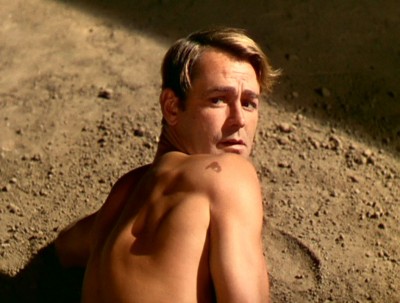
Weasel-eyed thief and killer T. Jefferson Leffingwell (Robert Keith) needs cold-blooded gunslinger Choya (Alan Ladd) to stay alive. Choya, holed-up in a general store with kindly hostage Dad Travis (Edward Clark), is the key to Leff’s long dreamed-of scheme: tattoo an accomplice like Choya with a distinctive “birthmark,” and pass that person off as the long-lost son of cattle baron, Richard Lavery (Charles Bickford).
At the right age, and with no scruples, Choya fits the bill for Leff’s plan, so Leff tracks the escaped Choya into the mountains, where he sells him on the deal. After a painful tattoo session from who else, Tattoo (John Berkes), and some pertinent background info from Leff on the Lavery family―including a crucial childhood memory of the lost Lavery boy that should prove Choya’s ace when the chips are down―Choya is ready.
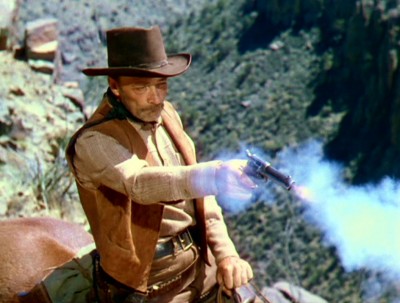
Arriving at Lavery’s Bar O ranch, sans Tattoo (who met an early demise at the hands of greedy Leff), Choya dismisses Leff and proceeds with the con, muscling his way into a job with foreman Ransome (Tom Tully), courtesy of pretty “sister” Ruth Lavery (Mona Freeman), who takes an instant interest in the handsome, churlish stranger.
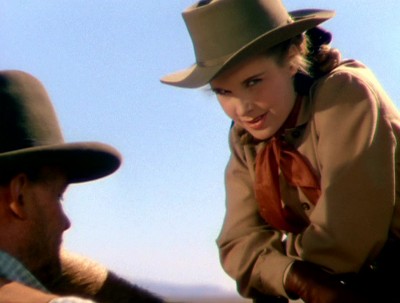
Provoking Richard Lavery as part of his plan, Choya allows Lavery to discover his birthmark, with the hook set in deep when Lavery and his wife (Selena Royle) are overjoyed at their boy’s return. What Choya didn’t count on was pangs of conscience at the sight of these two upstanding people buying his deception…or at the sight of his lovely “sister,” Ruth.
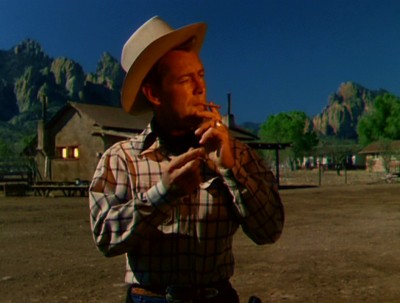
Watching a determinedly unpretentious, solidly-crafted oater like Branded drives home again how seductive the Western genre can be as a no-nonsense vehicle for a viewer’s fantasies of ultimate violence, moral redemption, and perhaps the most quintessential expression of an American’s notion of “freedom.”
If Western movies and television reached their peak of popularity in the nervous 1950s, when rapid, wholesale modernization (not just technologically-speaking, but also sociologically, politically, and culturally) was hell-bent on transforming almost every aspect of American life into the so-called “atomic age,” imagine how a typical early 1950s American moviegoer, lined-up to enjoy Alan Ladd blowing away all his obstacles―a viewer still remarkably free of governmental oversight and crushing legal restrictions at that time―imagine how he or she would now pity the infinitely-oppressed, cowed modern moviegoer of today?
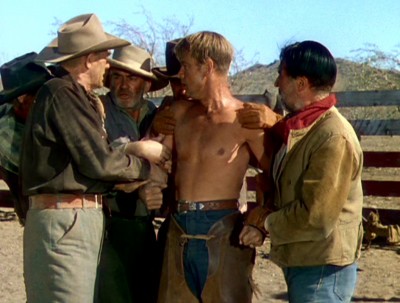
If our fathers and grandfathers, tired of the “rat race” of their Man in the Gray Flannel Suit world, or weary of the union corruption of their On the Waterfront jobs, or sick to death of their Sitting Pretty “perfect” suburban home life (wives, especially), derived some sort of solace from watching Alan Ladd settle all his problems with his fists and six guns, would such big-screen big-saddle comfort be even possible today in our chilling, truly Orwellian world of NSA/Google/AI totalitarian omniscience, and the spiritual cradle-to-the-grave desiccation of the nanny state?
RELATE | More reviews of Westerns
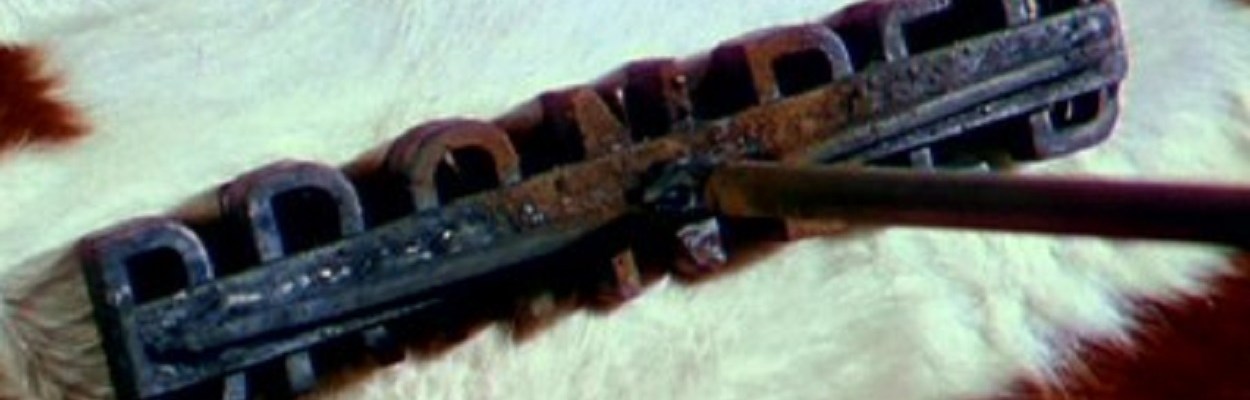
Probably not…but at least something like Branded is a distraction from this decay, serving as a quaint reminder of how a once-great people saw themselves. Based on Max Brand’s Montana Rides (using his “Evan Evans” pen name), and scripted by pros Sydney Boehm (When Worlds Collide, The Big Heat, Violent Saturday, Shock Treatment) and Cyril Hume (Tarzan Escapes, The Great Gatsby, Forbidden Planet, Bigger than Life), Branded‘s leathery, straightforward approach is epitomized in the opening sequence: the branding of the title into a piece of cowhide, before the sight of men silently crawling out of windows and off roofs, waiting to get a shot at an unrepentant, cold-as-ice Ladd, holed-up in the town’s general store.
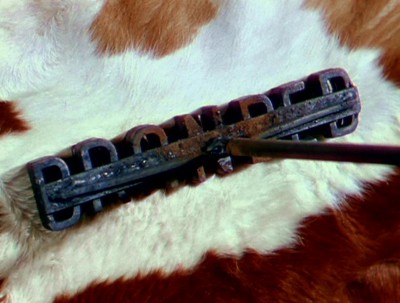
No pretext. No “Arizona, 1888” title card. No narrator. No theme song. No backstory on Ladd, or explanation of what he pulled to get into this situation. Story and character development through action is Branded‘s method, and it’s a refreshing, bracing one (when characters do speak here, it’s in an equally spare, yet ironic, cynical tone: when Freeman asks the cocky Ladd, “You kinda like yourself, don’t you?” Ladd silkily drawls back, “It’s the only affection I can depend on,”).
Beginning with a decidedly nasty tone, Branded‘s hard-heartedness is reflected in everything from the unforgiving Arizona landscapes to each character’s outlook. Keith calmly blows away his partner off a mountain for his share of the loot, and thinks nothing of suggesting Ladd plug innocent Bickford as soon as their ruse is accepted.
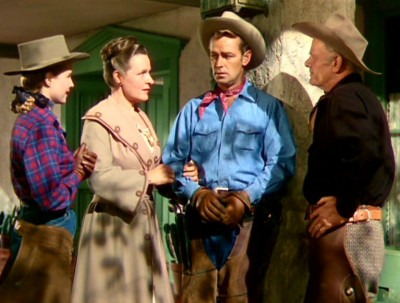
Bickford becomes incensed when one of his wild broncs is busted by Ladd―Bickford only likes to bust the difficult ones. Even pretty, mild Freeman comes from gristle; she suggests Ladd be hired so foreman Tully can knock “uppity” Ladd down a peg. As for Ladd, he’s an unrepentant rat bastard from the start, using kindly “Dad” Travis as a human shield for his initial escape, and later not batting an eye when Keith admits to killing his partner for the money.
Naturally, this being 1950 and not one of Sergio Leone’s or the subsequent Leone-influenced Hollywood Westerns of the 1960s, we expect moral redemption for Ladd’s anti-hero gunslinger, but it comes here subtly, in fits and starts, as the movie moves in unexpected ways toward a final message of surprising tolerance, spoiler through the reuniting of the “real” Richard Lavery, Jr./Tonio (Peter Hansen) with his birth family―at the same time allowing for a relationship to continue with the man who actually raised him, Mexican bandit Joseph Calleia―and through the assimilation of loner Choya into the Lavery fold as a surrogate son/son-in-law, presumably, when he marries Ruth.
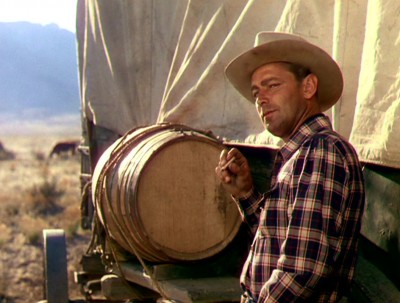
Too many reviewers are always “surprised” when they see a fine Alan Ladd performance, such as the one in Branded, as if they’ve heard the only good thing he ever did was for director George Stevens in Shane. On the contrary: not only was Ladd an adept, even sensitive performer (tough to do in the action genres he often found himself), he was also, to my mind, an iconographic figure that helped set into motion that modern gestalt of “cool” (owned lock, stock and barrel by Americans) we now attribute to other, more readily-accessible forefathers.
RELATED | More 1950s movie reviews
Certainly when you try to run down the forerunners of the “cool” attitude as it’s understood in pop culture today, guys like Steve McQueen and Robert Mitchum immediately come to mind, and of course their godfather, Bogie, to be sure. However, you never hear Ladd’s name mentioned in the same league.
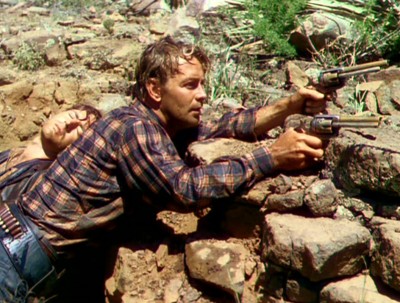
Too bad, that, because his brand of frozen, inexpressive, sculpted blonde “Angel of Death” detachment (perfect for the early noirs he appeared in) plays as uniquely modern today, as does Bogie and McQueen.
Portraying a character in Branded that could literally be Leone’s “Man with No Name” (when asked what his real name is, or where he came from, or who his parents were, the cosmically isolated Choya―meaning “cactus”―truthfully answers, “I wouldn’t know,”), Ladd’s perfect features and weird mix of uber-calm and blank potential for violence, create an existential loner gunslinger that works first in the visual, before that deep, beautifully radio-trained baritone, devoid of emotion, glides out and seals the deal: this guy is death (that opening moment, where Ladd, expressionless, answers, “My guns,” to Dad’s query about Choya having any friends, is one of the most succinct, beautiful examples of post-modern nihilism I’ve ever seen in the movies. Period.).
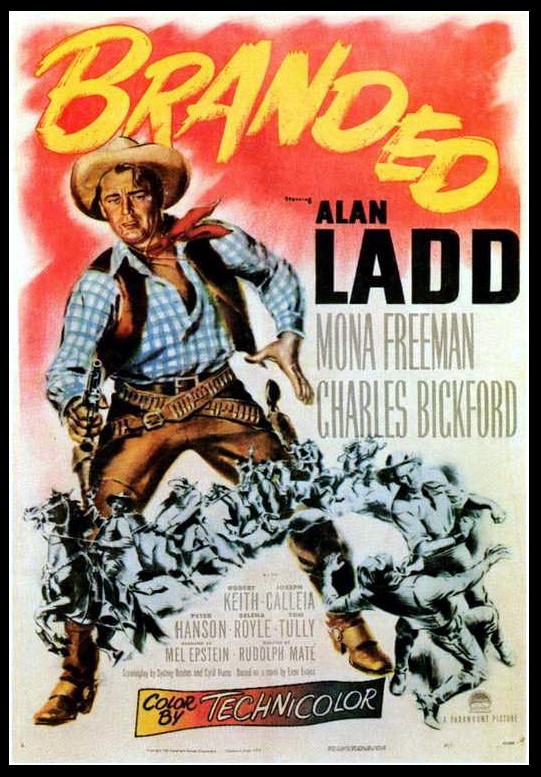
That Ladd persona of handsome, deadly nothingness, married to director Rudolph Mate’s (D.O.A., The Violent Men, The 300 Spartans) driving story construction and clean, crisp, deeply-focused square frames (courtesy of wiz cinematographer Charles Lang), is a puissant combination, elevating Branded‘s classical, epic-in-scope construct of disintegrated families, isolation, and revenge, into an elemental, primal―and entertaining as hell―oater.

Read more of Paul’s movie reviews here. Read Paul’s TV reviews at our sister website, Drunk TV. Visit Paul’s blog, Mavis Movie Madness!…but mostly TV.
 Movies & Drinks
A terrific picture, but Paul, your review is even better.
Love and kisses.
Barry
LikeLiked by 1 person
High praise, indeed. So glad you’re still stopping by! Hope all is well with you, Barry.
LikeLike
Going okay these past few weeks.
LikeLike